
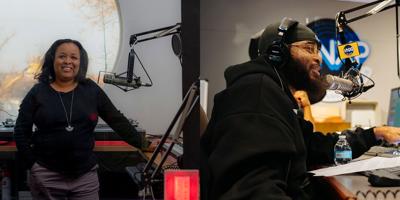

This year’s roundtable on Black popular music in Nashville takes a different approach from previous years, in that the focus is more on the future than the past, and it’s as much predictive as it is reflective. Our two participants are ideal for providing an informed examination of Black music in Nashville, in terms of both its status within the city and within a nationwide view of music.
Erica Hayes Schultz has an extensive background in radio, which includes long-running program Soul of the City on Nashville’s WXNA — though she recently announced that she’s retiring this show, it will continue to air Thursdays 5 to 7 p.m. until a final broadcast on a date TBA — and The Brunch on WNXP, airing Sundays 11 a.m. to 1 p.m. She is also an educator, and her shows not only spotlight emerging artists in contemporary soul and R&B but also celebrate those enjoying consistent success. Justin Causey hosts WXNA’s The Corner (Mondays from 5 to 7 p.m.) and co-hosts WNXP’s Cashville Radio (Thursdays from 6 to 7 p.m.) with Carlos Partee. Causey’s work also includes collaborating with numerous brands in content production and design, and he’s worked with a variety of Nashville musicians in different capacities. Our conversation has been edited for length and clarity.
How do you feel about the prospects for Black popular music in Nashville in 2026 and beyond?
Erica Hayes Schultz: I’m very optimistic. I’m seeing way more creativity in the music that has been released in 2025. New sounds not previously used before, and an honoring of classic sounds in new music. For example, I’ve just been introduced to Shelldhn, a musician who is throwing back to early-2000s R&B with a fresh take and a beautiful voice. I see a great future for him. [I think this year we’ll see even more] new and diverse sounds with the artists that are coming up.
Justin Causey: I’m overly optimistic for what the future holds for Black music within Nashville. We have so many talented acts that are building their own communities and are finally getting recognition from the industry as a whole, as well as cementing themselves as serious recording artists and not just hobbyists.
Who are the local Black musicians you anticipate will make the biggest impact in the years to come?
EHS: Summer Joy, Shelldhn, Vibeout, Tim Gent, Ron Gilmore, Brian Brown, Lord Goldie, Foundation Mecca. Most of these artists have been working the Nashville scene and helping musicians along the way. Their impact will last for sure.
JC: The artists I’ve seen really laying the groundwork in 2025 and will reap the benefits are ones like Tim Gent, Daisha McBride, 2’Live Bre, Sweet Poison, Summer Joy, Shelldhn, Ashley Emj, Jack Vinoy, Jyou, K.O.N, Blvck Wizzle and Chuck Indigo. There are incredible artists making their presence known as well as some amazing songwriters, producers and instrumentalists that are really making Nashville’s hip-hop and R&B scenes thrive.
Is there such a thing as a Nashville sound or style in Black popular music?
EHS: Yes, it’s getting there. I think some artists previously were trying to re-create sounds that had worked in the past, like Memphis vibes and such. Now that idea has been pushed aside and I’m seeing artists that are creating sounds that show their influences and lyricism that is representing their personal stories. Because of these new sounds, there are more artists getting attention from bigger artists [and other entertainment spheres like] television.
JC: There is no definitive answer, but I always say that you can hear the soul and true musicality within Nashville Black music because everyone has a background in church or choir singing that they are able to translate over into this space. So artists take a little more time with the cooking in the kitchen, and you can hear that when you listen to projects. The notes, rhythm, melodies and performance come from the heart. They aren’t forced.
What is missing that’s needed to improve opportunities for local Black musicians?
EHS: Black artists of all genres having proper PR/management teams. Some PR teams have a stronger focus on the country scene and don’t have as much experience with Black music. Some PR teams are just inexperienced. The effort of all PR teams in Nashville to support Black artists is an amazing thing, but in this town you have to get creative to get more attention for artists outside of country music.
Part of that issue is with venues! There are venues in this city that will have Black artists perform. Teams for these artists are working really hard to get the artist in a decent venue, but [two issues affect the outcomes]. First, venues are not strongly advertising shows as they could. Advertising is completely reliant on the artists, and sometimes the artist needs help from the venue — especially newer artists. Also the costs involved in hosting a show at some venues deter an artist.
In my opinion, these two things slow the growth of Black music in Nashville. Having more quality Black-owned venues could help, but ultimately the artistic community has to create a demand for better.
JC: Educational support. A lot of artists don’t truly know how the business works, and they believe recording and releasing music is the only part of the game.
We need more labels in Nashville to actually support the talent that is here, instead of signing the transplant that just moved here and has a following on TikTok. The homegrown talent will be able to tell stories that truly connect to the heart, not the like button.
Lose the crab-in-the-barrel mentality. So many people are collectively making amazing things happen. Either aid in it or completely remove yourself from the space.
[There has been a] changing of the guard. We have a lot of people in high positions who could truly show light on the up-and-coming executives and creators within this space, but instead they like to use them for their own gain and notoriety.
You can’t do it by yourself. You need a team of people who believe in you and your art.
Are various communities in local Black music — be they R&B, soul, hip-hop, country, gospel or beyond — able to work together? Or are their audiences and interests too different?
EHS: Yes, they are able to work together and have been for years now. There are tons of artists in R&B, soul or hip-hop who are working with country and gospel artists, either as backing musicians, in production or in songwriting. Many Nashville R&B artists that I have on my radio shows have day jobs in the background for country and gospel artists. And within those spaces, they are creating new music with the help of those artists. I think the reality of music and creation in this city [and] what is portrayed in the media are not the same.
Collective spaces where artists have been meeting and collaborating — like HOME in East Nashville or noncountry writers’ rounds — have been helping connect a diverse set of musicians as well. The projects that have come out of these collaborations have changed perceptions and sounds here in Nashville.
JC: We’ve clearly seen that various communities can coexist and collaborate. We saw that firsthand with how BigXThaPlug was welcomed into the country scene here in Nashville, and they paraded him around as a success. Meanwhile, we have our own homegrown artist 2’Live Bre making amazing strides within the space, and companies like Origins Music Group that are leading the conversation for Black artists in country. (Black artists created country music, by the way.)
In order to achieve their goals, should local aspiring musicians in various parts of Black music stay in Nashville or go elsewhere?
EHS: Start in Nashville. Whether you are a native or you’ve moved here to start out, the creativity in Nashville is unparalleled, and Nashville is a good starting point. It’s not too overwhelming compared to bigger cities like Los Angeles, New York or Atlanta. Then create an initial sound. Work with musicians (who may have a different sound than you) who are touring or create a tour — and as you are going to different cities, listen to and link with musicians there. Be receptive to musical ideas, bring them back to Nashville, and see how it works musically for you.
JC: They should absolutely stay here in Nashville. If you can’t build the dream here, why would you leave the town where every label writes checks? You just have to show them that the proof is in the pudding. I always said Nashville is a jumping pad [to the rest of] the world. You show them that your talent is unmatched and they’ll tell the world. Nashville has this!!!



Post a comment as anonymous
Report
Watch this discussion.
(0) comments
Welcome to the discussion.
Log In
Welcome to the discussion.
Keep it clean. Please avoid obscene, vulgar, lewd, racist or otherwise abusive language. Comments featuring hate speech or threatening or violent content will not be tolerated.
PLEASE TURN OFF YOUR CAPS LOCK.
Be truthful. Don't knowingly lie or mislead.
Be proactive. Use the “report” link on any comment that violates our comment policy.
Share with us. We'd love to hear your feedback.