


“I
’ve been thinking that I should go / Because if I don’t leave now / Then I’m never gonna leave Ohio,” sings Arlo McKinley on the title track to Die Midwestern. The album, out Friday, is his debut for John Prine’s Oh Boy Records. “And that’s a chance that I just can’t take / Now that I’m getting older.”
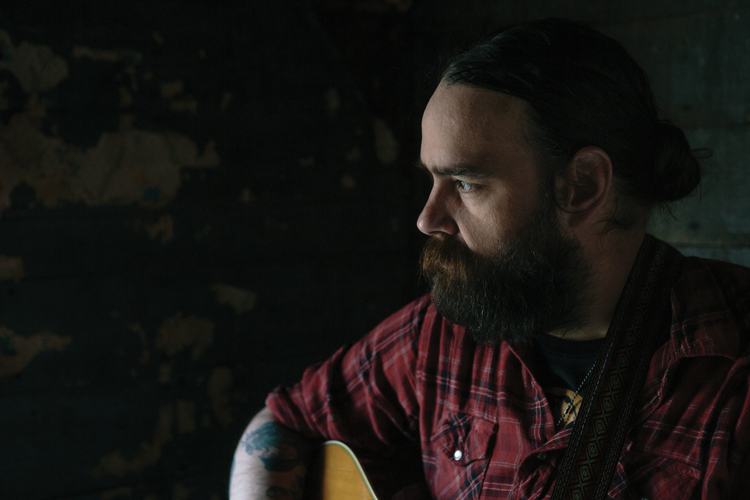
A love-hate relationship with the Buckeye State is part and parcel of growing up there, McKinley says. The 40-year-old singer-songwriter-guitarist has lived in Cincinnati his entire life.
“It’ll always be home, but you get burnt out on a lot of what you see in the Midwest,” he tells the Scene. “There’s some people who’d want to fight me for even saying that, but they’re delusional.”
Southern Ohio’s status as a geographic and cultural crossroads between Appalachia and the Midwest meant an eclectic musical upbringing for McKinley. He had older brothers in the local punk scene and a country- and bluegrass-loving dad. Years ago, many of his relatives sought better lives by migrating to the Cincinnati metro area from Eastern Kentucky. They came to work at GM’s Norwood plant, which the auto manufacturing giant shuttered in 1987.
“We were raised in the city with country values,” McKinley explains. “When my brothers weren’t around I’d go through all their punk, metal and hardcore records, and when they were home I’d listen to my dad’s records — classic country like Merle Haggard, George Jones and bluegrass stuff like J.D. Crowe that was obscure at the time.”
This was pre-O Brother, Where Art Thou, McKinley notes. He points to the 2000 Coen brothers dramedy as a force that brought mainstream attention to music that, if you’ve got Appalachian roots, is just in your blood.
“Before that movie, bluegrass was as much of a punk movement as punk was,” McKinley says. “Doing it yourself, renting out VFW halls, raising as much money as you could, making it work.”
It makes sense, then, that Die Midwestern has a trad sound but a punk heart, landing it in the same neighborhood as Tyler Childers, Jason Isbell and John Moreland in the modern folk-country-bluegrass canon. Since McKinley and his band The Lonesome Sound got together in 2014, they’ve shared stages with all three.
The 10-song collection was tracked at Memphis’ Sam Phillips Recording Service, the studio that the late Sun Records founder opened after he outgrew the space where he recorded Elvis. It’s hallowed ground too, having hosted musicians including Prine, Johnny Cash and Jerry Lee Lewis. McKinley was nervous at first, but producer Matt Ross-Spang guided the proceedings with a steady hand. They hadn’t met in person until the sessions began.
“We hit it off right away,” McKinley remembers. “He really just set the tone for it and made me feel at home.”
Ross-Spang’s recent engineering credits include The Mountain Goats’ In League With Dragons and Prine’s The Tree of Forgiveness, and he produced Margo Price’s Midwest Farmer’s Daughter and All American Made. Like Price, McKinley is a Midwesterner who began a solo career later in life than many, but with the experience to tell convincing stories and an understanding that the classics are classics for a reason. Asked what he’s been listening to during quarantine, McKinley cites Bob Dylan’s latest, Rough and Rowdy Ways, Bruce Springsteen’s stripped-down early-’80s masterwork Nebraska, and newer LPs from Deer Tick and The Marcus King Band. “And The Band,” McKinley adds, “who are my go-to for everything.”
Die Midwestern’s standouts include the heart-on-sleeve country laments “She’s Always Been Around” and “Gone for Good.” “Suicidal Saturday Night” is a youthful ode to life on the lam with Memphis players Jessie Munson and Rick Steff lending wistful, Last Waltz-style fiddle and warm analog keys to the proceedings, respectively.
But the song that started it all is also the very first McKinley ever wrote from start to finish — “Bag of Pills.” A staple of his live repertoire since he was in his mid-20s, “Pills” is a candid first-person account of the prescription-drug scourge that began to impact his hometown and region in the early 2000s and has snowballed into a national crisis in the decade-and-a-half since he penned it.
As the story goes, Oh Boy director of operations Jody Whelan, a friend of McKinley’s from the road, played “Bag of Pills” for his dad, the late John Prine. His response: “That’s a good song.” At McKinley’s next Nashville show, which was at The High Watt in Nashville, he had a surprise guest in the crowd — and eventually a contract, making him the final signee to Prine’s label before the legendary songwriter’s death in April.
“I don’t think John was able to stay the whole time, but for him to come out on a Thursday night to a club where there’s no place to get privacy, and listen … that’s success to me,” McKinley says. “I wish I’d had more time to sit and talk music with him. But to know I was even on his radar meant the world to me.”



