
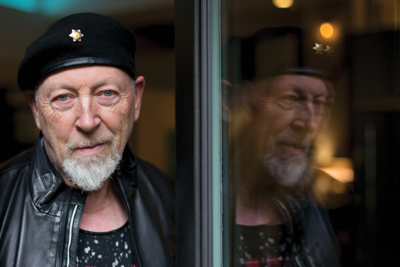


Going Americana six years ago didn’t hurt Richard Thompson’s career, and maybe that’s because he’d already been nearly everything that Americana fans call authentic. By the time the London-born singer, guitarist and songwriter recorded the tracks for his 2013 full-length Electric in Nashville with Americana guitarist Buddy Miller, Thompson had been a folk-rocker and a guitar hero. He had also been a boot-stomping, quasi-country artist whose ’70s and ’80s records with then-wife Linda Thompson bore comparison to the work of George Jones and Tammy Wynette. He says he doesn’t mind the Americana tag, but Thompson’s new full-length 13 Rivers is too sharply conceived to be roots music. Thompson’s songwriting has never been more lucid, and his guitar playing is both brilliant and structural, as befits a master musician.
“Of all people, I don’t really play a style that’s derived from America,” Thompson tells the Scene from a tour stop in Ithaca, N.Y. He’s currently touring with his electric band on a run that includes this week’s Nashville stopover at 3rd & Lindsley. I saw Thompson at that venue earlier this year when he performed an acoustic set as part of the Americana Music Association’s annual get-together. He played superbly, but it’s his electric-guitar work that scrambles the categories in ways that go beyond Americana.
“To me, it just means roots music, basically, a more roots-based style,” Thompson says about Americana. “It seems to include all kinds of people these days that I don’t think of as particularly American. You know, how would they classify Bob Marley? Would he be Americana? He might be.”
Born in 1949, Thompson made his name as guitarist, singer and songwriter for the English folk-rock band Fairport Convention. Although the group began in 1967 as adepts of North American rock and pop who covered Joni Mitchell, Bob Dylan and power-pop singer Emitt Rhodes, Fairport began playing Anglo-American folk music with dynamics they derived from Dylan and The Band.
“We’d be playing some British traditional folk songs, and we’d play instrumental jigs and reels, all that kind of thing — Scottish-Irish music,” says Thompson about Fairport, which toured the United States in 1970. “So that was different, for sure, for the [American] audience. Audiences in those days were almost trained to have a broad acceptance of music. [Promoter] Bill Graham, of the Fillmore, would put on bills where he’d have a wide range of acts on the same bill.”
Thompson wrote material for Fairport, which included quintessential folk-rock singer Sandy Denny. Thompson’s song “Meet on the Ledge,” which appeared on the group’s 1969 album What We Did on Our Holidays, is one of his finest. After making his solo debut with the fine 1972 full-length Henry the Human Fly, he released a string of albums with Linda Thompson. In later years Richard Thompson moved to Los Angeles, began recording for major labels and beefed up his sound with production help from former Crowded House producer Mitchell Froom, Wilco leader Jeff Tweedy, and Miller, who gave Thompson a dirty, clangorous sound on Electric.
It was his association with Miller that helped Thompson connect with the Americana audience, but he moved beyond the genre on his 2015 full-length Still, cut in Chicago with Tweedy. Far from being a musician who relied upon conventional thinking, Thompson wrote brilliantly for Still, and his guitar playing was an astonishing synthesis of folk, avant-rock and jazz.
Thompson plays guitar throughout 13 Rivers as if he were some amalgam of rockabilly picker James Burton and Captain Beefheart guitarist Bill Harkleroad, but my description only scratches the surface of Thompson’s biting, melodically sophisticated approach. Thompson frames his latest batch of songs with gleaming, architectural riffs. Cut at Los Angeles studio Boulevard Recording (Thompson moved from Los Angeles to New Jersey in early 2018), 13 Rivers may be Americana, but it echoes guitar-vocal records like Television co-founder Tom Verlaine’s 1981 Dreamtime.
Like Verlaine, Thompson never lets the guitar heroics steal the show. You could call him a Nashville-influenced player, but Thompson doesn’t strike me as a person who accepts the standard line on music or, for that matter, on Nashville — a city he tells me he finds delightful to visit these days.
“I didn’t use to like Nashville 35 years ago,” he says.“When I first came to Nashville I was kind of depressed by how commercial it was — the Barbara Mandrell Gift Shop and Museum, that kind of stuff. I accept that country music used to be like that. You loved it for the incredible songs and great musicianship. It was always a little corny.”



Post a comment as anonymous
Report
Watch this discussion.
(0) comments
Welcome to the discussion.
Log In
Welcome to the discussion.
Keep it clean. Please avoid obscene, vulgar, lewd, racist or otherwise abusive language. Comments featuring hate speech or threatening or violent content will not be tolerated.
PLEASE TURN OFF YOUR CAPS LOCK.
Be truthful. Don't knowingly lie or mislead.
Be proactive. Use the “report” link on any comment that violates our comment policy.
Share with us. We'd love to hear your feedback.