
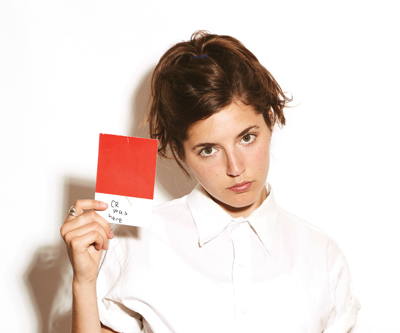


Talking to Caroline Rose is a lot like listening to her music. For starters, it’s a good time. About an hour-and-a-half into a conversation at East Nashville’s Dose Coffee, during which we touch on everything from Dollywood to Patricia Highsmith, I realize I haven’t even asked a regular interview question yet. It’s similarly easy to reach the end of Rose’s new album LONER, released in February, without realizing quite how you got there. It’s a concise, carefully thought-out 35-minute set that blends pop hooks, laugh-out-loud sarcasm and gutsy vulnerability — the kind of album the “repeat all” button was made for.
LONER is Rose’s attempt to put an authentic representation of herself on tape, something that, for many artists, is easier said than done. Rose spent close to three years writing LONER, during which time she realized that the multitudes she contained — some more contradictory than others — were actually her biggest asset. She can be sarcastic, cerebral, goofy and introspective, sometimes over the course of a single verse. She’s fiercely independent, but still longs for connection. She loves Rihanna as much as she does Kate Bush, and she wanted to make songs that bridged the gap between the two. She got super into the color red.
Instead of presenting some unified theory of herself, Rose wrote 11 song-sized snapshots of life inside her head, crafting a kaleidoscopic listening experience that still feels cohesive thanks to her newfound confidence, unflinching honesty and no-fucks-given commitment to doing things her own way. “One of the things I was trying to do is bridge together all of these different types of songs that were all me,” she says. “But it’s hard to find a unifying way to reflect your personality.”
Throughout LONER, Rose catalogs social interactions with an anthropologist’s eye, effortlessly alluding to perspectives contemporary and timeless. In “Soul No. 5,” she flirts with the interplay between sex and conspicuous consumption in today’s pop culture (“I got kicks, bitch, fresh out the box / I got that box, go like ‘pop, pop, pop’ ”), while “Getting to Me” nods to an “ostracon vase,” referring to an ancient Greek practice in which shards of pottery were used to mark votes to exile people from society. Sonically, Rose builds a collage of frenzied rockabilly (“Money”), soulful synth pop (“Jeannie Becomes a Mom”) and sensual psych rock (“Talk”), drawing all the pieces together in a style she calls “schizodrift.”
“The most notable thing is how I feel manic a lot, having mood swings,” she says. “Or one day, I’ll feel incredibly depressed, and then the next day I’ll want to go be the life of the party. I wanted to make music that sounded like that. My old music, I was really only tapping into one part of me, and that was always difficult because in my personal life, it was confusing. People would meet me and be like, ‘Why do you sound so different from your music?’ ”
Rose first gained notice with her 2014 album I Will Not Be Afraid, a capable collection of Americana tracks that showed her to be a promising new voice in roots music. By the time she released that LP, though, she already felt somewhat disconnected from its songs. The tension between her actual self and the self presented on the album eventually led to an overhaul that yielded LONER.
“People bring up the last album a lot, and how different they sound, but life happens,” Rose says. “To me, it’s actually a really gradual change. But people just didn’t really see the change, or experience the change, because I just wasn’t ready to put it out. I’m glad I waited, because now I feel fully formed, and I know exactly what I want to say and how I want to say it. … I’m just happier now. I think it sounds a lot more like me.”
While Rose is still rightfully proud of her earlier work, she sees in hindsight that some of I Will Not Be Afraid was shaped by external pressure, which she was careful to avoid when making LONER. She wrote and arranged the entire album, producing the bulk of it herself with assistance from producer-engineer Paul Butler.
“I was hyper-concerned about being taken seriously as a songwriter, especially being a young woman in music,” Rose says of her earlier work. “I was definitely more concerned with being taken seriously than I needed to be, to the point where I was taking myself too seriously. … Now I’m just more concerned with making things that I enjoy.”
It’s tempting to reduce Rose’s narrative to an artist “finding her voice,” but the voice has always been there. It just took a little time to figure out how to translate one with so much to say into the narrow confines of a single LP.
“I can say with certainty the next album is not going to take as long,” she says. “Now I’ve hit my stride. I know what I want to say and how I want to do it, and I have the vocabulary for it. And the biggest thing of all … when you do it yourself, you can do it so much faster. You don’t have to explain yourself to anyone.”



