
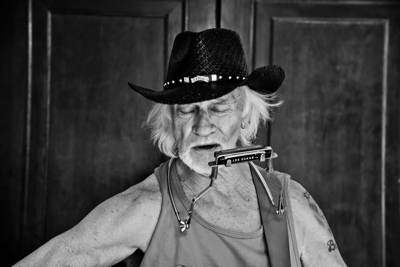


The notion that Nashville has always been hostile to musical innovation is a canard that fits neatly into standard critiques of modern country music. But plenty of people have been hospitable to experimenting with new ideas. For example, the strange performances that songwriter Chris Gantry recorded four decades ago at Hendersonville recording studio The House of Cash enjoyed the blessing of the studio’s equally famous owner, Johnny Cash. There, Gantry and a crew of session players combined folk, rock and jazz in ways that would prove both uncommercial and prescient. Long thought lost and now issued for the first time as At the House of Cash, the avant-garde music Gantry and his fellow musicians wrought still sounds weird today, but it could be that the times have finally caught up with one of Nashville’s most fascinating eccentrics.
At the House of Cash collects 11 tracks Gantry recorded at the studio in late 1973 and early 1974 with a roster of musicians that included fiddler Buddy Spicher and guitarist Jerry Smith, who produced the sessions. Already a celebrated songwriter who had written Glen Campbell’s 1968 hit “Dreams of the Everyday Housewife,” Gantry displays jazz guitar chops on At the House of Cash, and he writes as an iconoclastic devotee of the work of Beat poet Gregory Corso.
“I was totally into writing Jimmy Webb-type songs in the ’60s,” Gantry tells the Scene from his Nashville home. “But then I heard [Charles Mingus’ 1963 jazz album] The Black Saint and the Sinner Lady. That’s what I presented into my music in those early days. When I got up to the Cash album, I just let it fly, and who gave a fuck.”
Gantry was born in Jamaica, Queens, in 1942 and grew up listening to classical music and rock ’n’ roll. After moving to Nashville in 1963, he wrote songs for tunesmith Marijohn Wilkin’s publishing company and released his debut album Introspection in 1968.
“That’s when we started our quest to do things differently in Nashville,” Gantry says of his time with Wilkin. Gantry’s 1970 full-length Motor Mouth remains one of the most agitated albums ever recorded in Nashville, and foreshadows the music Gantry would record three years later.
At the House of Cash lay forgotten until Cash’s son John Carter Cash discovered the tape reels last year and sent them to Nashville journalist Peter Cooper, who then passed them on to Ohio-born producer and singer Jerry DeCicca, a longtime Gantry admirer. DeCicca, who produced the official release of At the House of Cash, had seen Gantry’s 2008 performance at Nashville’s Bluebird Cafe, which he says prepared him for what he heard on the tapes.
Gantry skews a blues shuffle on the House of Cash track “Dreamin’ of a Leavin’ Train” and recites “Hatred for Feeny,” the tale of a Dallas laundromat operator who emulates Jesus by wearing a zoot suit and a crown of thorns. Meanwhile, world-music band Oregon appears on the record’s “Tear,” another spoken-word piece.
If At the House of Cash sometimes feels a little dense and prolix, it’s worth taking the time to absorb the force of Gantry’s jazz-influenced guitar and his Beat-influenced lyrics. The record represents Nashville modernism taken to the breaking point in an era that remained suspicious of modernism itself. Some tracks resemble Americana-style art songs, which makes Gantry a prophet of post-country.
“My destiny has put me in the place of the guy who is still in his right mind, still has the energy and can tell the story,” he says about the part of his half-century career in which he became one of Music City’s most innovative songwriters. “I’m the scribe of the Nashville era.”
Email music@nashvillescene.com



