
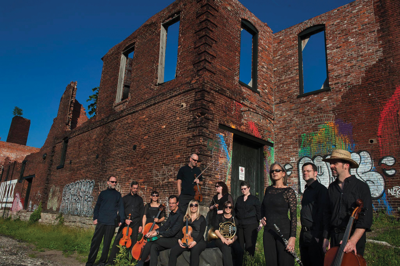


“I am sick and tired of all the anti-immigrant rhetoric I’ve been hearing lately,” says Zeneba Bowers. “What’s funny is a lot of the people spouting off about immigration wouldn’t know what to do if they couldn’t get an egg roll or a taco.”
Bowers, the Alias Chamber Ensemble’s founding artistic director, has emerged in the past year as a kind of unofficial mayor of Nashville’s progressive classical music community. Her passionate, eloquently stated views on current events have become a fixture on Facebook. Some of her most loyal followers have recently called on her to run for public office — Tennessee Sen. Bob Corker’s seat will be open, after all.
Bowers, of course, has little time — and even less inclination — to campaign for anything other than music. Besides, her Grammy-nominated group now provides her with a powerful platform to get her message across. Not surprisingly, Bowers and the other musicians of Alias have decided to focus their attention this season on the theme of immigration.
Alias’ 2017-18 series, which includes concerts that take place next week and again in February, is titled Unbounded Creativity. The programs are devoted entirely to the music of composers, past and present, who immigrated to the United States. Arguably, the highlight of the entire season will be a 100th-anniversary performance in February of the song “God Bless America,” which the celebrated composer Gabriela Lena Frank has arranged specifically for Alias.
“I love the fact that America’s most recognizably patriotic song was written by an immigrant,” says Bowers, who notes that Irving Berlin arrived at Ellis Island at age 5 after fleeing with his family from anti-Jewish pogroms in Russia.
Alias’ focus on immigration this season is timely, and not just because of the issue’s prominence in the current national political debate. Nashville’s immigrant population has grown explosively over the past few decades, and the Hispanic community alone makes up 10 percent of Davidson County’s population, according to the U.S. Census Bureau. The Metro Planning Commission’s NashvilleNext plan made the prediction that the county’s Hispanic population could grow to 34 percent by 2040, giving Music City a proportion of Hispanic residents close to that of present-day California.
Nashville’s arts groups have taken notice of these demographic shifts. Last year, the Nashville Symphony received a grant of $959,000 for its Accelerando education program, which is dedicated to training the next generation of minority classical musicians. On a somewhat smaller scale, Alias is also adjusting its education and outreach programs. Instead of donating the proceeds of its concerts to nonprofit partners — something the ensemble has done since its founding in 2002 — Alias is now focusing its resources on sending its musicians out to perform in area schools. It has also organized its first free community concert, specifically reaching out to community members from organizations like Conexión Américas.
Alias’ program Tuesday underscores the centrality of immigrant talent in the history of American arts and culture. Hollywood films are surely among America’s most popular and influential exports, and one wonders where the art of the Hollywood film score would be without the contributions of the program’s two most notable composers, Erich Wolfgang Korngold and Miklós Rózsa.
An Austrian native, Korngold was in Hollywood working on the soundtrack for Errol Flynn’s Robin Hood when the Nazis annexed Austria. As Korngold’s widow later told an interviewer, “We thought of ourselves as Viennese; Hitler made us Jewish.” Korngold won an Oscar for Robin Hood and became a naturalized American citizen in 1943. The Hungarian-born Miklós Rózsa was arguably even more successful in Hollywood, winning Oscars for such films as Alfred Hitchcock’s Spellbound and William Wyler’s Ben-Hur.
“I found it fascinating that [Rózsa] found his success in the Hollywood film industry,” says Alias cellist Sari DeLeon Reist in a recent email to the Scene. “He was actually quite a serious composer. He collaborated and wrote pieces for Jascha Heifetz and Gregor Piatigorsky.”
On Tuesday, Alias will perform one of Rózsa’s most serious — and intensely beautiful — pieces, the String Quartet No. 2. Other works on the program will include Korngold’s 6 Einfache Lieder, Oswaldo Golijov’s Mariel for cello and marimba, Karim Al-Zand’s Stomping Grounds and Piotr Szewczyk’s Rebecca’s Dance. Alias’ fall event will also feature a dessert reception featuring pastries from a variety of different cuisines and a reading of poetry by immigrants.
Email music@nashvillescene.com



