
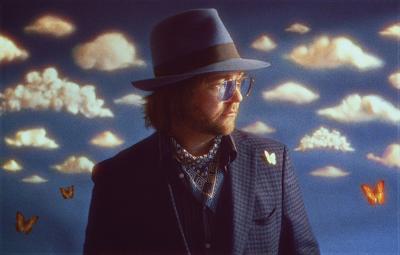


Before he made Nashville his home more than a decade ago, Aaron Lee Tasjan already had an impressive career playing in bands like Semi Precious Weapons, the revived New York Dolls and Drivin N Cryin. He lit a fire under his work as a rock-pop-country singer-songwriter and frontman with 2015’s In the Blazes. His sixth solo LP Get Over It, Underdog, which was our Writers’ Choice pick for Best Album in this year’s BON issue, is a string-slathered adventure in cosmic American music, on which he stakes out new sonic ground while doubling down on the wry and heartfelt observational humor and songcraft that are consistent themes in his work.
The Scene caught up with Tasjan on the road as he was making his way back toward Music City for a show on Wednesday at The Basement East celebrating the record. Our talk touched on touring a record with some new sonic approaches — including playing with a string section on some dates, including the Nashville show — and on the creative generosity of the late, great Todd Snider. Our conversation has been edited for length and clarity.
How's the West Coast treating you?
Oh, it's been really lovely. The weather has been beautiful. God bless these people for what they have to pay for gas every day, man. Other than that, it's been really, really lovely.
How have the shows been so far?
We've had some really good ones, man. L.A. — and I'm doing the same kind of thing for the show in Nashville — was the first time that I had ever performed live with the string section, which was really fun. And the way we did the show was, I kind of came out on stage and did a couple solo songs, and then we added the strings and we did just a couple songs, me and the strings, and then we added the band and did the band and strings. And it was really, really fun. And we're doing the same kind of show in Nashville at The Basement East, which I'm really excited about.
But it's been cool, man. This is the first record I've had where people who are coming out to the shows are asking for songs from the new album, shouting them out and stuff. I think that has something to do with the fact that in the past we've always toured right when the album came out. And this time I wanted to wait a little bit and give people a chance to absorb the record. And I think that's been working because people have been coming out and shouting out — a lot of people seem to want to hear “Lydia's Boots,” or “Twilight Zone Blues” is another one that seems to be an early crowd favorite. So that's been a really cool and different experience than I've had before.
That's kind of a different experience for going to a show in general. It's kind of a running joke that audiences don't want to hear the new songs.
Yeah. Time to get a beer.
Right? So congratulations on that. That's weird and wild and super cool.
Thank you.
And congrats on the new record as well. It's got a wonderful energy. What has it been like preparing those songs for performing with a string section?
It’s my first time, so it's been a lot of trial and error getting it going. Fortunately, the person who was [music directing] the very first show that we did was Eleanor Masterson, who was a multi-instrumentalist in Steve Earle and the Dukes for a long time and now plays with Elvis Costello — and does her own incredible music, both with her sister Bonnie as The Whitmore Sisters and then with her husband Chris as The Mastersons. Really, really incredible musician. [On] the record I think the arrangements were written for four voices and we were just doing a trio live because we don't have giant stages that we're playing on — so it just made more sense to do it as a trio. But she helped me rearrange the parts for that scenario, so that everything was still represented — even though we're technically one less voice than the original parts were written for, which was very handy.
And so when we got up to play the first time, it was like, “Oh man, it doesn't sound like anything's missing. This is great.” And I could tell that first night, the audience reaction when we brought the strings up and started playing those songs, was super positive. So that made me excited because, especially in a live setting where everything's different than it is whenever you're practicing it, you never know how something's going to go over.
And there’s a lot that can happen, good and bad, with strings.
Definitely, yeah. It can go a lot of ways. And so to plan something like that, and work on getting it together and then have it come off so good is such a great feeling.
What was your inspiration for the sonic approach you took on this record, including the strings? Were you thinking about the live performance aspect at all?
Well, I've always sort of just made the records that I felt inspired to make and then tried to figure out how to represent that in a live setting after the fact. And for the most part, I've been able to be fairly successful in that endeavor, I feel like. Because a lot of the time, the stuff that I was trying to get out live that I didn't have was maybe a synth thing I'd played on a record or something — which, you can make a guitar sound like a synth, you know what I mean? There's things you can do in those sorts of scenarios.

Catching up with the songsmith ahead of his fifth solo LP
This one was a little bit of a doozy because I was like: “Well, I really am feeling called, in this time of everything AI and all that kind of stuff, to really just dig in. And I'm not going to play a strings patch on a keyboard. I'm going to hire a real string section and human beings to arrange it and the whole nine yards.”
And there's really no way to replace, not only that sound, but also that energy of that group of people playing together as one part. So I was a little nervous in terms of just figuring out the economics of that. But what I figured out is there's markets that I can do it in. And then there's some markets where I won't be able to do the full vision for this tour, but that's OK. And the way things are now anyways, everybody films everything at the shows. It's like you can put it online, people will sit there. And so in these times you have to figure out how to make something work for you. Because I feel like it's easy to just be like: "Ah, it's too expensive. We just won't do it."
And I don't give up easily, especially when it comes to the vision that I have for my art. If it's in my heart to do that, and to want to put that in front of people, I got to figure out some sort of way to do it. So I feel like we were able to do that at the end of the day. And I'm really glad that I got some killer videos that I'm going to post from that L.A. show for people to check out and stuff. So I think it definitely is going to be something that I don't regret doing. And I hope that for the people who do come to the shows, that it feels like something that's special and unique.

The beloved Nashvillian and prolific folk songwriter died Friday following health struggles
What do you think you've learned about writing while you were working on this album?
Well, this one was different in terms of, I asked Todd Snider to be my A&R guy. And I asked him if I could send him what I felt were finished songs, or close-to-finished songs, and if he would be willing to help me zero in on ones that felt like they belonged on a record and maybe even make those a little bit better if I could.
I had done that previously when I was at New West Records. Kim Buie was really interactive with the artists and she was really good at it. I remember having conversations with Luther Dickinson and stuff like that where he would be like, “Man, Kim really helps me finish.” And I was like, “Yeah, I feel the same way.” … It's a lost art, kind of, what she does in terms of record labels and stuff. And Blue Élan, which is the label I'm on now … they put a lot of faith in me. And I think partially because of that, I wanted to really do the best that I could. And I knew that Todd — because I'd had past experiences with him showing him my songs, I knew he would really be honest with me and objective about the process.
So it was a totally different kind of process writing the songs this time, because I sort of had this wingman who also happened to be one of my favorite songwriters of all time to bounce everything off of. And through that process, I feel like I was kind of able to do something a little bit different in my work this time — where I feel like in the past I've sort of written two kinds of songs, one song that's more sort of observational and one song that's maybe more personal. And he kind of showed me through this thing that John Prine taught him.
[It’s] called “finding the emotional rock” of the song — in which you could write a song where you were even writing as a character, but you put something into the song, a couple of lines or something that had a deep personal meaning for you, so that you didn't have to try to be singing a story that's purely fictional every night. There's a part of it that really is you, and that's in the song as well. And so for the first time, I feel like I was kind of able to do both at the same time, if that makes sense.
Wow. That's a pretty heavy tradition right there.
Yeah.
Does it feel more vulnerable to put a little rock of yourself into each of these songs? Does it feel different without the cover of fiction?
What it did for me was it basically made it so that performing the song live, it kind of becomes easier to put yourself out there — have a performance that really comes from the heart, I think. Because when you have, as you said, more vulnerable parts of those songs, you sort of inhabit that in a performance setting in a way that you don't versus when the song is purely fictional. I mean, I think I've definitely met artists who are amazing actors on stage and can really dramatize a song emotionally with their performance of it live. And I have tremendous respect for that, but I think I always wanted to be the kind of performer that felt like someone that the audience really related to personally. And I think because of that, I've not really gone that route of acting as I'm performing or whatever.
And so having these lines in these songs now, that have that vulnerability, I feel like I can sort of authentically express that without having to try because it's just sort of what comes out when you're singing about something that is deeply personal like that. But what I like about it is, I never feel like I'm beating people up with my trauma or whatever I was personally experiencing, because those lines are wrapped in something else that isn't just that. So it's like this kind of cool way to really express what I've actually been going through without having to drag people through all of it again with me night after night, which I also feel like would be a hard thing to do.
That album by Allison Russell, Outside Child, I don't know how she did that. That record is so personal. I've just listened to it again for the first time in a while. It's so incredible. … I don't think I could do what she did on that record. Or maybe if I got some more therapy or something, but she's just amazing. But yeah, I think in my own way, I'm finding how to do that and inhabit that space authentically. And I feel like people can tell. I've gotten a lot of people coming up after the shows and going like, “Man, that was really from the heart what you did tonight.”
You’ve made some big additions to your art and your practice. Where are you taking that from here?
Losing Todd just feels like something that will never go away. And I don't know that that's even necessarily only a sad thing. … It's almost like losing a parent or something, if you have a good relationship with your parents — he was the guy who sort of picked you up and kept you going. And just knowing that he was out there doing his thing was always really inspiring, and another reason to just keep going and keep on. … I guess in certain ways, maybe the emails and the conversations and everything that he and I got to share outside of music, of making music together — in a way, maybe that is a little bit of a roadmap and sort of like, “OK, I have the blueprint.”
Maybe there's a way I can figure out how to do some of this stuff for myself now. And maybe that's one of the important lessons that I need to learn in the massive wake of losing a guy like that. … We sort of lost all of these people right in a row. Kristofferson, Prine, Jerry Jeff, Todd, just one after the next. And it's not really clear where we go now.
But I think as songwriters, one thing that is very clear is we all need to do our best work because people need this music. And it's not Taylor Swift-sized, hundreds of millions of people or whatever, but it is a significant group of folks who really get something from whatever you want to call us — troubadours, folk singers, Americana singers, whatever the word is for it. What we do, I think, is essential for a certain group of folks out there. So we have to find a way to honor these massive North Stars of our lifetime that we've lost, by doing our best work and continuing forward even though the path isn't clear. Because when I think about those guys, whether it's Todd or John Prine, I think about how there were definitely times in both of their respective careers where the path forward wasn't necessarily 100 percent clear either. And yet they kept going and made some of their greatest work in the process. So that seems like a good thing to think about when I try to think about what to do next.





Post a comment as anonymous
Report
Watch this discussion.
(0) comments
Welcome to the discussion.
Log In
Welcome to the discussion.
Keep it clean. Please avoid obscene, vulgar, lewd, racist or otherwise abusive language. Comments featuring hate speech or threatening or violent content will not be tolerated.
PLEASE TURN OFF YOUR CAPS LOCK.
Be truthful. Don't knowingly lie or mislead.
Be proactive. Use the “report” link on any comment that violates our comment policy.
Share with us. We'd love to hear your feedback.