
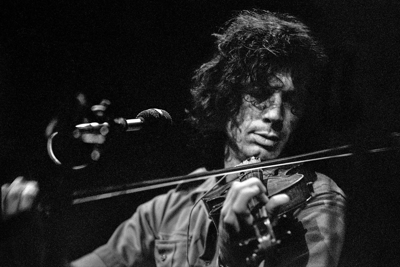


Depending on whom you ask, you may get a lot of different answers about who John Hartford was. The prolific New York-born musician and lover of Mississippi River lore wrote one of the most-covered pop songs ever, “Gentle on My Mind.” But he was a scholar of many kinds of folk and roots music, and spent much of his career putting that knowledge to work in Nashville. He made key contributions to The Byrds’ 1968 country-rock masterpiece Sweetheart of the Rodeo. His 1971 album Aereo-Plain set the standard for progressive bluegrass (aka “newgrass”). Not long before he died of complications from non-Hodgkins’ lymphoma in 2001, his work on the soundtrack to O Brother, Where Art Thou? helped usher in a renewed interest in roots music that boosted the nascent Americana genre.
John Hartford’s Mammoth Collection of Fiddle Tunes, a book project spearheaded by his family and published in 2018, testifies to another aspect of his relentless creativity. It contains 176 of some 3,000 original compositions written between 1983 and 2001. It’s an amazing resource for musicians who can read and play music from standard staff notation. Thanks to the array of outstanding musicians who play on The John Hartford Fiddle Tune Project Vol. 1, a 17-track album completed with help from a Kickstarter campaign and out Friday, anyone will be able to hear selections from this body of work for themselves.
The project began not long after Hartford’s death, when his daughter Katie Hartford Hogue and her family moved back to Nashville and eventually filled their basement with the contents of Hartford’s office. Among the materials — many of which were donated to Vanderbilt’s Blair School of Music, the Country Music Hall of Fame and Museum, and the Center for Popular Music at MTSU — were 68 spiral-bound notebooks filled with pieces, some of which ended up in the book. Before Hartford started writing these tunes, he had only played music by ear, and his prolific writing was partly spurred on by having learned to write notation.
“Whenever he did something like that, he was obsessive about it,” Hogue tells the Scene. “He would always have tunes going on in his head — everything would kind of make music to him. Now he had a way to write it down. So he just started writing. And the more he started writing, the more came out.”
The recording was produced by Matt Combs, who also assisted with the book. Combs, a fiddler and mandolinist in the Grand Ole Opry house band who studied under Hartford, recruited a slew of world-class musicians to play on the album, including bassist Dennis Crouch, fiddler Megan Lynch Chowning, banjo player Alison Brown and mandolinists Sierra Hull and Ronnie McCoury. It was important that the project not feel stiff and constrained, so each musician picked songs that spoke to them, then interpreted and arranged them through their own creative filters. While the album is mostly fiddle- and mandolin-centric, it doesn’t adhere to any one specific style: There are old-time tunes, progressive experiments and parlor waltzes, among other things.
“A lot of what John was doing was effectively journaling,” says rising mandolin picker Tristan Scroggins. He performs on the album and has been helping the family with archival work for the past year. “It was like a musical diary. One of the songs on the album is recorded with a string quartet. It’s clearly John practicing writing four-part harmony stuff. It’s not particularly complicated, but it’s this view into his brain. It’s like his musical thoughts for the day.”
Chris Eldridge, whom you’ll know as a member of Punch Brothers and the other half of a duo with fellow masterful guitarist Julian Lage, also plays on the album. He sees Hartford’s work as an essential guiding force in moving string-band music forward.
“He’s so prolific, so creative, so reverent of tradition while simultaneously being completely irreverent towards it,” says Eldridge. “He kept those two things in just beautiful balance. To me and a lot of my peers, Hartford is kind of an eternal hero.”
Scroggins will be part of a tour, being planned for May, on which some of the fiddle tunes (and other longtime Hartford favorites) will be performed live. He appreciates how the project opens up another avenue for more new audiences to experience Hartford’s unpretentious genius for themselves.
“He’s had a real staying power, and now the new generation of performers and artists and creators is coming along, he’s a part of that,” Scroggins says. “Once that happens, you’re cemented into the fabric of music.”



Post a comment as anonymous
Report
Watch this discussion.
(0) comments
Welcome to the discussion.
Log In
Welcome to the discussion.
Keep it clean. Please avoid obscene, vulgar, lewd, racist or otherwise abusive language. Comments featuring hate speech or threatening or violent content will not be tolerated.
PLEASE TURN OFF YOUR CAPS LOCK.
Be truthful. Don't knowingly lie or mislead.
Be proactive. Use the “report” link on any comment that violates our comment policy.
Share with us. We'd love to hear your feedback.