
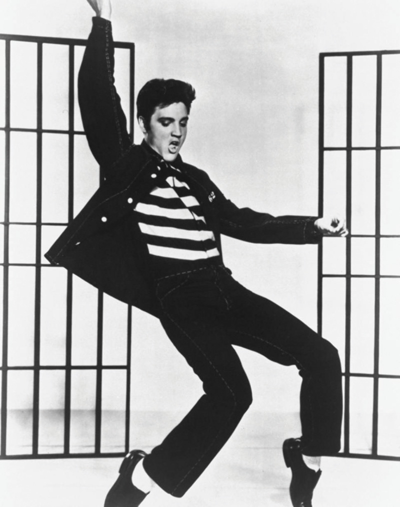

When Elvis Presley died in Memphis in August 1977, his Nashville producer Felton Jarvis perhaps best summed up the impact of the passing of The King of Rock 'n' Roll. "It's like someone just came up and told me there aren't going to be any more cheeseburgers in the world," Jarvis told future Presley biographer Peter Guralnick after Elvis' untimely death.
That psychologically penetrating comment says much about a singer who always managed to leave the building just a little bit early. It also reveals just how well Jarvis, and Nashville's music business, understood Elvis, who made sustaining work that cultural arbiters have often shrugged off as just another patty on the griddle. On the occasion of what would have been Presley's 80th birthday (he was born in Tupelo on Jan. 8, 1935), it's fitting to look at the relationship between Elvis and Nashville — two entities that, when working together, could make one of the best cheeseburgers you ever had.
It's part of rock lore that Presley never regained the purity of his mid-'50s Memphis-recorded Sun performances. After signing with his manager, Tom Parker, in 1955, Presley came to Music City in early 1956 to cut "Heartbreak Hotel," a Mae Axton-Tommy Durden stop-time blues with a country-style narrative. Not only one of the earliest modern rock 'n' roll records, it remains a monument to what Nashville does best, as well as a mild repudiation of purity as an essential ingredient in pop and rock 'n' roll music.
Cut that year at 1525 McGavock Street on Jan. 10, "Heartbreak Hotel" was done with guitarist Scotty Moore, bassist Bill Black and drummer D.J. Fontana, Elvis' regular backing band. Vocal group The Jordanaires sang backup; Floyd Cramer played piano, while Nashville session musician and RCA executive Chet Atkins added guitar. "He was just old Cool Hand Luke himself," Moore said of working with Atkins in Guralnick's Last Train to Memphis: The Rise of Elvis Presley. "He wasn't there to disturb or anything."
Although RCA had its reservations about "Heartbreak Hotel" and the supposedly gloomy nature of the performance itself, it now sounds remarkably undisturbed. If the experimental audacity of Presley's Sun sides is missing in this and Presley's cover of Jesse Stone's R&B standard "Money Honey," the Nashville system exercises quality control in recording technology and production supervision, and expertly matches artist and repertoire. The result is an exciting record that combines elements of blues, country and rock 'n' roll.
It's the contrast between what Presley did in Nashville and elsewhere after his Sun sides and what he could have done that troubles me on Elvis' 80th birthday. Some of it is great, much of it is oddly compelling — and nearly all of it is somewhat askew. The common complaint about Presley is that after Sun, he sold out and became a cipher who only intermittently returned to the gospel of raw, uncompromised rock 'n' roll as preached by, say, Lester Bangs.
I agree, but with reservations — and here again Nashville comes into play. Using the city's great session players, Jarvis cut something as unexpectedly fine as Presley's legendary 1966 recording of Bob Dylan's "Tomorrow Is a Long Time." Cut during his supposed wilderness years, it's a song Presley learned from Nashville multi-instrumentalist Charlie McCoy, Dylan's sideman on the epochal Blonde on Blonde sessions, and it bizarrely first turned up as a bonus track on Elvis' Spinout soundtrack album.
By then, the pop process that had begun in Nashville with "Heartbreak Hotel" had turned Elvis into something of a joke: a shallow movie actor and a has-been. But "Tomorrow Is a Long Time" ambles along darkly in exemplary swamp-pop fashion, as Presley nails the Hank Williams-esque desolation in its lyrics. "And only if my own true love was waiting / If I could hear her heart softly pounding," he sings.
You wish for more of these transcendent moments in Presley's catalog, but that wouldn't be Elvis. Had he made it to 80, perhaps he would have become a sage elder like Leonard Cohen, made duet albums with Peter Gabriel and David Byrne, and collaborated with Dylan himself on an album of songs originally performed by Dean Martin. Perhaps Rick Rubin would have produced.
But I'm glad it turned out the way it did: oddball quasi-pop with Nashville licks and B-grade songwriting. Around the same time Elvis cut the sublime "Tomorrow Is a Long Time," he recorded "Spinout," written by the famed songwriting team of Ben Weisman, Sid Wayne and Dolores Fuller. The ex-girlfriend of legendarily awful Poverty Row film director Ed Wood, Fuller acted in the anti-auteur's Glen or Glenda and wrote or co-wrote several songs for Presley, including "Rock-a-Hula Baby."
So Elvis was no David Byrne — good taste may not be relevant. Whatever the case, Nashville saved him in 1967, when he recorded two of his greatest tracks here. Written by Weisman and Wayne, "How Can You Lose What You Never Had" sounds like Nashville musicians playing in the style that The Band was perfecting for their 1968 debut full-length, Music From Big Pink.
And Presley's version of Jerry Reed's "Guitar Man," cut here in September 1967, proved to be the recording that announced his brief artistic reawakening in 1968 and 1969. Here again, Nashville matched song to singer, provided Presley a gimmick courtesy of Reed's great guitar playing on the record, and gave him a way to reconnect with the rock audience. Different moods, different cheeseburgers. Only the deep sense of satisfaction is the same.
Email music@nashvillescene.com



