
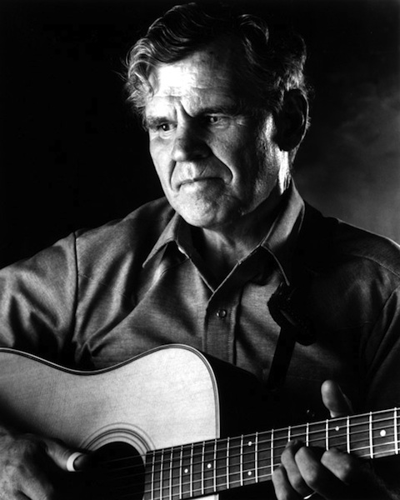


When the pioneering music critic Nik Cohn summed up post-Elvis pop, he got it half right. "Mostly, pop boiled down to electric guitars," Cohn proclaimed in his 1969 book, Rock From the Beginning, which remains one of the most insightful pieces of rock criticism. I would say, following the lead of the great Cohn, that pop music in the '60s boiled down to guitars, and the career of the guitarist and singer Doc Watson illustrates that point perfectly. The reason Cohn didn't include Watson in his survey of rock and pop is a little more complicated than the fact that Watson didn't exactly play rock 'n' roll — actually, Watson did, and on a Les Paul electric guitar.
Since 1969 — a time when the folk revival of the late '50s and early '60s had already subsided, but lay cunningly dormant — the revival of Appalachian music, bluegrass, blues and all manner of American-British folk music, not to mention commercial country music, has changed some, but the idea of folkiedom is as strong as ever. Yet in the '60s, the cult of the guitar, both electric and acoustic, was the driving force behind the various revivals of the decade.
Start naming them: Bert Jansch, Davy Graham, Nic Jones, Doc Watson, Clarence White, Roger McGuinn, Skip James, Eric Clapton, Peter Green and B.B. King. These are all names I chose more or less at random, and all avatars of the cult of the guitar, whose British wing included Jansch, Jones, Richard Thompson and all the pale, wan British blues guitarists who worshiped at the altar of James or B.B. or Albert King, when guitarists like Jimi Hendrix were actually extending the very traditions these players believed they were venerating.



