
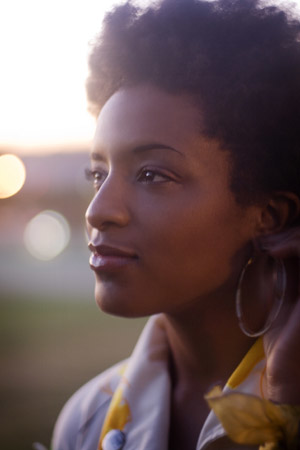
These days, Denitia Odigie is pondering just about every significant question that a songwriter can have. Where is she at home stylistically? Who should her audience be? What's the best ratio of commercial appeal to artistic expression? Where does she fit in the local music scene? Despite how much is up in the air, she seems remarkably Zen about it all. It's as though the answers are working themselves out.
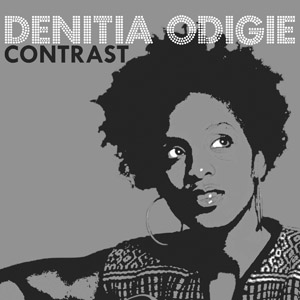
Contrast is Odigie's fourth release (for the record, she's recorded strictly EPs to date) and—true to its title—it sounds unlike anything she's done before it. Her alt-rock leanings now take a backseat to country-touched soul, and her earlier penchant for abstract lyrics and avant-garde melodies have disappeared altogether. The difference is clear from the very first track, a 3/4 ballad framed in languid slide guitar titled "Missing You." Her girlish cayenne-pepper voice skips from breathy to syncopated to belting, not exactly the kind of singing she was known for in the past.
Some strategic listening kicked off Odigie's shape-shifting journey. "Somewhere along the way I got a hold of some rare Aretha Franklin and it freaked me out a little bit," she says. "I mean, I just listened to it over and over and over again." (The Aretha she's referring to is the 1970 album This Girl's in Love With You.)
"I just connected with that soul feel," says Odigie. "That's my first musical memory—Al Green. So I think it was just a matter of me getting back in touch with the kind of music that really moves me. I think when I was doing more of an alternative thing, it was an unconscious movement from my late teenage years: 'This is the music I've been listening to and this is the music I'm going to put out.' And this whole soul direction has been more of a conscious thing."
Odigie—who completed an art history degree at Vanderbilt in 2004—started thinking more about a songwriting overhaul when she signed her first publishing deal in November with upstart Weston Boys Entertainment. (That offer played a big role in drawing her back to Nashville after a short stint exploring acting opportunities in Atlanta.) "The whole idea of [a publishing deal] has really been a catalyst in me re-approaching songwriting as its own craft. I've not really labored over songs—like, ever—in the past."
"It really was [a time to consider], 'What am I trying to do with my songs?' " she continues. " 'Are these just for me? Or am I trying to really communicate to people, open this up as a reciprocal relationship, me to the audience member?' I would like to speak directly to people to where they would understand me, at least on the second listen."
Late last year, Odigie went on her first proper tour and passed the ultimate performance test: her first-ever show in front of family and friends in her hometown of Houston, Texas. "They loved it," she says. "Times like that, I think back to two years ago: Had I been playing this more abstract, alternative material they would have been like 'What?' And now I'm singing love songs and I'm howling a little bit. And I think older black people get that. I want to communicate to my grandmother. I want her to get it, what I'm saying."
That experience got Odigie contemplating where she fits among her pop-rock musician friends "from that whole Christopher Pizza circle," what her Nashville shows are like and how—once in a blue moon—an industry person will look at her and assume that an African-American woman with a guitar adds up to Tracy Chapman.
Odigie's EP title implies a change in sound, a surprising studio pairing (she recorded it with Darryl Swart, drummer for the Christian rock band Tree63) and the wide range of emotion—from giddy to seething—she covers in five songs. But there's even more to it than that.
"When I named it Contrast I was thinking about Nashville specifically, what an audience looks like at most of my shows—it's a Caucasian-American audience—and how cool it would be to get some racial intermingling going on," says Odigie.
"Artists like Damien Horne and Darnell Levine, what they're doing and the people that I see hanging out at their shows, it's a mix of people. I can sincerely say that. And I think that part of my whole soul bent [came from asking], 'Where am I coming from racially, ethnically, socio-economically—where am I coming from and who do I want to speak to?' I want to speak to a wide range of people. How nice would it be if people who would never be in a room together came to be in a group together because of music? I didn't make that up, but that's a great thought."
Email music@nashvillescene.com.



