
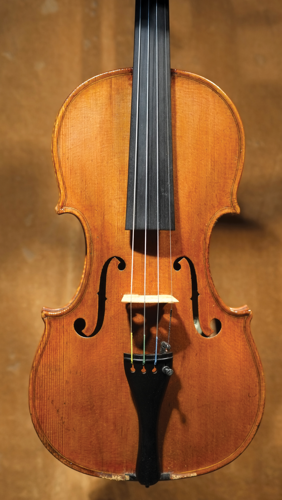
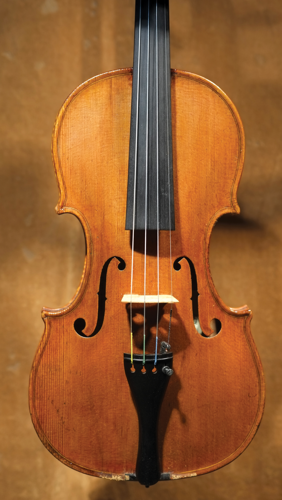


The Krongold Violin, one of the Violins of Hope
Violinist Sylvia Samis moved to Nashville not long ago to be near family. A former assistant concertmaster at the Cincinnati Symphony Orchestra, she was content to keep a low profile. But then Charlottesville happened.
“Charlottesville brought me out of the weeds,” says Samis, speaking with intense emotion about the white supremacist rally in Virginia that turned deadly in August. “After that terrible day, I could no longer stay silent.”
Samis had good reason to be angry. Both her parents were survivors of the Auschwitz concentration camp and were the only members of their large extended families not killed during the Holocaust. Appropriately, Samis will give voice to her parents’ suffering and commemorate their lives during a communitywide interfaith cultural project happening in Nashville this winter and spring.
The focus of this collaborative venture, called Violins of Hope, will be a rare collection of Holocaust-era violins that will be performed, recorded and displayed in Music City. Over the next few months, about two dozen Nashville arts, education and civic organizations will participate in performances, lectures and exhibits related to these instruments. Organizers of the project are clear about their intentions.
“We’re hoping our events drive a communitywide discussion about hope, diversity, civil rights and censorship,” says Steven Brosvik, the Nashville Symphony’s chief operating officer. “We want there to be a serious interfaith dialogue in Nashville.”
People will certainly be talking about the 34 violins in the exhibit, which will be on display for free at the Nashville Public Library downtown from March 26 to May 28. All of these violins once belonged to Jewish musicians swept up in the Nazi Holocaust. Some are ornately decorated, with Stars of David emblazoned on their varnish. Many boast heart-wrenching pedigrees.
One of the instruments, known as the Auschwitz Violin, was once owned by an unnamed prisoner who performed in that notorious death camp’s men’s orchestra. The musicians in the ensemble were forced to perform for newly arriving inmates as they were removed from cattle cars and marched under the infamous sign reading “Arbeit Macht Frei” (“Work Makes You Free”). They also performed in the mornings as other inmates left the camp to do forced labor in factories and farms, and they were even compelled to entertain their Nazi captors.
“These instruments have powerful voices,” says Alan Valentine, president of the Nashville Symphony Orchestra. “The first time I saw the Auschwitz Violin, I could feel its energy. It speaks without even being played.”
The man responsible for collecting, restoring and ultimately sharing these violins with Nashville is Amnon Weinstein. A second-generation luthier born into a family of Lithuanian Jews who escaped the Holocaust, Weinstein has spent the past 22 years researching and collecting these instruments, which he lovingly restores in his basement workshop in Tel Aviv. At first, Weinstein kept the violins in Israel. But in recent years, he has sent them on tour in Germany, Italy and the United States. They first arrived in the U.S. in 2012, when 18 of the instruments were showcased and performed in Charlotte, N.C. Three years later, 26 of the violins were played and exhibited in Cleveland.
These visits caught the attention of the Nashville Symphony Orchestra, but it took an unexpected controversy to bring them here. The fuss began in 2015, when the Nashville Symphony presented the American debut of Ça Ira, an opera about the French Revolution composed by former Pink Floyd frontman Roger Waters. Waters’ harsh criticism of Israel’s Palestinian policy had drawn accusations of anti-Semitism from some quarters. Not surprisingly, his visit to Music City raised eyebrows at the Jewish Federation of Nashville and Middle Tennessee.
“We had a group visit the Schermerhorn to try and find out what was up with all of this,” recalls Mark Freedman, executive director of the Jewish Federation. “Alan Valentine turned out to be very gracious and indicated he wanted to find a project where the Jewish Federation and symphony could work together.”
That project was Violins of Hope. Freedman was tasked with contacting Weinstein about the possibility of bringing the instruments here. “Amnon knew all about Nashville as a music city,” says Freedman. “And he was extremely enthusiastic about our project.”
Events related to the project begin in earnest next month, when Nashville Ballet presents Light / The Holocaust & Humanity Project as the latest installment of its Attitude series at TPAC’s Polk Theater (Feb. 9-11). Choreographer Stephen Mills created this work in 2005 for Ballet Austin. Paul Vasterling, Nashville Ballet’s artistic director, attended the premiere in Texas.
“I’ve had Light in the back of my mind since then as a piece that I’ve wanted our company to perform for our local community, but I had been waiting for the right opportunity,” Vasterling tells the Scene via email. “When the Nashville Symphony approached me with the Violins of Hope initiative and how we could be involved, I knew this was the right time.”
Light recounts the story of Naomi Warren, a real-life Holocaust survivor. The work is divided into five sections, featuring music by contemporary composers and performers Steve Reich, Evelyn Glennie, Michael Gordon, Arvo Pärt and Philip Glass. Interestingly, the ballet is abstract, rather than a literal retelling of the Holocaust, allowing the work to relate to all forms of injustice.
Questions of injustice are at the heart of Slavery, the Prison Industrial Complex, a photography exhibit at the Frist Center for the Visual Arts (Feb. 23-May 28) that will feature the work of photographers Keith Calhoun and Chandra McCormick. The two spent more than 30 years documenting the grim existence of prisoners at Louisiana State Penitentiary at Angola.
“The black-and-white images of African-American prisoners working in the fields, guarded by armed white police officers on horseback, look like they could be from the 1850s,” says Katie Delmez, a curator at the Frist. “It’s a shock to learn some are as recent as 2013.”
The Angola exhibit and two other shows, We Shall Overcome: Civil Rights and the Nashville Press (March 30-Oct. 14) and Nick Cave: Feat. (open now through June 24), were already in the planning stages when the Frist was approached about Violins of Hope. Since all these exhibits focus on issues of civil rights, they proved to be a natural fit for the Holocaust project.
The Nashville Symphony is pulling out all the stops for Violins of Hope, including commissioning a new work from American composer Jonathan Leshnoff. His Symphony No. 4 “Heichalot” will be premiered using Weinstein’s Holocaust violins (March 22-24 at the Schermerhorn). Recordings of these performances for the Naxos label will be the first professional recording of these historic instruments. Other symphony events include a Yom HaShoah — or Holocaust Remembrance Day — memorial service on April 12 along with a performance by Pinchas Zukerman April 12-14, violinist Joshua Bell performing on the Huberman Stradivarius violin May 9, and Verdi’s Requiem May 31-June 2.
Samis, the daughter of Holocaust survivors, will perform with her son, Nashville cellist Michael Samis, at Vanderbilt’s Blair School of Music on April 22. Blair will host six events for Violins of Hope, including an ongoing exhibit at Ingram Hall about Jewish string players, chamber concerts March 29 and April 18, a showing of Schindler’s List on April 29, and a choral concert featuring the Blair Girls Concert Choir and Vox Grata Women’s Choir on May 15.
Sylvia Samis’ performance will be among the most deeply felt of the entire project. During her concert, she will read selections from her mother’s unfinished memoir recounting her life in a concentration camp.
“I am grateful for this concert,” says Samis. “It’s a chance to give voices back to those who have been silenced.”



Post a comment as anonymous
Report
Watch this discussion.
(0) comments
Welcome to the discussion.
Log In
Welcome to the discussion.
Keep it clean. Please avoid obscene, vulgar, lewd, racist or otherwise abusive language. Comments featuring hate speech or threatening or violent content will not be tolerated.
PLEASE TURN OFF YOUR CAPS LOCK.
Be truthful. Don't knowingly lie or mislead.
Be proactive. Use the “report” link on any comment that violates our comment policy.
Share with us. We'd love to hear your feedback.