

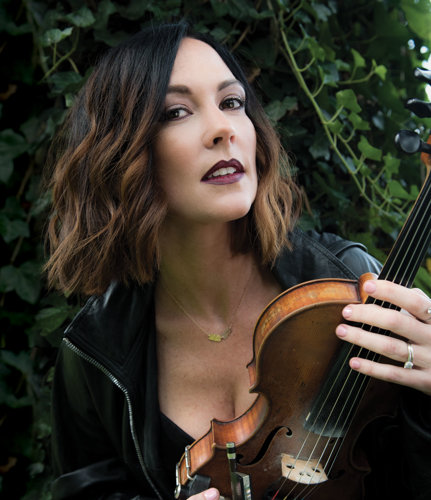
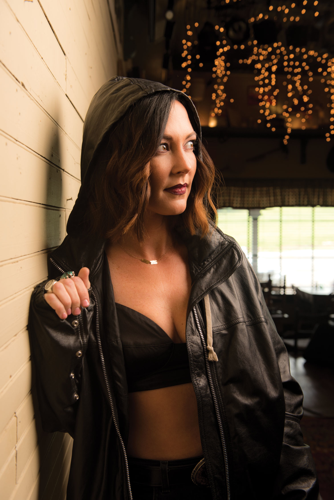


Amanda Shires at Green’s Grocery in Leiper’s Fork
Amanda Shires was driving her band’s van down a Tennessee highway last month, listening to Knoxville’s country radio station Q100.3-FM — “Today’s Continuous Country” — and she didn’t like what she wasn’t hearing. So she called the station, while a bandmate filmed on his cellphone.
“Do you love the songs that you’re playing?” Shires says, calmly conveying in her Texas-tinged voice that she is, with all due respect, not here for bullshit. “Really? Did you know that in 18 songs, you played one woman that wasn’t a request, and the second one it was a request?”
Eighteen songs, somewhere around an hour of music, and just two female voices — only one of which was chosen by someone at the station.
“I was just wondering if you might be open to playing more women on the radio, like Kacey Musgraves or Margo Price,” Shires says, looking to her bandmates to chime in with more worthy female artists.
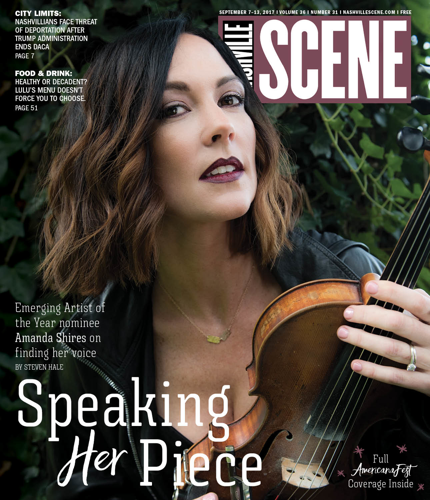
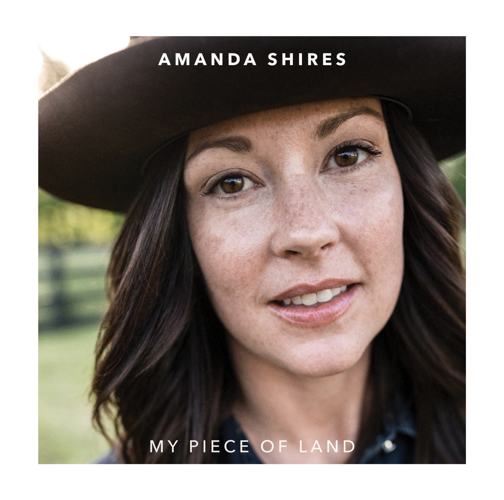
Shires is also a female singer-songwriter — one you would be hearing on country radio if the game weren’t rigged against women and, for the most part, thoughtful songwriters of any gender. She is nominated for Emerging Artist of the Year at this year’s Americana Music Association Honors and Awards, but while she certainly earned trophy consideration with last year’s LP My Piece of Land — her fifth and best record yet — “emerging” doesn’t quite fit. At 35, she’s been touring and playing music for 20 years, first as a fiddle player with the Texas Playboys and Billy Joe Shaver, then as a singer-songwriter in her own right. She is also a member of The 400 Unit, the formidable backing band for her husband, Jason Isbell.
She doesn’t mention any of this on the phone with the Q100.3 DJ, who assures her that she must have just caught the station in a “weird patch.”
“We’re a radio station that sometimes plays two and three female artists in a row,” he explains.
“Let’s move this music forward,” Shires says. “Let’s not stay in the past, man.”
She hangs up the phone, briefly recaps with the band noting that the DJ was nice and polite, and then turns up the radio again. You can guess what was on.
“Oh look, it’s another guy! Song 19.”
The Scene sat down with Shires at Green’s Grocery in Leiper’s Fork. You can listen to the interview on this week's episode of the Scene podcast.

So we’re coming up on a year since your album came out, and since one of my favorite blurbs that we’ve ever published appeared in the Scene. You reviewed your own album in our Year in Music issue, if you remember that.
Yeah, I do. I remember it was the best album of the year.
You called it the album of the year.
Because it is.
Do you think about those songs differently a year removed from releasing the record?
I think about it differently. I think when I made the record, I was pregnant with my daughter, and I was dealing with a lot of, “How do you be a mother, and a songwriter, and a wife, and a side player, and how do you make room for all that and still have time to write and record music?” I think I was opening for somebody, and their tour manager said, “So you’re just going to be a stay-at-home mom?” I was like, “I’m not going to, but if somebody wanted to do that that’d be fine.” ... Looking back on it now, I made that record as a sort of insurance to myself, like to make sure that I would have part of my identity still when I was done.
That’s interesting. Burning the ships behind you, like you were going to have to tour on this and play these songs.
Yeah. And in hindsight, I think that I put a little bit too much pressure on myself, because it’s not any harder being a woman with a baby in the music business. You’re still a woman in the music business, you know?
You’re nominated for Emerging Artist of the Year.
It’s like a beautiful butterfly. It sounds like a butterfly.
I wonder what it’s like after many years of playing and recording to have someone — even in a positive way — call you an “emerging artist.” How does that strike you?
I’ve thought about that some, and I think — you would think that the first record by a person [would be] an “emerging artist” record, but I don’t know how they decide that. I’m obviously honored. I don’t know if it’s because this album was more successful, at least more successful than the last one. But I don’t know how they decide those things. But I’ve been at it a while, so I might probably not get it, because I’m not technically emerging, and voters probably know that. And I’m OK with that, because I know I’m great.
So you came up in Texas, and you’ve lived here now for a while. What’s the difference between writing and performing in Texas, in what you can broadly define as country music, versus working in country in Nashville?
The thing I had a problem with was I had worked from the age 15 to ... 20-something as a side person. I played with the Texas Playboys, I played with Billy Joe Shaver, I played with my old band Thrift Store Cowboys, I played with whoever would have me. And it was with Billy Joe Shaver, when I was touring with him, that he wanted to hear my songs. I made a fiddle instrumental record that’s not what I consider part of my artist records, because this was to supplement my income while I was touring as a side person, so there’s lots of old, traditional fiddle songs. And there was maybe two songs on it that I wrote just because I wanted to showcase that I could sing without having to pay royalties to somebody for covering a song. And so ... at that time I wasn’t ever thinking about being an artist.
I was on the road with Billy Joe, and he was like, “Put that tape in,” and I said, “OK, Billy Joe, I prefer we not,” and he said, “Well, we’re going to.” And he heard those [original songs] and he’s like, “You could be a songwriter, you could be a songwriter. You should go to Nashville, move there and be a songwriter. There’s no loyalty in side-person work. One day, they’re going to like a fiddle, the next they’re going to like a dobro, and then where are you going to be?”
In that moment, I thought he was firing me, and I was like, “Wow, this is the easiest letdown I’ve ever had,” thinking in my mind. I said, “No, no, I love playing in your band, Billy Joe. I love it, it’s my favorite thing,” and I continued to play with him some more. And then the seed was planted, and about a year later I sold my record collection and moved to Nashville to pursue my dream of being a waitress.
The difference is, the reason I couldn’t stay there in Texas and be an artist is because I tried, and they only saw me as a side person — the promoters and the bookers and all that. So I had to come start over here, and at that point I was like, “I’m never playing in another person’s band unless it’s somebody’s writing that I admire and I feel like I could learn from that person.” I sort of stick with that.
Is the experience of being a woman as a side person in a band different from when you’re the person in the center of the stage, since you do both?
I’m lucky that my husband is a feminist in a sort of way. When I’m headlining my own shows and I go on tour, there have been times when we’re loading in and the guy’s like “That’s where you set up the merchandise table, right over there,” and I’m just like — [frowns] “Cool.”
Do you pull out a shirt and say, “This is me on the merch here”?
I just think to myself, “What a fucking idiot.” … But I also have had experiences — my drummer [longtime local sideman, bandleader and DJ Jerry Pentecost] is black, and I’ve been into a club where they thought he was going to steal everything. Like when he came in, he had his hoodie on and he was setting up the drums, and the guy’s like, “What are you doing here?” My problem isn’t like that problem, but I like how sometimes it intersects.
So, headlining and playing my own shows, and going out and … leading a band, it’s difficult. You’ve got to be a little bit stern and sift through bullshit a lot. People like to try and pull one over on you. As a side person, if somebody says anything that I think is off-putting or whatever, I just sort of meet it head on and say, “Listen, I know you think that, but really I need to take a break and go chill out or whatever.”
Not that this dynamic is new, but it feels like women in music, especially country music — again, broadly defined — have to be twice as good. A lot of great women songwriters are getting noticed right now, which is a great thing. But it’s also sort of a sign of the injustice that exists.
There are so many. How many spots do you really get? Like, let’s go with charts, how many slots are there? Ten or 15 that people look at first. In country radio, there’s two [top female artists] right now, and one of them is a group. You have to be twice as good because it’s a patriarchal setup, and they [pit] you against one another because there’s only one spot — so the competition, it’s rigged. So they want me and Margo [Price] to fight, or me and Kacey Musgraves to fight. And we all love each other, but we can’t really make more spots. That has to come from the above tiers, and they need to get with the program, or somebody needs to fire them. I wish I could.
Maybe one day you can.
People love great songs, and that’s what I think is going to win, is songs.

I’m hesitant to ask you this next question, because there’s this awful thing where by talking about this, you’re reinforcing an unnecessary distinction. The category of “a woman in music” doesn’t need to exist, but it’s also a reality, so it’s a very tricky thing. How you feel about discussing “women in music”?
I think it’s important because you’ve heard it before. There are other people who say things like, “This is a great woman songwriter.” But they haven’t had it pointed out to them or been made aware, “Yeah, but isn’t she just a good songwriter on her own?” I think a lot of it is education and awareness and trying to be considerate. People are pretty self-absorbed these days. A little empathy goes a long way, I guess.
Speaking of people who are self-absorbed, the topic of the president came up during your guest appearance on the podcast Death, Sex and Money. You mentioned that after the election, it got a bit harder to go to the gas station.
It did, it did. We were in California, and it was happening during the campaign — it was not even when he got elected. I’ve never been catcalled so hard as [during] the past year, and I’ve been touring since I was 15. I don’t need any help pumping my gas, but if you want to pay for it, go for it.
Speaking of songwriters, I think I’m right in saying you’re a big Leonard Cohen fan. Tell me what Leonard Cohen means to you.
Breathing, to me. He writes slow. I love that he wrote slow, because I write slow.
What do you mean by that? You mean literally it took him a while to write songs?
Yeah, like he’d write verses and verses and verses, and I like that, I identify with that. My husband writes fairly quickly. He can turn a song out in a day. He might revise it, but ... he knows how to put his thoughts into words, and I sort of see a lot of pictures or visuals in my mind of what I’m trying to explain. And so it takes me longer, and I want to get it as precise as I can, and true to what I’m thinking. But Leonard Cohen started out as a poet, and he had stage fright. I used to have issues with that, there’s a lot I identify with. I like the cleanness of his lines — there’s not a word there, not a preposition there, that doesn’t belong there, that doesn’t mean something. And it changes the meaning of all of it in this weird, snake-eating-its-own-tail kind of thing. I love it, and I know the productions are hard to wrap your ears around most of the time. But if you take the words on the page and the song for what it is, I think everybody will learn to love him as much as I do.
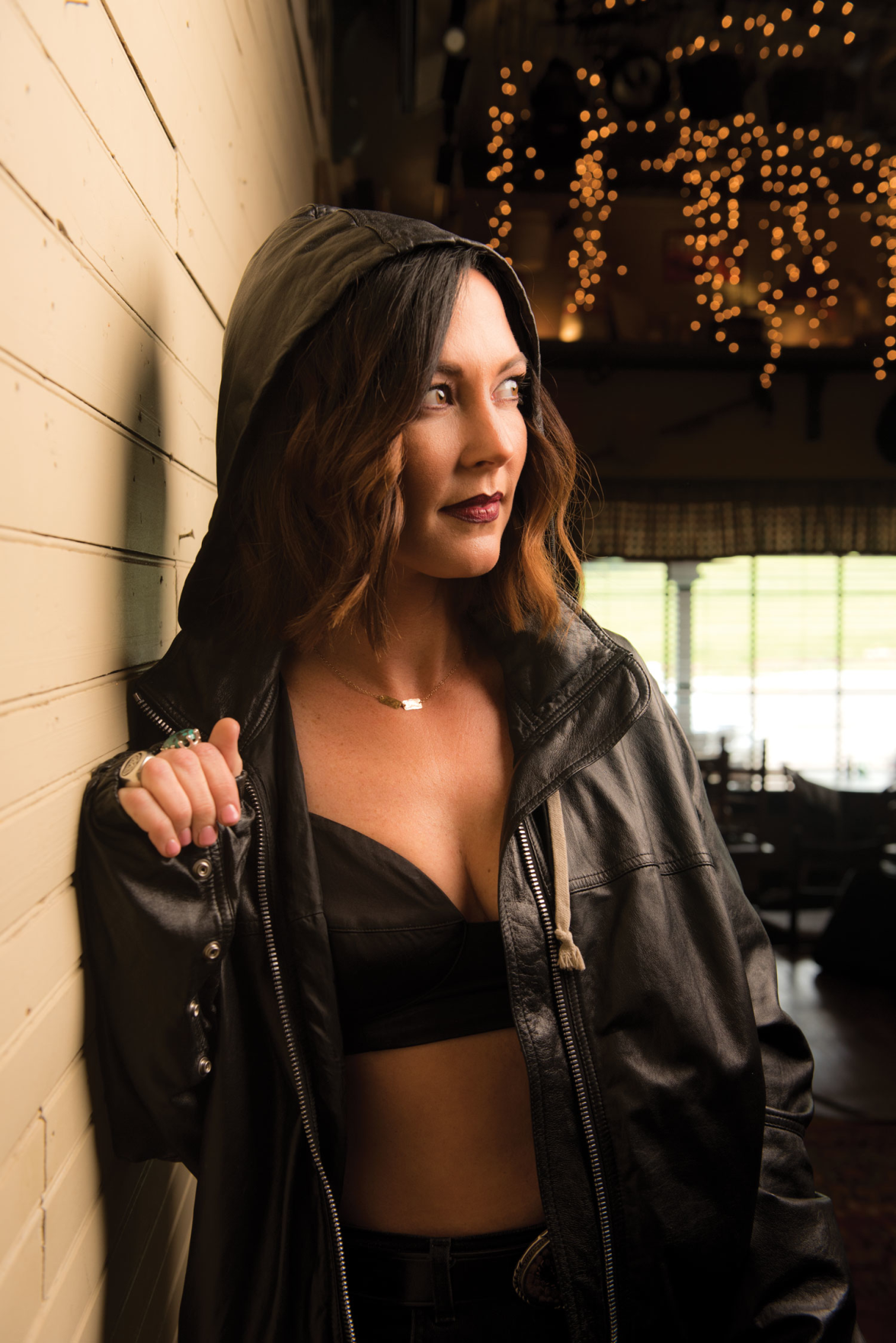
Amanda Shires at Green’s Grocery in Leiper’s Fork
You recently received your master’s in poetry. I can imagine all the ways poetry goes into your songwriting in terms of writing lyrics. Are we going to get a book of poetry from you?
Yeah, definitely. I’m having one published this next year. ... They didn’t even know that I was a songwriter, so I got accepted on just my poetry, so that was pretty sweet, kick-ass as hell. Because poetry is a really hard thing, and there’s so many greats that sometimes, like with songwriting, you just want to throw all your papers down and just say, “I’m going to go be an electrician or something that’s more stable.” But poetry really, I like the lens. It’s so small, and you can say a lot with very few things, and it takes time to read poetry. I like the fact that it takes time, you have to think about it. You sit in your chair, you have to read a line, you still don’t get it, you have to reread it and think some more.
It’s the antithesis of our culture right now in so many ways. You won’t be able to successfully read poetry if you’re checking your phone every two minutes.
And it helps you to reconnect with yourself, that kind of quiet and listening to your own thoughts. Most people are just too afraid to be in their room with their own selves without their phones. What would they do? You would look inward and figure out you had some things to fix. Nobody wants to do that.
Speaking about the way you and Jason write differently, I know you co-wrote “Anxiety” from his album The Nashville Sound. I wonder if you could talk about your role in that.
Well, I have had issues with anxiety ... so I brought to the table just my natural gift of panic and anxiety and exercises that I do to combat those things. Just a different perspective, because everybody has anxiety and worries and whatever, but just different extremes and different manifestations. And so I just brought another voice.
In terms of your music, have you turned the corner yet to go, “OK, some of these things I’m working on are starting to come together into something new”?
That’s what I’m feeling. ... My other records, I felt like, “I gotta do this, I gotta do it this way or think of things like this,” and this time I’m just like, “I-D-give-a-fuck.” I’m going to do what I’m going to do, as weird and maybe not commercial as it is, and it doesn’t fucking matter, because whoever dies happiest wins.
It’s funny you say that right after talking about anxiety. Where does that confidence come from?
I think it comes from growing up, I guess. I’m like, 35. I think it comes from growing up, and really paying attention to living in the moment. That’s a big deal with Jason and sobriety, and I think that some of the lessons he’s learned and preached to himself are rubbing off on me — in a good way, obviously. Just to be conscious of your — to get all fucking hippie on you, pay attention to each breath, try to remember, if you pay attention to one breath, it’s like enough time [pauses]
Mindfulness.
Mindfulness, yeah.
You organized a voter-registration event in May. What motivated you to do that?
It wasn’t a thing about parties, [that] didn’t matter. To me, it’s about participation. The parties like to take polls and stations and make things hard for one side or another. And [it’s also about] awareness. I think the whole deal for me was like to try and bring awareness that, you know, they don’t make it [easy] for single women or minorities to exercise their right to vote. So it doesn’t matter who you vote for, but everybody should have the same amount of ease to be able to. I think — make it a holiday or something, get a paid day of holiday, I don’t know. I wanted to bring some awareness to the fact that we need to do more about that, and that was a way I could help. ... And again, we didn’t have to talk about politics, because it was — sometimes you don’t want to know who voted for Trump, you just might lose it. I think everybody I know — I know one person that voted for him, I just can’t. It’s OK, it’s OK, she regrets it now.
I just mean is that a discussion that you’ve had or is that something you avoid?
Yeah. Some people just bought all that, “Everybody’s going to give me $20,000,” or whatever rumors there were. And a lot of people, their parents vote a certain way, so it’s what they’re expected to do.
Earlier, you mentioned thinking in images, and you just put out a video for “Harmless,” which has a striking relationship between the lyrics and the visual. What can you tell me about where that song came from?
OK, so, whether you’re married or have a boyfriend or whatever, some couples aren’t allowed to talk about, “Oh, I saw somebody that I think’s attractive.” “Look at that girl, she looks cute.” “Look at that guy, he’s hot.” Or, “This guy totally just gave me a compliment — it was awesome.” A lot of people get all jealous about that. Then there’s times when you meet somebody and you can talk to them, and they can talk to you, and it is weird, and it’s a chemistry. And it’s not because you’re looking for it, and then you’re in the position of, “Am I going to see what else is up?” And then past that, what happens? It’s an exploration of that. That may or may not have happened to me.
I understand what you mean, and that comes across. Jason also just released a video by Joshua Britt and Neilson Hubbard, the same duo who made the “Harmless” video. How did that collaboration come about?
I was talking to Joshua Britt in the studio when I was telling him about how I needed a video. I don’t have a manager, so I’m just always talking to other people about stuff. And I don’t know why I can’t get a manager. [Sighs] It’s probably because I’m not available. That’s all women’s problems: If they know that you’re married and you have a kid, then you’re not available. Different tangent.
Let’s go there. When was the last time you had a manager?
Six months ago, but I’ve only ever had two in my whole life. One I had for six months, and [another] one I had for six months.
In your experience, is that a relationship that can be fraught with those sort of gender issues?
Yes, definitely. Nobody wants to have an artist that is pregnant. I don’t see many people who are like, “Oh, she’s probably going to go home, and stay at home and eat bonbons all day.” I don’t know. Until pop culture and Beyoncé and all this stuff, you couldn’t sell that. ... You have to sell somebody with a six-pack or nine-pack of abs, that’s flirty and kind of a ding-dong.
There’s this whole cultural thing of how famous women would go away in private and re-emerge with the child. It’s like pregnancy didn’t happen for famous people.
Yeah, exactly, so weird. But it doesn’t take that long to have a baby, you just kind of grow it in your belly, and then you go have your baby and then you take your baby on the road with you. No big deal.
It’s about the time length of an album cycle right? Nine months.
So, if a guy can’t imagine himself with you, then your product can’t be sold.
I don’t even have anything to say because it’s so —
Leonardo DiCaprio, he still hasn’t gotten married. I’m just trying to change the subject. I heard he was getting back together with Kate Winslet, though. Jason read me the news last night.
OK, so I was going to ask you about that, so we can just ask you now.
I know that that’s a great series, because I’m a critic.
It is a great idea for a series. Will we ever get that the way Jerry Seinfeld does Comedians in Cars Getting Coffee?
Yeah, if anybody wants to donate their time and talent to audio and visual situations.
That sounds like a Netflix series to me, or maybe a YouTube series.
Yeah, I love it. But you asked me a question when I went off that tangent.
You were talking about how, because you don’t have a manager, you were having to talk to Joshua to coordinate the video.
I never know if any of my ideas are good or shitty, so I just try them out. But I told Joshua the only video I ever liked that represented my music was one for this song called “Ghostbird.” And I was asking him if he did animation, and he said he’s been experimenting with it a little bit, and I said, “Do you think you can do one for ‘Harmless’?” And he said, “I’ll give it a whirl.” And one thing led to another, and then we have a beautiful, beautiful video.
Is that something you think you’ll want to do for another song on that record?
Honestly, I’d like to just do all animation videos. So if you guys want to help me with that, you can too. Just taking an audience poll now, I guess. Y’all step in and help me out, all you readers and listeners.
Speaking of readers, what are you reading?
I started to read that Hillbilly Elegy, but then I put it down. … I think the problem with me is that I am looking for a different thing to read right now ... because I’m going to read it. That was the one I just put down, and I’ve been reading my 1956 dictionary mostly.
For writing purposes, I gather?
Yeah, to build up my precision, because it takes the right word and to try and not use things that have more recently become clichéd. The older dictionaries have words that you’ve forgotten that are helpful. And I’ve been reading The Vegetable Gardener’s Bible, because I’ve been having a garden. It’s amazing.
What are you growing?
Everything. Cucumbers, a lot of tomatoes. It’s basically just a tomato garden, there’s like 19 types of tomatoes, and I got them from heirloom seeds. And I’m also growing butterflies. It’s because I’ve planted a shit-ton of heirloom zinnias and milkweed. I’m growing basil and peppermint because I like to make simple syrup and put it in my mojito. And I’ve got a gigantic watermelon. I built this hammock out of pantyhose, and so they all are up off the ground.
Your vegetables have a hammock for themselves?
Yes, isn’t that funny? Kind of like a banana hammock, but for a watermelon. So they’re my tights from tour that ripped because Velcro is everywhere on stage for some reason. And so I saved them up, and I had this idea I could get this watermelon vine up off the ground so I could plant shady things under it like arugula and spinach. So I’ve tied stakes, and there’s pantyhose all over, cradling watermelons. It’s beautiful.
It strikes me that gardening is a little bit like poetry and writing, in that it doesn’t have to be solitary, but it’s sort of quiet work.
It’s an endless task.
You can’t do it for five minutes and let it all go. You gotta come back to it. Do you feel like you’re attracted to things like that, or did you have to cultivate that feeling in yourself?
Nope, I’m attracted to things like that. I think that on the road, there’s so much movement and inertia. I tend to compartmentalize, I guess. So I think in that headspace, and I accept that headspace when I’m on the road, but I refuse it when I’m at home. I live in a house where we don’t get Internet. If we want to send witty tweets into the air —
Which you do.
I don’t, I’m not as good as my husband. But we come to Green’s Grocery and we send our tweets into air.
Interesting. So this is where the magic happens, where we’re sitting right now?
Exactly. Sometimes we can send them from a block in one of these other directions, like at that Shell station down there.
And the decision not to have internet is about that same thing, right?
No, we have it.
Oh, you have it and it just doesn’t work — it’s not like a conscious thing you’ve decided to go without?
Well, we kind of have now, though. We have that satellite dish TV thing, it’s not worth a damn. … We can watch our computers, we can download Netflix if we go down the street, and download some shows and whatever, but we’ll plan for that. But it’s really nice to live like this. It seems crazy, but we’re not home that much, so when we’re home, we’re home. And then I’m like, “Sorry, you can call my landline,” because we have one of those. We’re home this week, and we were home last week. And two of those days, I went to New York, and we go back on the road for six weeks. So it’s nice to do what we’re doing, and kind of leave it like that.
You mentioned earlier that when you were making My Piece of Land, there was this feeling of, “Am I going to lose my artistic identity?” And, I imagine, part of your personal identity. A year later, you’re working on new songs and you have an almost 2-year-old daughter. How do you feel? How’s it going?
It’s going great. If I could tell myself some stuff that I didn’t know then, as we all want to do all the time, the thing about having a child is that your attention to detail gets so much bigger. But even seeing her see her shadow for the first time, like the things that you don’t appreciate, you sort of appreciate again. She’s really into putting water in one cup, and then having a lot of cups, and putting them back and forth. I was like, “It is amazing, it’s pretty amazing.” She’s like a person that reminds you of all the tiniest things all the time. And she’s not scared of bugs, so it’s really entertaining for me to test her boundaries and her limits. So the identity thing ... having kids, I think for me ... makes me know the answer to questions sooner. Sometimes I get all in my head and I think, “This person’s asking me this for, like, some manipulative reason,” or something. I don’t do that anymore — [phone alarm goes off]
What song is that?
[Rocko Feat. Future and Rick Ross] “You Don’t Even Know It.” It’s so good. He says something like, “I don’t like snakes, keep my grass mowed so low, can’t even mow it.”
OK. Having kids, details, clarity — you have less time to yourself to overanalyze and overthink things, really. That’s basically what I was trying to say before that song came on. It’s just one more thing that makes you more intentional, and also it’s like being in love with somebody and the newness never wearing off.
That’s a great place to end, I think.
Awesome. If you have any other questions you can just text me, because I don’t have a manager.




