
Iggy's Pop
By the time we made it to Vanderbilt's annual Commodore Quake — beset by the sucking hellscape of Vanderbilt parking and Predators traffic — R&B crooner Jeremih was already onstage, warming up the crowd with slow jams about doin' it. Or at least we're pretty sure that's what those songs are about; we couldn't make out a damn thing he was singing. Memorial Gymnasium, a building typically used for Vanderbilt basketball games and the occasional graduation ceremony, has all the acoustic resonance of an abandoned well. Jeremih's smooth pop music was swallowed whole by the woefully undersold arena, getting trapped in a deserted third tier. We did hear him sing, "If you're sexy and you know it, clap your hands," though. We kinda wish we hadn't.
In any case, Jeremih was fine. He may not have the hipster cachet of Frank Ocean, and "Birthday Sex" isn't exactly the most brilliant song ever written, but he has a charisma and swagger that suited the warm-up slot well. If nothing else, it made more sense than the two-fisted snoozefest of Brett Dennan and Guster before Kanye West at the 2008 Quake, or the inexplicable Trey Songz/My Morning Jacket bill in 2011.
"Everybody is 19," said a girl in the row in front of us. "I know it's a Vanderbilt event, but holy shit, there are so many crop tops."
This woman, a post-college medical professional, was there to see Iggy Azalea. Most people were there for Iggy Azalea. "Fancy," the song of summer '14, made the 24-year-old a household name, provided everyone in your household is younger than, say, 30. Along with Nicki Minaj, she is ushering in a new era of women in hip-hop. But despite her pioneering, Azalea takes a large amount of criticism, mostly because of a perceived posturing. True, a certain level of posturing about wealth and sexual prowess is central to hip-hop, but Azalea adds another layer. White and Australian with a discernible Aussie accent, she nevertheless raps in a Southern drawl, having lived in the South since age 16, including Miami and Atlanta. Debate on cultural appropriation is a central story with Azalea.
The girls in front of us, before Azalea took the stage, were convinced that it was total bullshit that Azalea wasn't headlining. What about Ludacris being a national name since 2000's "Back for the First Time," or the fact that he's arguably had success parlaying his musical achievements into an acting career, most notably with the Fast and Furious franchise?
"Since Paul Walker died we don't give a fuck," one said.
At 8:55, DJ Wizz Kidd spun Azalea's first track, and out strutted Iggy in hot pants and a crop top, flanked by four backup dancers in black-and-white harlequin one-pieces. Her blond hair was pulled back in a long ponytail, and during the third song of the set, Azalea turned her back to the crowd and allowed her famously disproportionate ass to take a solo. Her ass was not very loud, but moved well enough, eliciting quite a roar from the crowd. Azalea's flow, often criticized for its studied, un-flow-y nature, was more than anything unmemorable. She has become a very large symbol of women's empowerment in a largely male-dominated genre, and whether or not she's worth a damn has become irrelevant to her fans, aka Azaleans. The rumor that she uses ghostwriters for her rhymes is moot. Azalea seems swept along by momentum, and from start to finish she is the complete package of swagger without any real backbone. There was a T-shirt gun at one point and "Fancy" to close the set, and glitter fell from the ceiling, adhering to coeds' faces and bare shoulders and arms.
At 10:30, Ludacris took the stage and immediately answered the question of why he was headlining over Azalea: Ludacris can flow at any speed, but at the top end, he is staggering. It doesn't matter that he's done more acting than rapping since his last release, 2010's Battle of the Sexes; he is as deft as ever. "Southern Hospitality," one of his many, many hits, immediately got the crowd moving. His live show included both drums and DJ, along with guitar, bass, sax, keys and some odd-looking middle-aged man in a suit and tie with a concerned look on his face patrolling behind the main performance area. Bodyguard? He did not speak.
After everyone had ingested a good dose of chart-toppers, Ludacris broke for a DJ set before resuming the hit parade through the later part of his career. "All I Do Is Win," a DJ Khaled track he rapped on along with Snoop Dogg, T.I. and Rick Ross, began the closing portion of the evening, followed by "Move Bitch" and "Get Back." After his final song, Ludacris took off his shirt — looks like he's been working out for Fast 7 — and threw it into the crowd. There was no encore. There couldn't be. Next year will be a year that you want to forget Ludacris thanks to a godawful movie and a rumored new record. But this year is one to remember.
Miner Threat
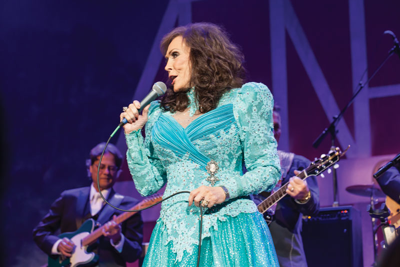
As Loretta Lynn's son Ernest Ray Lynn was warming up the crowd at the Ryman Friday night with a spirited but rather tongue-in-cheek version of "Mama Tried," a roar of approval burst forth from the right side of the auditorium. The catalyst was the glittering appearance of Ernest Ray's mama in the wings of the Ryman stage, dressed in her full Country Music Princess regalia. It was a moment that spoke of the love that filled the Mother Church that night, the first of a two-night stand. It's a love that includes family and fans and is powered by the Coal Country Cinderella story that began over five decades ago.
Before that roar, the evening began with a crackling set from Brandy Clark. Accompanied by her guitarist Forrest Whitehead, Clark's all-acoustic set spotlighted her feisty, story-driven songwriting and strong vocals that immediately demonstrated how her music was nurtured in the long shadow of Loretta Lynn's legacy. Clark delivered audience-pleasers like "Crazy Women," "Hold My Hand" and "Stripes," drawing material from her successful debut album, 12 Stories, along with hit songs she penned for others — "Mama's Broken Heart" (for Miranda Lambert) and "Better Dig Two" (for The Band Perry). Her tale of a dope-smoking housewife and mother, "Get High," drew an especially long toke of approval from the audience.
After Clark finished her 30-minute set, Loretta Lynn's daughter, Patsy Lynn Russell, took the stage to welcome the crowd. Patsy followed the old-time country music tradition of a little pre-show shilling with plugs for Loretta Lynn's Ranch and Campgrounds in Hurricane Mills and the special merchandise for sale at the show (available in the lobby from Loretta's own grandsons). Sharing the hard-to-believe info that the audience was about to witness her mama's first-ever headlining appearance at the Ryman, Patsy also shared that Loretta was quite likely to refer to the Ryman as the "Grand Ole Opry." It was a tasty tidbit that explained the presence of the traditional Opry barn backdrop that filled the back of the stage.
Building on the family theme of the evening, Patsy introduced her brother Ernest Ray and the "adopted" family of Loretta Lynn's anthracitic accompanists, The Coal Miners. After a pair of country covers from Ernest and the boys, the 82-year-old Loretta took center stage, greeted by a standing ovation. She immediately launched into her 1974 hit "They Don't Make 'Em Like My Daddy Anymore." She then continued on in fine form with her truth-in-packaging anthem "You're Lookin' at Country," slowing things down a bit for the emotion-packed "When the Tingle Becomes a Chill" and "Blue Kentucky Girl," and then revving the crowd up with feisty classics, "I Wanna Be Free" and "You Ain't Woman Enough (To Take My Man)."
Through the first several songs Loretta was in fine voice. Her patented charm machine was hitting on all cylinders — exchanging quips with Ernest, spinning quick anecdotes from her long career and greeting every shout of, "We love you, Loretta!" with a, "Well, I love you too, honey." Along with the memories and snappy repartee, Loretta mentioned she was battling a cold and near the end of a rousing rendition of "Fist City" her voice momentarily gave out. With her energy level clearly ebbing a bit, a chair was brought onstage. Mentioning that her back was hurting, she deflected any worries with a cheerful, "Y'all are sitting down, so I can too."
Lynn then continued with a pair of tributes to departed friends — Patsy Cline's "She's Got You" and a moving duet with rhythm guitarist and vocalist Bart Hansen, the 1971 No. 1 Loretta/Conway hit "Lead Me On." Hansen then took the lead for the Ray Price country shuffle classic "Crazy Arms" while Loretta rested, enjoying the music of The Coal Miners like a proud mother watching her children entertain. After her breather, Loretta soldiered on through a string of her biggest hits: "One's on the Way," "The Pill," "Honky Tonk Girl," "Your Squaw Is on the Warpath" and a particularly moving rendition of her 1966 costs-of-war heartbreaker "Dear Uncle Sam." Although Loretta continued to charm and entertain, it was clear she was tiring. When the band kicked off "Don't Come Home A Drinkin' (With Lovin' on Your Mind)," she hopped in with the lyrics for "Fist City." Once she realized her mistake, she passed off the error with good humor.
The spotlight then swung to the Coal Miners again as pianist Craig Morris, backup vocalist Lee Hilliard and bassist Michael Lusk took center stage for three-part harmony on "The House at the End of the Road," originally recorded by Morris and Hilliard's former band 4 Runner, and a crowd-pleasing — or time-wasting — version of the ever-divisive Eagles' "Peaceful Easy Feeling."
Lynn then took the lead for a medley of her classic gospel tunes, "Everybody Wants to Go to Heaven," "Who Says God is Dead" and "Where No One Stands Alone." Clearly tired but determined to end the evening in style, she delivered her autobiographical "Coal Miner's Daughter," quickly leaving the stage with assistance as the audience rose for a standing ovation. A roar followed, cheers for a simple Coal Miner's Daughter, a gifted songwriter, charismatic performer and a homespun country Cinderella.
Email thespin@nashvillescene.com.



