
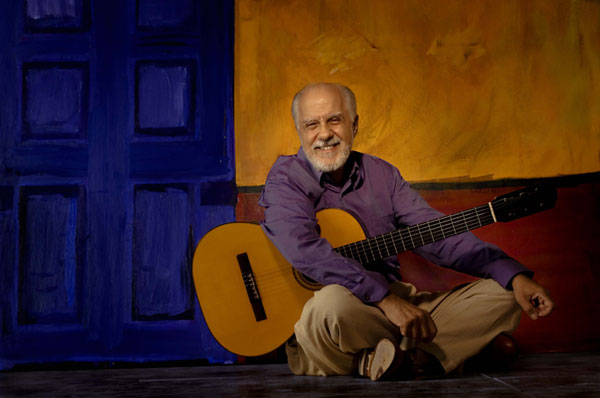
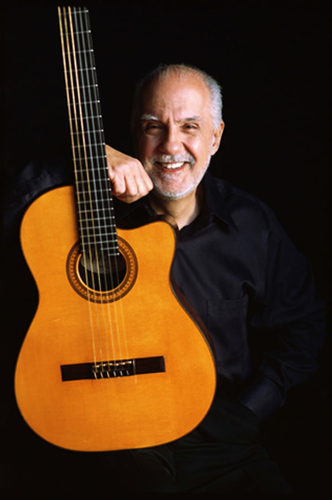

The famed guitarist, producer, composer, arranger and multi-instrumentalist Oscar Castro-Neves has appeared all over the world, and been an international sensation since the age of 16. His first song "Chora Tua Tristeza" was among the earliest breakout tunes of the lush, romantic Brazilian genre known as bossa nova — featuring a lighter, less frenzied but still hypnotic flowing rhythm. But as storied a history as he's been part of, and as well-traveled as he may be, Castro-Neves' voice lights up when he talks about his upcoming weekend residency at the Nashville Jazz Workshop.
"It's even a surprise to me, but I've never been to Nashville," Castro-Neves says. "That's a city that you just associate with music, and I can't wait to get there. I've heard so much about it, and am really excited to know you have a place there where jazz and Latin music are being celebrated and performed and taught. It's going to be a very exciting weekend."
Castro-Neves' long and influential impact on bossa nova is directly linked to his equally extensive relationship with Antonio Carlos Jobim, whom he met as a teenager.
"Times were a lot more innocent then," Castro-Neves recalls. "His number was listed, and I just called him up. I was playing in a band then with my brothers [pianist Mario, bassist Iko and drummer Leo], and he knew our music. He says, 'Sure, I'll be glad to play with you,' and we ended up just getting together and playing music in a very relaxed, almost kind of jam session environment. At that time, he was 40 and I was 16, so the relationship was a lot different. Over the years we became closer and by the time he died [at 67] I was much older, and my experiences were such that even though the mentor relationship was always there, we'd had a lot of collaborations and done arrangements together, and just gotten closer, both musically and personally."
Besides the smash single "Chora Tua Tristeza," which has been covered more than 50 times by both Brazilian and American musicians, Castro-Neves' proficiency on the cavaquinho (a smaller Brazilian acoustic guitar) as well as the classical guitar and piano, coupled with his extensive studies of other musical styles, helped him contribute to the bossa nova takeover of the United States in the early '60s. Castro-Neves participated in the seminal 1961 Brazilian Carnegie Hall concert, an event that preceded by a year the success of Stan Getz and Astrud Gilberto's "Girl From Ipanema." He freely admits he doesn't remember much about that night.
"I was running around so much that things were like a blur," Castro-Nieves says. "We knew it was an important night. American jazz musicians had been coming to Rio for quite a while and listening to the records, working with the musicians and telling us they thought people back home would really love the music. But none of us were really sure until that night. The reaction was intense and we were thrilled. Then, of course, after Stan had that big record, things really exploded."
Castro-Neves helped further popularize the Brazilian sound domestically before returning to Rio, where he stayed until 1971, when he relocated to his current Los Angeles residence.
Still, while the bossa nova has a sensual, soothing side, it's also very much in line with Brazil's rhythmic tradition, one Castro-Neves traces directly back to Africa.
"When you talk about bossa nova or samba or the sounds of other Latin nations like bolero or son, you trace it all back to mother Africa, because that's where the rhythm comes from. You take that rhythm, and then you mix with harmonies from other places like Europe, and that's where you get the bossa nova. I was drawn to the music of Charlie Parker and Debussy, jazz and classical, and later pop and the blues. We worked all those influences into the bossa nova, but that African rhythm and those European harmonies are the central element."
The list of Castro-Neves' achievements over the last four decades and continuing into the present is extraordinary. He served as principal guitarist and music director for Sergio Mendes' Brasil '66, was a key member of Paul Winter's Consort in both the '60s and '70s, toured and performed with Dizzy Gillespie, Stan Getz, Lalo Schifrin and Laurindo Almeida (among many others), or produced and/or wrote acclaimed albums and songs for Sarah Vaughan, Joe Henderson, Michael Jackson, Barbara Streisand and Stevie Wonder. He's also contributed to PBS specials, soundtracks and special events celebrating the work of the masters he's known such as Dorival Caymmi and Marcus Vinicius de Moraes. Castro-Neves has even found time over the years to do several LPs, each one often covering material ranging from Wes Montgomery to Jobim, from folk to pop to classical. In short, Castro-Neves has been a mainstay in keeping the Brazilian sound a vital part of the American music scene.
With a new album coming soon, Castro-Neves cites one musical goal that he’s never found time to tackle as a composer: “I would love to sit down and write some classical concertos, some things very much like what I used to listen to growing up,” he says. “It’s a style of writing that I don’t do as much, even though I certainly love that sound. It won’t probably be something that happens right away, but I am really interested in doing that very soon.”
The Nashville Castro-Neves fest kicks off Friday night, with a concert teaming him with NJW co-founder Lori Mechem and the band Ritmos Picantes. They will perform not only Castro-Neves classics but other anthems from equally vital Brazilian composers like Antonio Carlos Jobim and Vinicius de Moraes. There will be a free Young People’s Concert on Saturday at 10 a.m., and the evening concert will be an intimate solo presentation, with Castro-Neves not only providing the music but discussing his career, influences and various exploits in a program billed “Celebrating 50 Years of Bossa Nova.”
On Sunday, the residency concludes with Castro-Neves conducting an open rehearsal with the NJW’s ensemble in residence Samba Nove. Veteran jazz broadcaster and journalist Maxx Myrick will interview Castro-Neves for a future program to be presented on the NJW’s Internet radio station (www.nashvillejazzradio.com).
Email music@nashvillescene.com.



