
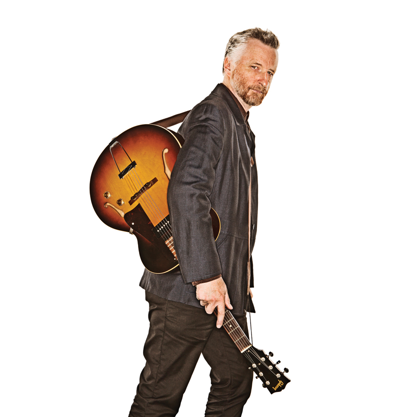

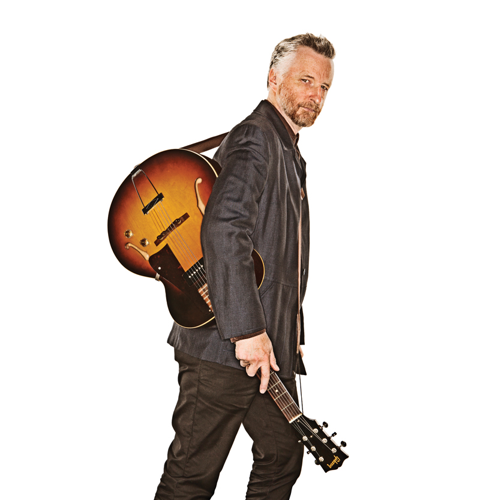
Rock fans and pundits who categorically pigeonhole Billy Bragg as a protest singer have probably never seen the cockney-voiced folk-punk troubadour perform "Tank Park Salute," a song about losing his father at age 18. Every night, audiences listen in silence, many moved to tears, when Bragg sings it.
"That song has much more effect on [people] than anything I sing politically," Bragg tells the Scene. "Sometimes when I'm playing it I think, 'And I'm just supposed to be a political songwriter.' " It's a distinction he's more come to terms with than embraced.
"That's the heartbreak, really," Bragg says, "that because I do write political songs and I don't make any bones about it — I'm happy to talk about it and I accept the label of 'political songwriter' — but unfortunately it allows some people who aren't familiar with my work to dismiss me as a political songwriter. ... I have to do things sometimes that set out specifically to counter that question."
The true theme throughout Bragg's three-decade-spanning catalog is compassion — or as he called it in his 1996 blue-eyed-soul stomper "Upfield," "socialism of the heart." "The socialism I believe in is, at heart, a form of organized compassion," he says. "It's a socialism that educates people for free; it's a socialism that provides health care to people for free; it's a socialism that provides affordable housing and pensions. It doesn't necessitate the abolition of capitalism."
Bragg did, however, have economics on the brain with Tooth & Nail, his first proper LP in five years. "Records to me, I'll be honest with you, have been a bit of a chore for the last 15 years — [they] take a long time; cost a lot of money; you lose focus sometimes — and I wasn't really looking forward to that."
To cut costs and maintain focus, Bragg recorded the album with Grammy-winning Americana producer Joe Henry in a marathon five-day session at Henry's home studio in California. As a result, Tooth & Nail's acoustic-based, sparingly arranged gospel-blues-folk set has a casual air that suits its light-at-the-end-of-the-tunnel ruminations. Lyrically, the album leans more to the personal than the political. "It addresses deeper emotions," Bragg says of the record, which he wrote in the wake of his mother's sudden death. "I was in a very reflective mode. ... The record isn't about [losing her], in that sense, but it became the means by which I moved on from that."
As a songwriter and activist, Bragg always strives to frame his humanist worldview in terms of emotional struggles, heartache and love, combining the personal with the political. "If I can write a song that covers both those areas and overlaps, then I think I'm doing really well," he says, offering "I Keep Faith" from 2008's Mr. Love & Justice as an example.
"If you want that to be about you and your partner, then I'm really happy about that," Bragg says, "because one of the verses is about my partner. If you want that to be about keeping faith in changing the world, I'm happy with that. But when I play it live, I talk explicitly about my faith in the ability of the audience to make a difference."
When Bragg does don the hat of "political songwriter," however, he knows he's preaching to the choir, and even makes a case for it.
"Songs don't change the world," Bragg says. "People change the world. Martin Luther King Jr. didn't march to Washington because he heard Bob Dylan write 'The Times They Are a-Changin'.' Bob Dylan wrote 'The Times They Are a-Changin' ' because he heard Martin Luther King Jr. and other voices from the civil rights movement.
"You're nothing more than a mirror, or a lightning rod," Bragg continues. "Your job is to leave the audience feeling that they're not the only person in their town that cares about this issue. ... You may be preaching to the choir, but you're also making them feel as if they're not alone in their town."
Bragg's appearance at The Belcourt reflects a post-Napster paradigm shift — one that brings singer-songwriters like Emmylou Harris, Richard Thompson, Steve Earle and himself before attentive audiences who might not own their albums.
"A lot of small towns in the U.S. that we didn't used to go to because they didn't have a college, now have a refurbished old cinema where people — sometimes through subscription — are happy to come and see whoever's on, because they just like live music," Bragg explains. "That seems to me to be a phenomenon that's popped up in the last 15 years, and I think that's really healthy, and I'm really happy playing for those people, because they know their stuff."
"There's clearly an audience out there for what I do," Bragg observes, citing a recent run of sold-out shows in Australia. "It's whether or not that audience wants to buy new records, or whether I get stuck in that kind of 'Rolling Stones playing the old catalog' thing. I don't want to do that. I still think I've got something to say. I still think I've got something to prove, and I'm willing to put my money down and roll the dice."
Email Music@nashvillescene.com.



