
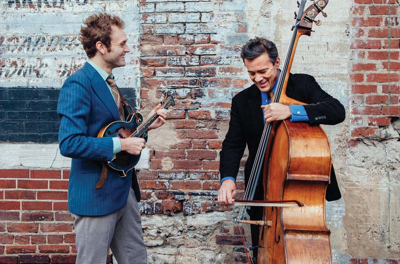

"It was not important to me that our second album be different from the first," says Edgar Meyer. "The musical conversation that Chris and I started six years ago is one I'd be happy to continue for a very long time."
Meyer, the celebrated composer and double-bass player, is on the phone from Seattle, where he is getting ready to perform music from Bass & Mandolin, his latest album with mandolinist Chris Thile. Many of Meyer and Thile's diehard fans have noted that the new disc, released earlier this month on Nonesuch Records, is far more lyrical than the duo's eponymous 2008 album. That observation is correct, Meyer concedes, but it's also beside the point.
"It's true that we didn't aggressively pursue every abstraction this time," says Meyer, who appears in a sold-out show with Thile on Tuesday at Blair's Ingram Hall. "But the new album, even if it is different, is still part of the same ongoing musical conversation."
In fact, Bass & Mandolin is part of a musical discussion that dates back nearly 20 years, to Meyer's earliest crossover recordings with cellist Yo-Yo Ma, violinist Mark O'Connor, banjoist Béla Fleck and mandolinist Mike Marshall.
On such albums as 1996's Appalachia Waltz and 1997's Uncommon Ritual, Meyer & Co. pioneered a style of music that was neither classical nor bluegrass, but which borrowed freely from both styles. The result was music that was seemingly sophisticated but folksy, traditional but sounding somehow new. It proved to be the perfect soundtrack for the Whole Foods-shopping, Subaru-driving fans of All Things Considered.
These early albums were also hugely influential in the development of the California-born Thile. As a teen, he found Uncommon Ritual to be a revelation, and he spent countless hours listening to it and learning all of its songs. About a year after that disc was released, Thile finally met his hero Meyer at the RockyGrass Festival in Colorado. Thile was so thrilled to meet a kindred spirit — a fellow musician fluent in both classical and bluegrass — that he just began blathering about Mozart quartets. Meyer recalls being deeply impressed with Thile's energy and enthusiasm.
"Although he was about 17 and I was about 37 at the time, Chris and I had a lot of the same musical acquaintances, and so I already knew a little bit about him," says Meyer. "He was ambitious, and even as a teen he was not interested in being pigeonholed as a bluegrass player or any other kind of specialist. As musicians, we immediately clicked."
About a decade later, Meyer and Thile walked into a studio to record their first dozen duets on the album Edgar Meyer & Chris Thile. Meyer's fans found this music, with its rigorous architecture and drama, to be welcome and familiar. Meyer, after all, had already established his classical bona fides, having composed music for such noted performers as Ma, Joshua Bell and Hilary Hahn.
For Thile's fans, who were accustomed to the accessibility of the mandolinist's playing with his progressive bluegrass band Punch Brothers, the album was more of a departure. Nevertheless, they couldn't help but admire the effortless virtuosity and spontaneous give-and-take of the two musicians. It also whetted their appetites for Meyer and Thile's next venture, 2011's The Goat Rodeo Sessions, a collaboration with Ma and violinist Stuart Duncan. That album garnered a Grammy Award for Best Folk Album.
Recorded earlier this year at Skywalker Sound in Marin County, Calif., Bass & Mandolin flows naturally and logically from The Goat Rodeo Sessions. The abstract instrumental passages of 2007's Edgar Meyer & Chris Thile are still apparent, but this time, as on Goat Rodeo, they share equal time with heartfelt lyricism.
Most of the 10 songs on the new album are first takes, which makes Meyer and Thile's breathtaking virtuosity seem all the more remarkable. In the appropriately named and fiendishly difficult "Tarnation," for instance, the two toss fleet-fingered passages back and forth at breakneck speeds.
All 10 songs are adventurous explorations of range, with Meyer often playing melancholy melodies in his instrument's creamy cello register. On songs like "Look What I Found" and "Friday," Meyer plays piano and Thile strums guitar, adding color and rich texture to what otherwise would have been a homogenous-sounding album.
Throughout the album, the duo's playing dovetails so seamlessly that they seem to be communicating on a different level, as if through some kind of musical telepathy. That should surprise no one, says Meyer. Both musicians grew up the sons of bass players, and both were weaned on the same music. "We're just living our fathers' dreams," says Meyer.
Email music@nashvillescene.com.



