
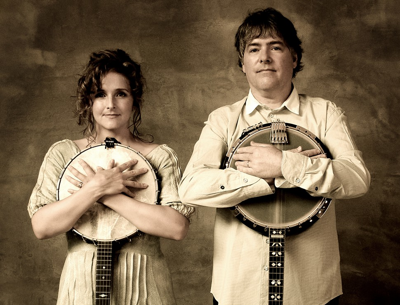


They've played together for over a decade, and been married nearly as long, but banjo masters Béla Fleck and Abigail Washburn released their first album as a duo just last month. In their individual careers and in their previous work — both individually and together, in The Sparrow Quartet — the pair have put a banjo-plucked spin on genres ranging from Chinese folk to jazz. This eponymous effort leans toward old-time Appalachian music, partly because they had a lot of it in their repertoire, and started working on the album shortly after the birth of their son Juno late last year, when time was a precious commodity.
Tomorrow night Fleck and Washburn play the Country Music Hall of Fame and Museum's CMA Theater. In advance of the show, the duo talks to the Cream about a pair of murder ballads from the album — the classic folk standard "Pretty Polly" and "Shotgun Blues," a Washburn original with an interesting twist.
Take a listen to both and read our interview after the jump.
Abigail Washburn: I think they’re an early form of the horror movie, back before TV and video or even radio, it was a really great way to tell a scary story. Some of the murder ballads are even tales of warning, especially for children.
Béla Fleck: Or to scare girls, to make them very, very careful about who they walk off with. Parents are certainly going to be all about that.
AW: Yeah, they have a lot of different purposes. Some of them are just plain old gory, and some of them really are lessons — “If you marry a jealous man, you might have to deal with this, or if you play in the woods alone, you might be caught by a witch and she might offer you candy and kill you,” you know? Those are definitely a part of a tradition.
What made you want to write your own murder ballad and turn it around the way you do in “Shotgun Blues”? Whose idea was it?
AW: Both Béla and I have been playing murder ballads a long time as part of our love of old-time and bluegrass music. That whole tradition isn’t unique to either of us. We had just gotten a cello banjo, which is about an octave lower than our normal banjos. It’s got a deep, resonant, intense sound to it. I thought “Oh, this would be so cool to play a funk riff on,” but I didn’t know how. Béla showed me some possibilities, and the riff that I came up with after he guided me is what became the foundation for “Shotgun Blues.” I also listened to an old blues from the ‘30s, also called “Shotgun Blues,” that was about this guy killing his woman for doing the wrong thing, ‘cause he was jealous. That got me thinking about how it’s always the woman that gets killed in a murder ballad, and I thought it would be nice to turn the tables around — a revenge song against all those nasty old men.
BF: Abby being a gentler kind of person, doesn’t actually kill anybody in the song. It’s more of a dire warning.
AW: It’s a tormenting! [laughs]
What made you want to not do away with him?
BF: She’s from the Midwest, she’s real nice.
AW: [laughs] I come from a family of real optimists — not that the song’s real optimistic — I have this belief that if you really guilt a person enough or shame them enough, they will come around. Or, if you think about it in worse terms, I want to torment him to his death rather than actually kill him, just let him live and be tormented and afraid.
This is the first time that just the two of you have made a record together. (Previously, they recorded and toured with Ben Sollee and Casey Dreissen in The Sparrow Quartet.) Did anything surprise you?
AW: The baby really threw a loop into how to think about how to make a record. We started writing for the record and recording pretty much right after Juno was born. That’s a time of major sleep deprivation, and complete and total commitment. I was nursing, so there’s a LOT of time spent feeding and trying to get sleep, and trying to be creative on top of that was a whole other kind of effort that I had never experienced. Even though Béla didn’t have quite the same responsibility, there’s just an energy around having a new baby that’s really intense and relentless. That went on and on as we tried to make the record, but luckily we made it in our basement. There were these little windows of time here and there where I came down and recorded before I went back upstairs to nurse try and get some rest. It was very different than we’d envisioned, which was recording for six or eight hours at a time. That was a surprise.
BF: Which kind of led us towards digging into the material that we already had, songs we’d already played together. Like “Shotgun Blues,” which we’d learned to play together on a trip to — where was it, Norway?
AW: Tønder Festival, in Denmark.
BF: We got booked to play up there [in 2009] so we went through Abby’s repertoire and learned a bunch of the tunes together that she had been playing for years, but never recorded. We thought, “Well, if we can learn it and play it, we know it’s a good song.” We played probably more traditional stuff [on the album] than we might have done originally because they were tunes that were in our duo repertoire but hadn’t been recorded by Abby. As we got further into the project, Juno was getting older and we were getting more and more in the pocket on how to do all that, we started to complete some new songs to fill out the record with some things that were more directly from our creation.
Of the material you wrote from scratch, what did you like the best?
BF: We knew we wanted to create a song that could end the album and maybe even end the show. We were working on this one for a long time. It came together literally in the last days before we had to deliver the record to make our release date. It’s called “Bye Bye Baby Blues.” We went through tons of different ideas on lyrics and so forth, but we had a pretty nice structure we had come up with, with this chorus that Abby had found. We figured out a way for us to modulate up a half-step after every chorus without anybody realizing it — it’s such a natural modulation that you don’t realize the song is getting higher all the way through until the last chorus. She really goes to her full-out voice to hit that last chorus. It’s an unconscious build — as a listener, you know it’s building, but you don’t know why. I think we’re both pretty proud of it.
Also, Abby played the cello banjo on it like an upright bass, walking and doing slides. I think it was lot of fun for her.
AW: Yeah, it was!
How big is the cello banjo, anyway?
AW: It’s a 16-inch head, isn’t it?
BF: Yep. It’s significantly bigger than a bigger than a regular banjo, which is usually eleven inches, so it fills up your whole belly and chest. It’s similar to a regular banjo, but it’s only half the length, so you have wider frets to play more in a cello kind of range.
AW: The strings are quite a bit thicker, so it’s nice to have a little more space on the frets.
BF: We also played some baritone banjos that we had built by Gold Tone for this project. We also used their bass banjo; It’s like an electric bass with a banjo head on it. We have a ukulele banjo that we’d gotten for Juno, but we appropriated it for the band. We had my old Gibson Mastertone flathead from 1937, and Abby’s old Jubilee clawhammer banjo; I think it was eight banjos in all on the record. Every track we tried to find a combination of banjos that had the potential to make an interesting blend together.
"Pretty Polly"
"Shotgun Blues"
Tomorrow's starts at 8 p.m. and
ticketsrun $25-$45.



