
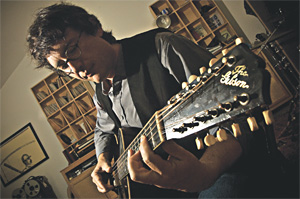

Paul Burch came to Nashville intending to make records, and he's managed to do exactly that, which might not sound like a particularly distinctive achievement. With his reverence for the past and his impeccable taste in role models, Burch could have recorded his songs in any number of ways, but he's devoted to simplicity. His music skirts the perilous edges of retro, but that's an inevitable affliction in Music City. He's a rocker, more or less, and cut his new full-length Still Your Man with a few friends in a converted garage near Music Row.
Now 42, Burch hit town in 1994 and promptly hooked up with a group of musicians who were busy reaffirming Lower Broadway's honky-tonk roots. He chose well, playing drums with guitarist Greg Garing and absorbing firsthand the music he'd heard as a youngster growing up in Virginia and Maryland. "Tim O'Brien lived here, and I thought he was really cool," Burch says. "And I wanted to meet Bill Monroe. I thought if you're a songwriter who wants to make records, this is the place to go. To my mind, Nashville was going through a funny phase at the time, with Shania Twain and Garth Brooks."
Still, Burch found the city's emphasis on songwriting a little confounding, at least at first. "The first thing I went to here was a songwriting, Monday-night cattle call at the Bluebird [Cafe], where you have to give your number and play two songs and not say anything," he says. "I was used to playing for two or three hours, and I'd played house parties in college. You had to decide, almost from the moment you presented yourself in Nashville, what you were selling yourself as."
Hanging out with the city's great session players, Burch was also attracted to the avant-countrypolitan collective Lambchop, whose impressionist non-narratives were the opposite of the pithy Nashville song. "I fell in with them," he says. "They were somewhat more my personality than the band at Tootsie's or a lot of the musicians I met here. Lambchop, they were more like contemporaries. I enjoyed a lot of music that was just feedback, and The Ramones. I really liked Yo La Tengo records, things like that."
Eventually Burch got down to making records such as 1998's Wire to Wire and Fool for Love, cut for roots label Bloodshot in 2003. He wrote simple, hummable songs that benefited from his relaxed tenor voice, and produced them in a deliberately anachronistic manner. "It was really challenging for me to go into a world of songwriting that did not know either Bob Dylan or The Beatles," he says of his early work. "But for my first records, I would try to write melodies that would seem to go somewhere but underneath wouldn't have a lot of changes."
Like BR549 singer Chuck Mead or Lambchop auteur Kurt Wagner, Burch was hooked on the elements of country music that Music Row had succeeded in leaching out of more conventionally produced records. Too, Burch had begun his career as a drummer and had dug deeply into soul and rhythm & blues. "I listened to people like Otis Rush and Magic Sam and Robert Johnson as much as I did country," he says. "Back in the early days, my favorite country singers were Tommy Duncan and Floyd Tillman."
This broad-ranging taste showed itself on Fool for Love, which included the lovely "Call My Name," an unclassifiable song that managed to recall John Lennon's lyrical side. He displayed a gift for the hook on "Time to Cry" and made folk-rock noises on "Sparks Fly Out." By 2006's East to West, Burch was rocking the garage on the great "I'm a Takin' It Home." The inevitable critical acclaim followed, but Burch's records didn't sell in anything approaching Shania-level numbers.
This doesn't bother Burch, who sounds like he had fun recording Still Your Man in his converted garage. ("Jason Ringenberg [of Jason & The Scorchers] built the skylight," he says. "He'd never built one before, and I said, 'Oh, Jason, you can do it.' ") He does a credible blues impression on Little Walter's "It Ain't Right" and sounds like he came directly from Beale Street on "Down to the Blackmarket." Not quite a collection of genre pieces, Still rocks gently and reveals a canny intelligence.
Still, you might compare "Down to the Blackmarket" with the late Memphis producer and singer Jim Dickinson's sublime 1972 take on Carl Perkins' "Dixie Fried," which grabs what Burch is reaching for on Still Your Man. Dickinson's recording busts up the pattern; Burch's follows it. Still Your Man is a work that could use some bad taste, and that's a concept Nashville can scare you away from for no good reason at all.
Email music@nashvillescene.com.



