
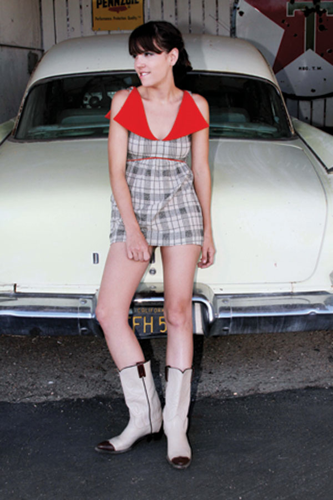
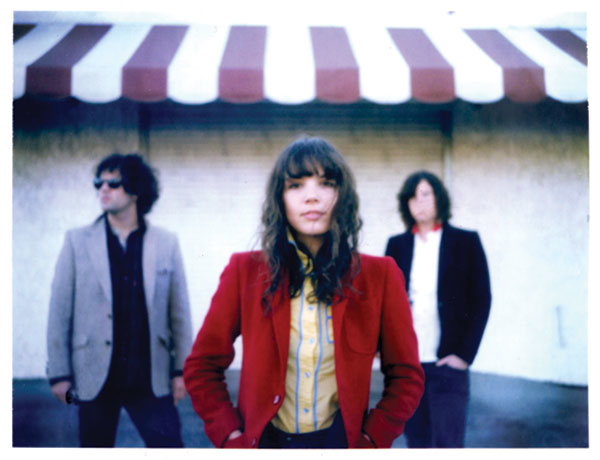
It's been 16 months since Tristen Gaspadarek appeared on the cover of the Scene alongside Caitlin Rose and country punk trio Those Darlins. Since then, Rose has gone on to win over just about every critic in the U.K. and elsewhere, while Those Darlins continue to shake down and enamor clubs across the U.S. and as far away as New Zealand, each spreading an evolved gospel of Nashville in their own way — embracing the strong, don't-hold-me-down feminine presence in country music that has been with us since the '50s, while at the same time refining those themes to make them modern and personal. But what about Tristen? In August of 2009, she was already laboring away on a debut album, but more than a year passed before we knew much more, aside from a recorded-at-home EP (Teardrops and Lollipops) and what could be heard in her regular and memorable live sets over the course of 2010.
We should be thankful that Tristen wasn't in a hurry. Charlatans at the Garden Gate finally arrives Feb. 1, and was well worth the wait. It's a collection remarkably warm in sound and biting in scope, and her perfectionist tendencies should hardly be looked on as a crutch: While a bevy of Nashville songwriters continued to write tired, confessional crap, Tristen devised what amounts to a loose concept record that fearlessly confronts both oppressive men and ideas, her frustrations apparent and articulate. Her work is literary, even fanciful at points, though never at the expense of clarity. Throughout, the "why" behind her chosen targets is harder to discern, but one thing's for sure: Tristen is an adept storyteller fully trusting of her audience's intellect. "There is no peace at last / When no answer can be cast," she sings over sparse, folk-pop instrumentation in "Battle of the Gods," her charlatans called to task with a tenderness that somehow feels sharp as a dagger.
As she worked alongside venerable producer Jeremy Ferguson at Battle Tapes, it's clear that Tristen's desire to get the Charlatans narrative right was met, if not surpassed, by her drive to disarm listeners at every turn. Somewhere between 30 and 40 musicians had played (or were scheduled to play) on the record by the time she posed for the cover of the Scene. Sixteen months ago. The sheer number of personnel was not a badge of honor, of course, so much as evidence of her commitment, a resilience that presumably could've just as easily run the entire project into the ground. By the time we reach the lovely, Cardigans-esque pre-chorus of opener "Eager For Your Love," however, it becomes apparent that her long suffering has paid off. (No fewer than 10 musicians pitch in on "Eager," the album's lead single, and its two B-sides.) With or without Tristen's acute capacity to portray relationships and ideology gone wrong, Charlatans is a musical document billowing over with rich, vintage hues and irrepressible hooks, her reverence for the lions of pop music and confident sense of self all meted out in the same breath.
At points, as in "Eager," "Baby Drugs" and "Wicked Heart," this sentiment comes to bear in the form of melodies that shift regularly and potently before resolving shy of three minutes, in the classic '60s pop mode, or in string-arrangement cadences that take their cue from Revolver. ("Wicked Heart," in particular, recalls "Eleanor Rigby.") Elsewhere, Tristen channels Tom Petty or Elvis Costello, rollicking through "Doomsday," "Heart and Hope to Die" and "Special Kind of Fear" with a charming swagger that belies the forlorn couplets floating atop the blues-rock of those songs. Traces of Nashville's country and saloon music heritage find their way into "Matchstick Murder" and "Battle of the Gods," too. But be careful not read into her influences too deeply, or the term "revivalist," which sometimes gets attached to her music. Through it all, it's very much Tristen's voice and way with words that leave a lasting, affecting impression. Charlatans be damned.
Email music@nashvillescene.com.



