
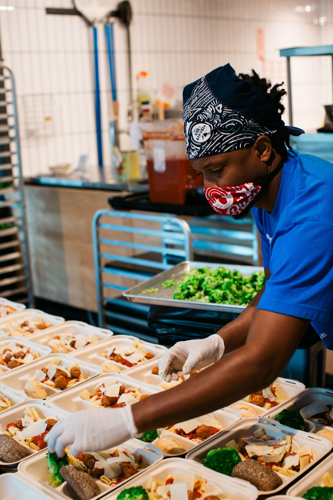
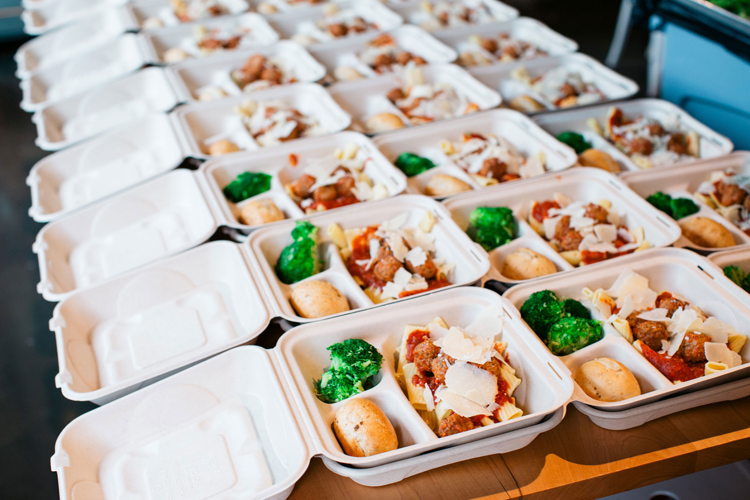
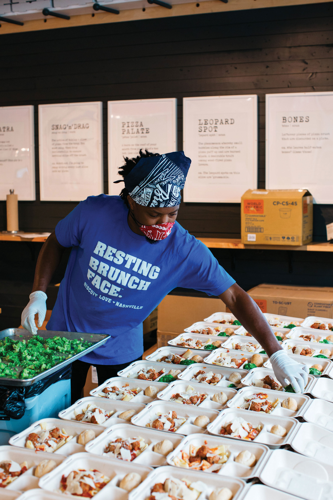
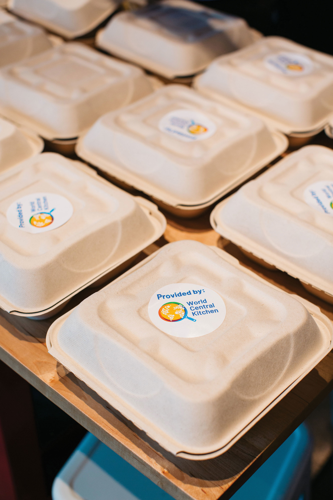


Preparing meals at Biscuit Love
“We were just sitting around waiting for the phone to ring for Uber Eats.”
That’s how James Garrido remembers the early days of the coronavirus pandemic, before World Central Kitchen came to town. Garrido is general manager for restaurants and bars at the Kimpton Aertson Hotel in Midtown, which includes Henley, the hotel’s adjacent restaurant and bar. It remained open for takeout and hotel guests, even as other restaurants were shuttered.
Garrido and the hotel ownership group wanted to do something to keep folks on their team employed and engaged. They also wanted to help as they saw issues of food insecurity becoming more acute with unemployment rates skyrocketing.
Garrido and Henley had worked with the Nashville Food Project before, so he reached out and asked how they could help.
When the pandemic started, nonprofits — like everyone else — had to rethink their business models. Before COVID-19, the Nashville Food Project would have had 15 to 20 volunteers in each of its two kitchens making food for its partner organizations. But then the nonprofit had to limit people inside the building.
Of course, need didn’t go away when Metro Nashville’s stay-at-home order went into effect. So Henley essentially became a satellite kitchen for NFP, making from 700 to 1,000 meals per week. As NFP was able to reopen its kitchens but Henley was still limited and looking for a way to continue that momentum, NFP connected Garrido to World Central Kitchen — the nonprofit founded by celebrity chef José Andrés. WCK is described on its website “as a small NGO [that] can change the world through the power of food.”
Through donations, WCK pays restaurants a price per each meal made. The restaurant uses that to budget however they like, and in the pandemic it has been useful to keep buying produce and other ingredients from suppliers who were also hit by shutdowns, as well as for hiring staff. Garrido says costs are covered so the effort is a break-even for Henley, as well as a way to help the community and keep people employed.
Nashvillian Whitney Pastorek was laid off from her music-industry job in April, and in May she started as Nashville’s project lead with WCK. “I have been in awe of what they are trying to do — not just helping to fight food insecurity but helping restaurants and restaurant workers,” Pastorek says. “The brilliance of using restaurants is that they already know how to get supplies and make food and package it.”
Pastorek had previous experience in political organizing and was connected with the local organizations that help people in need — including NFP, Catholic Charities, Preston Taylor Ministries and Second Harvest Food Bank. So she was able to connect those organizations to restaurants with capacity that wanted to hire and pay staff and vendors, and aid organizations that help those in need.
Since pandemic efforts began, through its Restaurants for the People program, World Central Kitchen has helped deliver more than 17 million meals in 355 cities and 34 states and territories, plus 36 towns and cities in Spain. In total, WCK works with more than 2,300 restaurants, and as of mid-June, the organization had disbursed $55.5 million directly to restaurant partners, exceeding an internal goal of $50 million in pandemic aid. The emphasis is on small, independent and community-focused restaurants.
WCK had been in town before, for a short period of time in March after the tornadoes. But that was a different model.
“It felt like the world’s craziest episode of Chopped,” says James Handy, director of training at Biscuit Love. That’s how he describes his first night making more than 1,000 meals for those in need. Biscuit Love and other participating restaurants were given a shipping container of donated food, funded by WCK. Handy and others went through that container, finding chicken, vegetables, chili and other ingredients, and figuring out what they could make to feed those who were displaced and in need after the storms.
“We joke that it is like our fifth restaurant,” says Handy of the volume of the 300 meals per day Biscuit Love is now making for kids in day care (primarily the children of essential workers) at the YMCA of Middle Tennessee. The meals are designed so that if kids don’t eat the whole thing at the Y they are able to take portions home for later or to share with family members. Each meal is about 1.5 pounds of food.
In addition to feeding hungry kids, Handy says the WCK experience has been transformative for the staff. “It is really cool to see the team here working together eight hours a day. It is cool to see them getting good at anticipating each other’s needs.”
Legacy Mission Village, which was founded by refugees to aid Burmese and Central African refugees, is one of the nonprofits receiving the meals made by WCK-participating restaurants. Many of the families Legacy Mission serves have specific preferences, such as no cheese or fried foods, and director of operations Tim Mwizerwa appreciates that the meals from Henley are not just sustenance, but made so that the person who receives it will enjoy it.

“We’re not just feeding kids packaged sandwiches,” Pastorek says. In addition to Henley and Biscuit Love, Maneet Chauhan’s Tànsuǒ is also cooking donated meals through WCK. Some have staff do drop-offs; others rely on the partner organizations to deliver the meals.
WCK is in Nashville through at least July 17 Aug. 7, and it isn’t supplanting the local organizations that are here fighting hunger and poverty on a daily basis. “We look to World Central Kitchens as experts in work that is different from what we do,” says Teri Sloan, development director for the Nashville Food Project. “We have gotten to see how their work functions. They are focused on high volume in very acute need. Our work is more focused on long-term, sustainable solutions from the ground up.”
Legacy Mission typically offers educational programming, but pivoted when need for food was acute, providing meals to 90 families at the peak of the pandemic. Mwizerwa is seeing demand for the meals decrease as people go back to work. But because some have family members who work in factories — areas that have been hot spots of the virus — Mwizerwa says that number may again increase.
The number of organizations currently in need of charitable gifts is not small. But Pastorek hopes that additional gifts now will extend WCK’s time in Nashville, allowing them to feed more families. If you are able to help, click the “donate” button on the WCK site. Where it says, “Leave a Comment,” indicate that your gift should be used in Nashville, and Pastorek assures that it will be put toward local need.
Update: The day this story ran, World Central Kitchen announced that it would extend its presence in Nashville through at least Aug. 7.



Post a comment as anonymous
Report
Watch this discussion.
(0) comments
Welcome to the discussion.
Log In
Welcome to the discussion.
Keep it clean. Please avoid obscene, vulgar, lewd, racist or otherwise abusive language. Comments featuring hate speech or threatening or violent content will not be tolerated.
PLEASE TURN OFF YOUR CAPS LOCK.
Be truthful. Don't knowingly lie or mislead.
Be proactive. Use the “report” link on any comment that violates our comment policy.
Share with us. We'd love to hear your feedback.