

Randall Grahm
There is a Napa vintner and man-about-town who was born into a winemaking family in France and married into winemaking royalty in California. His greatest fondness seems to be for throwing lavish parties and spraying his guests with Champagne. He is often depicted reclining on tufted furniture, tuxedoed and with glass in hand, but even in photos taken in the vineyard he dresses like he’s meeting James Bond for a game of baccarat. Picture this man.
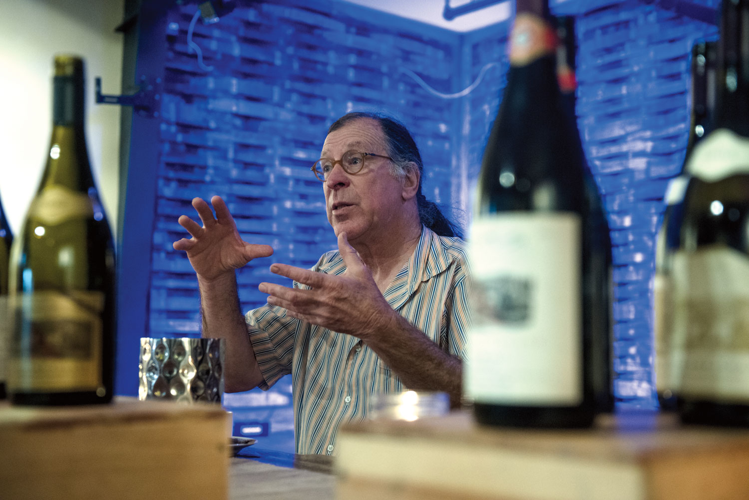
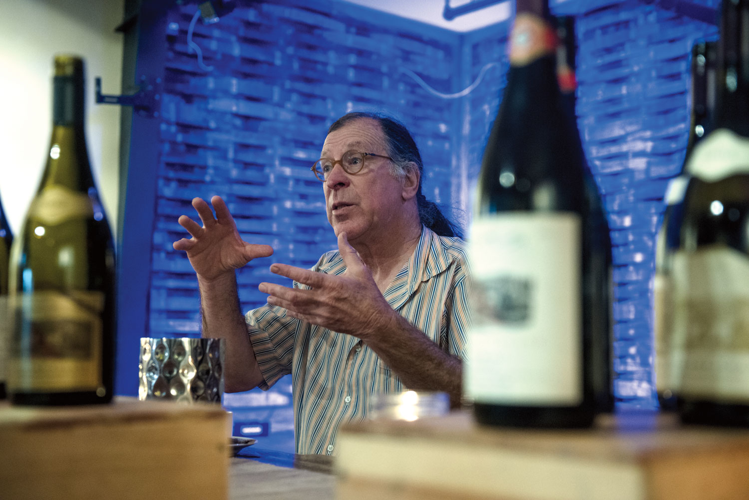
Now picture his polar opposite. That’s Randall Grahm, the founding winemaker from Bonny Doon Vineyard in Santa Cruz, Calif., who drives an old Citroën and writes parodic wine-themed lyrics to Dylan songs. Grahm is in his 60s, still ponytailed, and at a recent lunch at Husk he summed up his feelings about wine-industry schmoozing as he greeted those of us who were gathered to schmooze with him.
“I’m Randall Grahm, and welcome to my nightmare.”
This got a laugh, but it echoes his James Beard Award-winning book, Been Doon So Long, where one rambling footnote paints in grim detail the indignity winemakers have to endure to sell wine: Pour their “product” (or life’s work, whatever) for an overcrowded and underventilated room full of reps in moist branded polo shirts who might have been selling prosthetics instead of wine had that job called first. His quip was no joke.
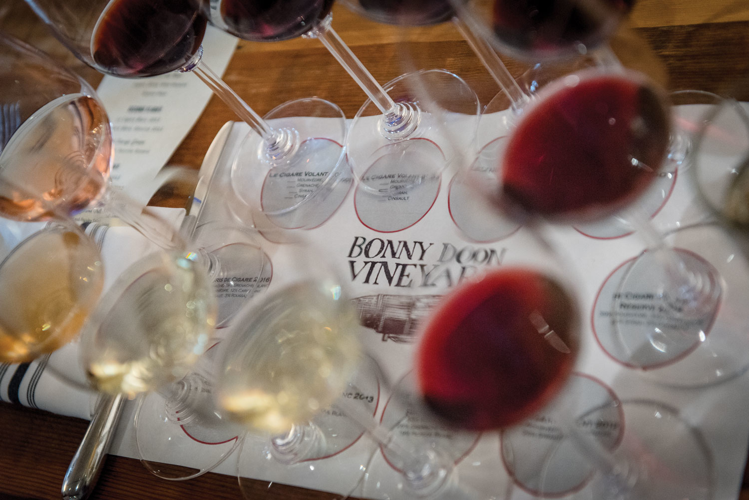
Grahm came to Nashville to host a tasting of various iterations of Le Cigare Volant, his signature wine, at City Winery — and to knock out a little schmoozing on the side. A little more industry ball-playing might benefit Mr. Grahm in Music City, I hate to say. About two-dozen of us were thrilled to taste with him at Husk and City Winery, but I couldn’t recall having seen any of his wines on the shelf in Nashville.
This is partially because what were once his wines no longer are. He sold his most commercially successful brands — Big House, Cardinal Zin and Pacific Rim — about a decade ago, reducing by about 90 percent his stake in an operation that was selling 450,000 cases a year. These days, you read about transactions like that every week: Winemaker sells his biggest brand to a larger outfit, presumably forfeiting a tiny bit of his soul but becoming suddenly flush and able to make up for it by pursuing a new soul-nourishing venture, or at least buying a yacht.
But pumping out hundreds of thousands of cases of those crowd-pleasing brands had encroached heavily on the goal Grahm set when he founded Bonny Doon in the early 1980s: to make vins de terroir.
Grahm glides in and out of French as he speaks and writes, so here is the essence of his conundrum: There are vins de terroir, and there are vins d’effort: wines of place, and wines of effort, respectively. The former are expressions of the land from which they come. The latter are expressions of the winemaker’s work and are, Grahm would argue, what California actually does well: take grapes that have proven over centuries to be perfectly suited to their ancestral homes, bring them here, and make them work. When I asked him whether the term vin d’effort was necessarily derisive, he answered, “Mildly.”
The problem is that the little things we do to make the wines work — like irrigating, say — don’t limit just their chances of failing, but also their shot at fulfilling their lofty potential. So Grahm is on a mission to plant the perfect grape at the perfect site, intercede minimally, and allow greatness to ensue in spite of him, not because of him. With what appeared to be real candor, Grahm said he was “pretty much chickenshit” for drifting away from that mission over the years. But here he is, refocusing on that challenge in his 60s, which seems anything but chickenshit.
After a years-long search, Grahm used the undisclosed sum he received in exchange for his brands to purchase his ideal site, Popelouchum, located in San Juan Bautista, Calif. It’s a place that came to him in a dream and whose name means “paradise” in Mutsun, the language of the Native American people of the area. (Despite his whole vibe, Grahm claims not to be “California woo-woo.”) His excitement about Popelouchum was palpable as he poured us a taste of its nascent wine from a hand-labeled 375-milliliter bottle. It looked tiny in his massive hand, and he handled it carefully, as if it contained a loved one’s ashes. The wine is a perfumed and fruity grenache from dry-farmed 2-year-old vines, and it is superb.
Grahm was in Nashville to talk about his present and future, of course, but his history should be required reading. He was at the vanguard of making syrah and other Rhône varietals into California mainstays. He risked significant treasure by bottling the entire 80,000-case production of 2001 Big House Red with screwcaps, and continues to bottle all of his wines that way. His commitment — and the splashy Death of the Cork funeral he staged in New York City in 2002 — have pushed the screwcap toward legitimacy, however slowly.
As the cork funeral suggests, Grahm’s aversion to conventional wine promotion may be exceeded by his knack for the unconventional. His cheeky wine names and labels injected whimsy into a staid industry back when that was refreshing. The jury is still out on his most recent movement — comprehensive ingredient labeling — which until now has been met with one big shrug. Only Ridge Vineyards in California and New York’s Shinn Estate Vineyards have followed Grahm’s lead. But perhaps they are just way out in front. As David Page of Shinn Estate told The New York Times’ Eric Asimov, “I do think consumers would understand the price differences in wine if they saw the ingredients that went into an $8 bottle with a kangaroo on the label.”
What goes into a wine? What determines what comes out? It is an answer that Randall Grahm, throwing himself into a new project nearly four decades into his career, still seeks with wide-eyed curiosity. It is one he is wagering Popelouchum will reveal, when the wine he envisions is a bottled reality. Maybe then he’ll say, “I’m Randall Grahm, and this is my dream.”
Email arts@nashvillescene.com




