


Repour
I have never relied much on wine-preservation systems at home because I rarely have enough wine left over to warrant one — see last month’s column — and because most are barely better than nothing. But as the physical toll of finishing off a whole bottle of wine has gotten steeper and steeper, my interest in preservation has gotten keener and keener.
Wine preservation is all about keeping wine and oxygen apart. Although it is considered wine’s archenemy, oxygen shouldn’t be vilified. To age a wine is simply to expose it to a tiny bit of oxygen, regulated by a cork, over a long period of time. But when a bottle is uncorked, the oxygen floodgates open, and the doomsday clock starts ticking quickly.

Products like the weightless spray-can Private Preserve consist of an inert gas that, when sprayed into an open and upright bottle, blankets the exposed surface of the wine, separating it from the damaging air above. Private Preserve works pretty well — far better than the hand-pumped vacuum systems that lie stuffed away and forgotten in cluttered kitchen drawers everywhere.
After reading my last column, a friend and wine writer recommended the Coravin, a product that wasn’t news to me — I heard about it several years ago from a restaurant guest who breathlessly reported that he had a 30-year-old Barolo in suspended animation as we spoke. Coravin does indeed represent a great leap forward for the wine consumer. Billed as an “access system” rather than a preservation system, the handheld contraption penetrates the foil and the cork via a hollow needle, releasing the wine and filling the newly vacated space with argon gas. Oxygen from outside the bottle never enters the equation, as the bottle is never “opened.” Coravin is a solid investment for those with even a modest collection, but many — including me, the ideal Coravin candidate — balk at the $300 price, which doesn’t take into account the pricy argon gas capsules that require frequent replacement.
Early this year, I read an article in Decanter magazine about a product called Repour. Its Kickstarter campaign had just concluded, but my interest was piqued, the science seemed solid, and I found myself checking for updates from time to time. Finally, Repour became available on Amazon. I placed my order and got in touch with Tom Lutz, Ph.D. chemist and Repour’s inventor.
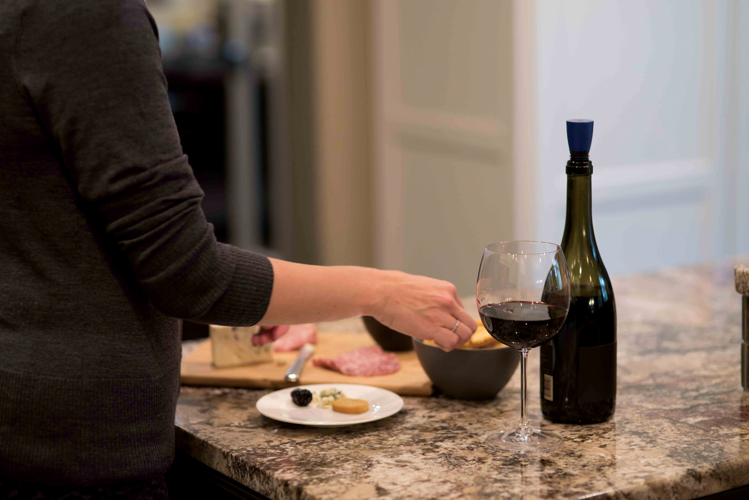
Repour is a bullet-shaped, ribbed stopper filled with an oxygen-absorbing material and sealed with a tiny foil tab. When the bottle is opened, the tab is removed and Repour is jammed in the neck of the bottle, in the cork’s place. Unlike the Coravin, Repour doesn’t attempt to keep oxygen from the wine, but intervenes after the fact by removing the oxygen from the air that fills the space in the bottle vacated by the wine.
To summarize the extensive testing documented on the website, Repour scrubbed the air in the bottle to less than 0.05 percent oxygen — approximately 1/420th of what would normally be present. Did I mention that during an abstruse scientific discussion, Tom Lutz gets animated at the precise moment when the average person’s eyes glaze over? He explained Henry’s Law, which dictates that as the oxygen in the air declines, the oxygen in the wine itself declines and settles below 0.03 parts per million. In English: The product works so thoroughly that the wine may have to breathe again after being sealed under Repour.
I have no lab, but I do have a palate. I dug into my cellar and came up with a bottle of 1995 York Creek Meritage, a quality but modest wine that was reaching its sunset days. Aged wines like the York Creek have extremely short drinking windows after being opened. Under normal circumstances, a 22-year-old wine opened at dinner time would be long dead by midnight.
I poured myself a glass of ’95 York Creek, and immediately stopped the bottle with Repour. The wine was tawny in color and ripe in aroma — still pleasurable, but undoubtedly a year or two past its prime. This made for a so-so glass of wine, but an ideal experiment. Without any intervention, the wine would perish in a matter of hours. For the next few days, every time I went to the basement, I passed the resealed York Creek and doubted that the wine would be anything but vinegar when I got back to it.
After five days, I pulled the Repour — the bottle made a satisfying hissss. I poured a glass and quickly recorked the bottle with the same Repour. I let Henry’s Law do its work, reoxygenating the wine in the glass. Five minutes later, I took a sip of the York Creek. I tasted what I had tasted five days earlier — no better, no worse. I forgot about the wine, then tasted again after another few days. Status quo.
I was impressed. For the next few weeks, I burned through the 10-pack of Repours I had purchased, mostly on younger wines. Finally, as time to write this approached, I raised the stakes with a $65 Brunello di Montalcino from 2010. Brunello can tend toward oxidation anyway, so it was an ideal candidate: a high-quality wine from an excellent vintage, heavenly when first opened, that would be unable to hide any damage sustained over a week uncorked. I checked in after three days. It was perfect. After a week, no worse for wear. I popped in a new Repour. By the time I try it again, it will have been two weeks. Instead of doubt that it will be in good shape, I have hope, based on experience.
At a price that makes it worthwhile for drinkers of even the most modest wines, Repour is a solid buy. It is new and unknown. The jury is still out. But this is one new product that certainly deserves a much bigger jury.
Email arts@nashvillescene.com



Post a comment as anonymous
Report
Watch this discussion.
(0) comments
Welcome to the discussion.
Log In
Welcome to the discussion.
Keep it clean. Please avoid obscene, vulgar, lewd, racist or otherwise abusive language. Comments featuring hate speech or threatening or violent content will not be tolerated.
PLEASE TURN OFF YOUR CAPS LOCK.
Be truthful. Don't knowingly lie or mislead.
Be proactive. Use the “report” link on any comment that violates our comment policy.
Share with us. We'd love to hear your feedback.