
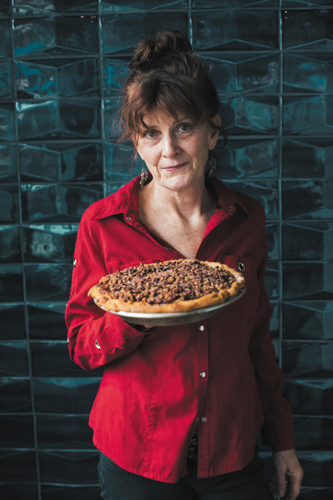



Deb Paquette
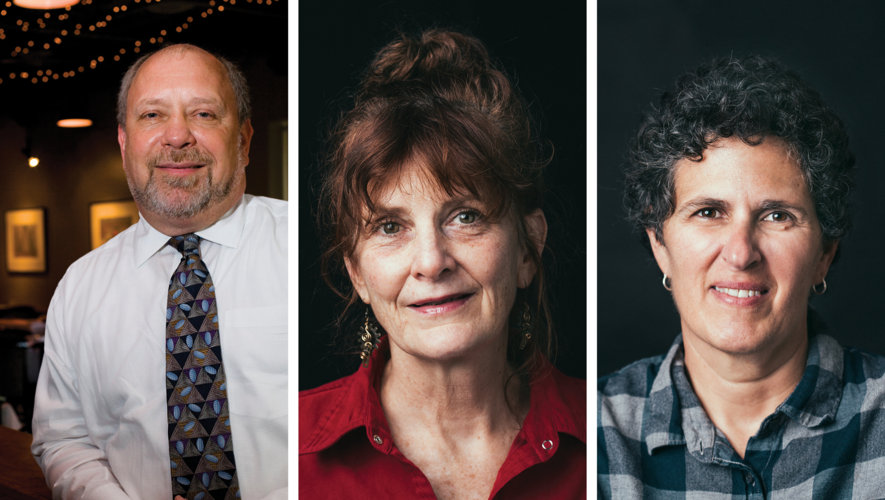
If the Metro Arts Commission ever decides Nashville’s next big piece of public art should be a Mount Rushmore of the city’s culinary heroes, there’s a pretty easy case to be made that three of the figures included should be restaurateur Randy Rayburn and chefs Margot McCormack and Deb Paquette. Not only has the trio elevated the local dining scene through their own talents in and out of the kitchen — they have also been integral in training a younger generation of culinary professionals who have helped push Nashville into the national spotlight. You can’t draw a family tree of the city’s most important current restaurant talent without a lot of branches extending from these three talented professionals.
We gathered the triumvirate together in a cozy corner booth between lunch and dinner service at Paquette’s Green Hills restaurant, which goes by the lowercase moniker etc., to swap stories about how the culinary landscape has changed since the Scene first took its current form as an alt-weekly newspaper in 1989. (“I’m still [Scene ad sales rep] Stevan Steinhart’s oldest customer!” boasts Rayburn.) Paquette is a gracious host despite the fact that her forearms bear numerous fresh burn marks, the tattoos of pride for a chef-owner who still works in the fire at her restaurants.
“I’m still working the line at age 63,” Paquette moans. “And it makes me a grumpy person. Everything kills me! I’m just glad I’m still here. I should have had three heart attacks by now!”
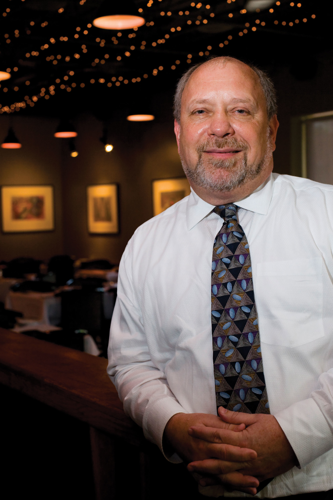
Midtown Cafe owner (and midday maître d’) Rayburn drops names and holds court like the natural front-of-house artist he is. He has connected with culinary pros, music stars and political icons throughout his 40-plus years in the business. McCormack has her well-behaved young son in tow, obviously running between errands in preparation for opening her eponymous Margot Café & Bar for dinner. The group starts off by reminiscing about where they were in their careers 30 years ago.
“I can only remember by whether I was pregnant or not,” Paquette recalls. “Yeah, in 1989 I was pregnant with my son Croix, so I was working at Cakewalk Cafe.” Rayburn remembers being involved in that hire: “I had just sent Anita [Hartel] to work at F. Scott’s, so when Rick Bolsom was looking for someone for Cakewalk, I suggested you.”

Randy Rayburn
1989 was a big year for Rayburn as well. He had already earned a reputation as one of the most successful restaurant-opening managers in town (“I stayed until I knew the owners or until they knew me”), and he’d just left F. Scott’s after a rancorous dispute with the owners over a partnership agreement that ended in a legal settlement. “I wound up checking myself into AA,” he says. “That’s when I decided I wanted to open my own restaurant.” He sold his house and used the proceeds to open Sunset Grill the following year, a restaurant that would be integral in dragging Nashville dining toward the 21st century with its combination of California cuisine and Southern sensibilities. Sunset had an intimate bar scene that made it the best place to hang out late on the night of the CMA Awards if you wanted to catch a glimpse of Clint Black canoodling with Lisa Hartman.
McCormack had already cut her teeth in the restaurant world after graduating from UT-Knoxville in ’86, working in kitchens at local spots like Tempo’s and Maryland Farms Country Club. A chef she worked for suggested she continue her education at the prestigious Culinary Institute of America in Hyde Park, N.Y. “I was like, ‘I just got out of college, and I don’t want to go back in, and I don’t have any money for more college,’ ” says McCormack. “I don’t know what happened, but Tempo’s wood-fired grill caught on fire, and they called the fire department, but they called the wrong fire department. So the general manager called my house and basically tried to accuse me of starting that fire because we’d had some sort of argument. I was like ‘Dude, that fire was because y’all didn’t get that shit clean!’ So I quit and drove to California and immediately back home and found myself at Faison’s making $4 an hour for lunch.”

Margot McCormack
Restaurateur Jody Faison “was very encouraging to me and brought in books and menus from his trips,” McCormack recalls. “He’s very tall, dark and handsome, and everyone loved him, driving around in his Saab. It was very intoxicating, in more than one way. All the people that worked there were very cool, and I loved it. So he was the one that introduced me to somebody in the Southern Restaurant Association who told me that there wasn’t enough going on in Nashville and that I needed to go to [the Culinary Institute of America]. I got a scholarship to go and get started, and then I came back and did my externship with Jody. I finally came back to town full time in ’95.”
When asked who should be the fourth face on Nashville’s Restaurant Rushmore, both Rayburn and McCormack immediately anoint Faison. “The list of chefs that he has worked with in this town is just as long as any of ours,” explains McCormack. Rayburn continues Faison’s nomination speech: “He helped start the local independent restaurant scene.” (After 24 years running Nashville restaurants, Faison quit and became an attorney.)
“I mean, people talk about all the local things that are happening now, and I might have been young and impressionable at that time,” says McCormack. “But in ’87, ’89 I felt like Nashville had a lot to offer, and we’ve kind of — I don’t want to say ruined it — but we had [several] vegetarian restaurants back then, like Laughing Man, Country Life, Windows on the Cumberland and Slice of Life. You had Faison’s, Julian’s, Mario’s — anyway, there were some really pretty good restaurants.”
“I have to make a point,” Rayburn adds. “Contrary to the revisionists who are recent arrivals to our city, there were some good restaurants and great chefs in this town.”
“There were some people doing good things,” explains McCormack. “And maybe it wasn’t the kind of food that is happening now, but it was the food that was happening then! It was the food that people liked, that people appreciated and supported. Also it wasn’t complicated for them to get behind. And we weren’t fighting off all these people who were coming from outside of our environs the way that we are now. You made a choice: You either went casual/fast-food, or you’re gonna go to an independent restaurant. It wasn’t like, ‘Which high-end restaurant am I going to go to that I have to choose between independent and some carpetbagger people?’ ”
“I call them all O’Chiligan’s,” jokes Rayburn. “For fuel, not food!”
“That’s what I miss,” says McCormack. “I miss the personality of restaurants. When you knew this was Randy’s or Deb’s. But now it’s like Restoration Hardware came in and made all the restaurants! What I hear from our regular customers is that ‘Yes, a new restaurant opens every day in Nashville, but we don’t care.’ They’re not interested in going and spending their money, because they have been disappointed in the last few years with their experiences at the new restaurants. I also think that it’s not about feeding Nashville anymore. It’s about feeding Nashville and ‘the other people’ that come here.
“It’s a combination of things,” she continues. “It’s not just about our restaurants, upper-echelon restaurants. It’s about hot chicken just as much as it is about Jeni’s and Biscuit Love. It’s all wrapped up in a big package with a nice bow on it. It’s the TV show [Nashville] and the Titans and the Predators. It’s the restaurant scene. Really, it’s just the bachelorettes, for God’s sake. It’s Sean [Brock]. It’s Tandy [Wilson]. Bourdain was here. You just keep fanning the flames and eventually you’re gonna start a fire. People are just coming here for a piece of that wherever that might be.”
Rayburn characterizes downtown Nashville as an adult theme park. “We lost Opryland, but we ended up with a French Quarter that’s safer. That pulls in a lot of people, but there are also folks looking for cultural tourism that aren’t Ma and Pa Kettle, and there’s a lot of diversity that comes. Some of those people are finding their way out into the neighborhoods because there are more neighborhoods that are thoroughly growing. In 2007, the No. 1 sign in downtown was ‘For sale or for lease.’ ”
Paquette also worries about holding on to employees. “You’ll find yourself accommodating and not writing people up like you should be because you can’t keep them,” she says. “Everybody has got to be paid more. You have to concentrate on keeping people happy.”
Rayburn adds, “Three years ago I laughed my ass off when Edgar Pendley told me ‘Randy, it’s gotten so bad I’m having to be nice to people!’ ” (Pendley spent seven years as chef at 12South’s independent blockbuster Urban Grub; a couple of years ago he launched Haute Iron — Live Fire Events.)
As far as the future goes, the group thinks it’s still a little hazy. “I really don’t really know,” says McCormack. “So many mainstays have closed. Will the old restaurants survive? The restaurant business has become a real estate game. If you don’t own your space, what is your future? I just think sometimes that maybe restaurants weren’t meant to be old. Because it is about the next new thing, the latest. So this idea that maybe I was going to be in business for 25 years maybe wasn’t right. I still want that, but I realized that [when a restaurant is] 10 years old, ‘Oh yeah, everything starts to break, and you have to start all over again,’ and I get older, and it gets tiring. And you start to think, ‘How many of these have I bought? How many knives and forks and glasses have I replaced?’ ”
“I think there will be more automation and technology, but I think that because of the circle of everything, more restaurants are going to go back to nostalgia,” Paquette adds. “Arnold’s will live on forever, but there’s going to be a few more people who will just say, ‘Bring me something simple.’ It even worries me about the food I do. Will it last a few more years? I still get people who are excited about my palette of flavors, and I guess we’ll stick it out and see what happens over the course of the next few years.”
“The next economic slowdown will thin out the herd dramatically,” says Rayburn. “There are a lot of people who are just holding on. How much rent can you afford at $50 per square foot and $20-per-hour salaries?”
When and how that next crisis arrives, you can bet Rayburn, Paquette and McCormack will figure out how to deal with it — even if it means working the line or the dish pit in their own restaurants.



