
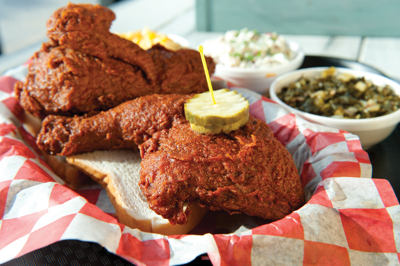


Hattie B's
A previous version of this story ran in 2016. We figure Hot Chicken Week is as good an excuse as any to revisit it.
To tell the story of hot chicken in Nashville, it is helpful to go back.
Way back.
Back before the fiery fowl was being celebrated with annual festivals and weeklong events.
Back even before Thornton Prince’s girlfriend spiked his breakfast fried chicken with a potent blend of cayenne and mustard powder and vengeance.
Back before Jackson and Robertson and Demonbreun.
You have to start at the logical beginning: in the Acts of the Apostles.
Acts lays a detailed map for the growth of Christianity, from a small Jewish cult of a dozen followers that spread first through Israel, and then east into Greece, and then throughout the Roman Empire. By the end of the fifth book of the New Testament, just as St. Paul starts his prolific epistolary career, it is clear that this philosophy that began with the son of a carpenter in a backwater is going to become the most powerful cultural force in the West.
This isn’t to say that hot chicken is somehow on par with Christianity as a phenomenon or as a force for good or ill. Hot chicken hasn’t inspired artists to paint ceilings — though someone ought to commission a painter to give us a Sistinesque rendition of the first time Uncle Thornton touched fire to fowl. Nor has hot chicken been used as a casus belli for a crusade from Nashville into the Commonwealth after KFC bastardized our civic culinary religion, though it certainly would be justified.
But just as in Acts, in a short period of time, our fowl following has gone from insular cult to global renown in a flash.
For decades, as detailed in Rachel Martin’s excellent essay for The Bitter Southerner, “How Hot Chicken Really Happened,” the dish wasn’t even known citywide. It was created and cultivated in the predominantly African-American neighborhoods north and east of downtown. Where it did seep into white neighborhoods, it did so in working-class areas. There are old-time West Nashvillians who remember being served hot chicken out of rougher beer shacks in The Nations, for example.
And then, starting in the ’80s and really picking up in the two decades after, gentrification came, and the fowl started to catch fire, aided in no small part by then-state Rep. Bill Purcell. Legend has it that Purcell ate an extra-hot leg quarter from Prince’s every day for lunch while serving in the legislature and later as mayor.
Please lift up his gastroenterologist in prayer.
Purcell, then, would be hot chicken’s St. Peter.
Upon his rock stomach would we build our church.
It was Purcell who had the idea for the Music City Hot Chicken Festival, which takes place every July 4 in East Nashville and now draws more than 12,000 attendees, with several shacks offering their wares and dozens of amateurs vying for the prize as the city’s best amateur poultritier.
While all the coastal It City praise is largely responsible for the expansion of hot chicken nationally, it started with a short segment on NPR’s self-parody food show The Splendid Table and its road-food segment by Jane and Michael Stern. The pair praised our famous hen in a 2008 episode, drawing Coexist-sticker-adorned Volvos to the strip mall that is home to Prince’s.
Like Saul on the Road to Damascus, Jane and Michael were struck by spice on Ewing Drive, and hot chicken had its Pauls.
Between the Petrine festival and the Pauline attention, hot chicken finally jumped the racial and class divide in Nashville, and waiting in line at Prince’s has become as much a Nashville rite of passage as negotiating the parking lot at Frugal MacDoogal on Christmas Eve.
Just as those coastal praetors were placing their imprimatur on our city at large did hot chicken get its Reformers. Hattie B’s brought the bird to Midtown, the first successful foray of a hot chicken shack into the central business district, and made the welcome addition of beer taps, finally giving a wise beverage-pairing option beyond milk or lemonade. Nailing their theses to the door, so to speak, Hattie’s offered hot chicken tenders, a heretofore heretical presentation, though certainly easier to eat and with a much lower risk of harming oneself courtesy of an inadvertent finger to the eye.
The irony is that bringing hot chicken to upper-class areas actually led to a democratization of the product. Recipes that had been secret for decades were being shared on blogs. The salvation of the spice no longer had to be granted by gatekeepers. It was available to all in the comfort of home.
And hot chicken became a symbol of our city, with no better proof being that when the Sounds got their fancy new stadium in gentrified Germantown, they changed their mascot to a rooster.
Now hot chicken can be found not just downtown or on the West Side or in Franklin, but in Brooklyn bistros, L.A. food trucks and at a variety of locations in Chicago, where one restaurant has had a Nashville Night with specials on hot chicken and bushwhackers.
Seriously.
The story of our city can, in many ways, be told by hot chicken, particularly the story of the past quarter-century. It is about race and class and development and the way we view ourselves and the way the rest of the world views us.
Events like the Music City Hot Chicken Festival and the Scene’s Hot Chicken Week aren’t so much about bringing hot chicken back to its roots, really, though the long lines are a little nostalgic.
These events are about putting hot chicken where it truly belongs: in our stomachs, all of our stomachs. All of us together, rubbing elbows and shoulders (but not our eyes!).
Blessed be the ties that bind (and burn).
Email arts@nashvillescene.com



