
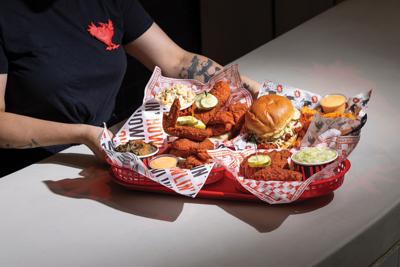

Los Angeles, it’s no surprise, offers a startling variety of food.
It’s an international city that has drawn immigrants for decades and has a mind-boggling variety of ethnic enclaves. A short stroll on Hollywood Boulevard carries a pedestrian from Little Armenia to Thai Town in rapid succession. Little Bangladesh is just north of Koreatown. The charmingly named Byzantine-Latino Quarter is just south of it. Of course, Southern California has been a destination for relocators coming from within the United States for a long time as well, drawn by dreams of gold strikes or silver-screen stardom or the charms of eternal sunshine and economic opportunity.
Southern food broadly — and soul food specifically — has a foothold, brought west by Black Southerners fleeing Jim Crow and heading toward a dizzying number of defense jobs during World War II. There’s both supply and demand for any cuisine imaginable. There’s a Cracker Barrel at Melrose and Western, and an elevated imitation of Waffle House at Sunset and Vine, for lard’s sake.
In that environment and with increased cross-pollination between the City of Angels and the Music City, it was — maybe — just a matter of time before hot chicken landed on the plates of Angelenos.
There are dozens of restaurants specializing in the dish. There’s Dave’s and Harold’s and Lily Mae’s. There’s Angry Chickz and Hot Chicko’s. There is both a Bad Mutha Clucka and a Hot Motha Clucker — the latter is advertised as a “Nashville Bar & Grill” but specializes in tequila cocktails and blasts trap music. Given that California has a, let’s say, much more open attitude to cannabis, there’s Tennessee Hot Chicken (which takes pains to point out that its initials are THC). A wistful former Nashvillian has no problem finding the fiery fowl, or at least some interpretation thereof.
As might be expected with such quantity, some of the offerings are, let’s say, far from authentic. Many offer just tenders or serve only sandwiches. While many Nashville aficionados have come to accept tenders as admissible, putting hot chicken on a hamburger bun instead of atop white bread is a bridge too far. Many jack up their heat using distilled pure capsaicin, a trick not unheard of even in hot chicken’s hometown. While such a move increases the heat, it does little to add flavor (and the price is an extra level of digestive discomfort).
Nashville’s famous bird first hit the streets of Los Angeles in 2015 with the opening of Howlin’ Ray’s food truck, but that was just the culmination of a journey that began the same way so many hot chicken love affairs do: the need for a late-night nosh.
Johnny Ray Zone was doing a stint at Husk and after a shift one night, at the invitation of a co-worker, headed down the hill to 400 Degrees. He was hooked. In short order, he tried Prince’s, he tried Bolton’s, he tried Hattie B’s. He flew back to L.A. and, joined by his wife Amanda, returned to Nashville for a hot chicken tour, eating the bird exclusively for days and days and days.
Zone comes from a fine-dining background — in addition to Husk, he worked at Nobu, at The London for Gordon Ramsey, at Thomas Keller’s Bouchon Beverly Hills. So, he says, he was able “to gram out” the recipe, drawing from the restaurants in Nashville he reverently calls “the OGs.” There’s Prince’s richness, the front-end heat from Bolton’s, the slight sweetness of Hattie B’s. When he travels to Nashville, he listens to and learns from those who’ve come before and gives back when he can. He financed the reconstruction of Bolton’s sign after the 2020 tornado, for example.
The result is quite good. The chicken itself is well-prepared — and available in traditional quarters as well as tenders — as are the sides. Ray’s offers seven levels of heat, including the ingenious medium-hot. A Nashvillian is likely to want to bump up a level from their usual order. (A Nashville “hot” is closer to Ray’s “Howlin’ ” level, for example.)
He doesn’t try to pretend he’s something he’s not, though.
“We took a dish and paid respect to where it comes from, and elevated it by paying respect and having a lot of integrity for it,” Zone says. “I’m not Southern. I’m from L.A. We aren’t saying we’re from Nashville.”
Eventually, Los Angeles fell in love with Howlin’ Ray’s, drawing long lines that persisted with a move to a brick-and-mortar in Chinatown. A new location is opening soon in Pasadena. The booths there are named for streets in Nashville, but the open kitchen and decor evoke the ubiquitous Los Angeles coffee shop (what nearly everyone else on earth would call a diner).
Ray’s success drew attention, not just from hungry spice-heads but from investors who begged him to franchise, to cut costs, to give up control.
“We launched a sandwich and those people were hounding us to do a franchise deal,” he says. “I said, ‘Have you been to Nashville?’ They saw hot chicken as dollar signs.”
But hot chicken is more than the money it can make. There’s not a soul in L.A. who knows that better than Kim Prince. Yes, of those Princes. Her aunt is Prince’s Hot Chicken Shack matriarch Andre Prince-Jeffries. Her great-great-uncle is Thornton, the man who legend tells us brought the bird to the world after a suspicious girlfriend spiked his fried chicken with cayenne. Prince operates Hotville just off Crenshaw Boulevard. No one needs to be convinced of her bona fides.
“I grew up around this bird,” says Prince. “It was not only prepared at the restaurant, but at home and other venues. It was the only way to eat fried chicken, and it had to have some kick in it. Not just on it. The good family nod was what I long for and finally got. A blessing of sorts to head west and embark upon opening my own brick-and-mortar store. Finance it and keep the family name and the legacy of Nashville hot chicken held high. Enlighten folk to respect the story and craft. Nashville hot chicken is not a trend. It’s a tradition. Something that’s been around since the 1930s doesn’t sound like a trendy train you just hop on. Earn the ticket and learn what the journey brings.”
Prince defends her family’s creation, as is to be expected, making sure to call what is served in Los Angeles “spicy fried chicken” rather than “Nashville hot chicken.”
“I have yet to find a business here preparing the bird in the manner of my Great-Great-Uncle Thornton and his brothers,” she says. “Again, the kick is in it. Not just on it. Frying hot chicken is a skilled art with attention on balancing flavors. Too much of the wrong thing, like this one irksome ingredient I see all too many use called brown sugar, just ruins it for me.”
It’s inarguable there’s a surfeit of L.A. joints claiming to serve hot chicken; whether it’s a bubble that bursts when the next food trend comes down the 405 remains to be seen. Prince says the “trend-minded makers of hot chicken” are bound to get burnt.
Zone says he saw the boom coming when investors came with open wallets and specious ideas of how to scale the dish.
“The secret is hours and passion and joy,” he says. “I’m not in charge of hot chicken, and I don’t control it, but we have integrity.”
Prince, who has stared down the challenges the restaurant industry faced in the past two years, doesn’t seem daunted by the competition of imitators — or anything else, for that matter.
“I am drawn to the business of restaurants, customer service, community engagement, education and empowerment of a space where the minority was not entitled to ownership,” says Prince. “Women and people of color lack access, and the barriers are worth exposing and then kicking down. My ancestors were true entrepreneurs and conquered challenging times. It’s their faith and fortitude that fuels me. That spirit was passed down to my father, Martin Prince, Aunt Andre Prince-Jeffries, her daughters, and the next generation. They have a mandate to pick up the frying pan and keep frying this bird hot.”



Post a comment as anonymous
Report
Watch this discussion.
(0) comments
Welcome to the discussion.
Log In
Welcome to the discussion.
Keep it clean. Please avoid obscene, vulgar, lewd, racist or otherwise abusive language. Comments featuring hate speech or threatening or violent content will not be tolerated.
PLEASE TURN OFF YOUR CAPS LOCK.
Be truthful. Don't knowingly lie or mislead.
Be proactive. Use the “report” link on any comment that violates our comment policy.
Share with us. We'd love to hear your feedback.