
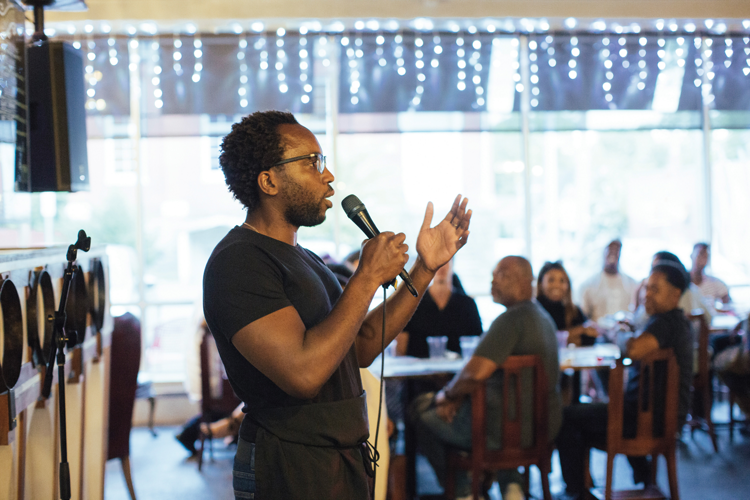
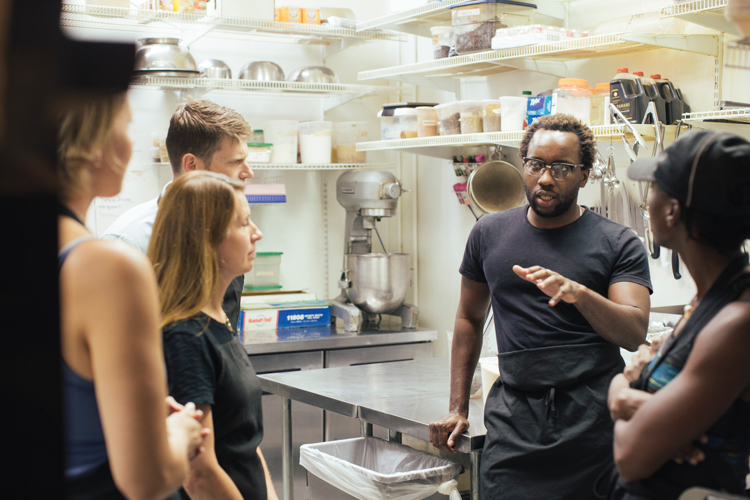
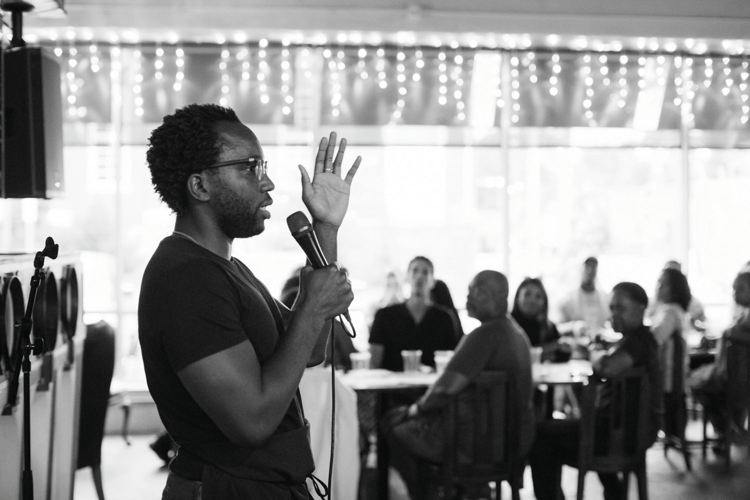
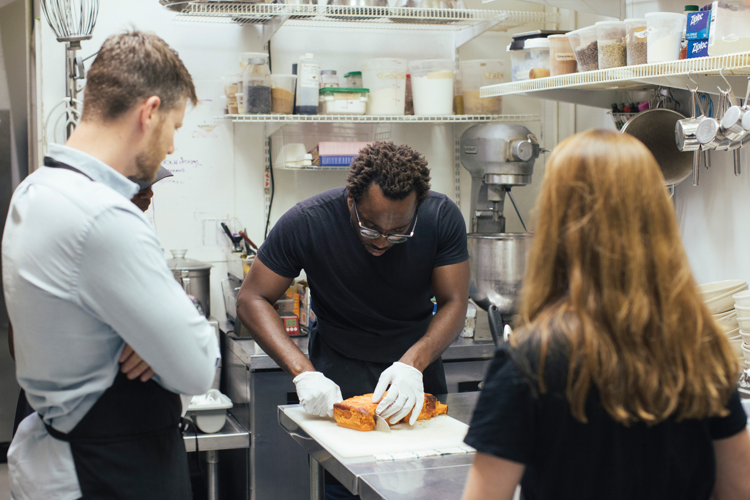
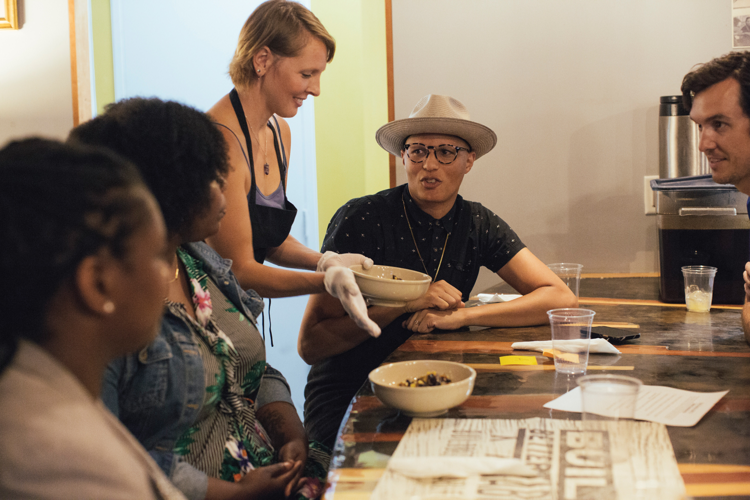


Tunde Wey Speaks to the crowd at The Post East
There was a combination of excitement, interest and more than a little trepidation in the air July 19 at The Post East, where an audience of roughly 50 artists, architects, government workers and others had gathered. Chef Tunde Wey had emailed those with reservations to his H*t Chicken Sh**t event in advance letting them know that discomfort was on the menu.
“I say this regretfully but also from experience,” wrote Wey, who has hosted similar events in other cities. “Because we will be talking about intersectional issues of race and class, and [because this dinner] will have folks from different racial groups attending, and we each have varying awarenesses of racial and class issues, three things are most likely to happen: 1. Folks of color will be doing a lot of emotional labor. 2. White folks will be extremely uncomfortable. 3. There will be general frustration. Hopefully, what also happens is that we leave with some concrete solutions moving forward.”

Wey continued, offering cancellations with refunds for anyone uncomfortable with the plan (or uncomfortable with the dinner’s “expletive-laden” playlists).
With bottles of gin and bourbon tucked under their arms as they entered the BYOB space, guests who paid $55 for a dinner (at what Wey promoted as “gentrification prices”) were given a folded Post-it note drawn from a paper bag and instructed to wait to open it. The crowd mingled.
Guests had known even before Wey’s email that they had signed up for something unusual. The dinner is one piece of Metro Arts’ ongoing Build Better Tables temporary art exhibit.
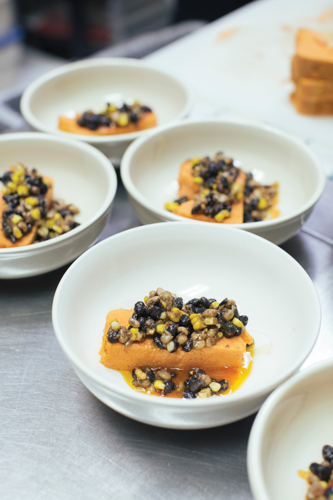
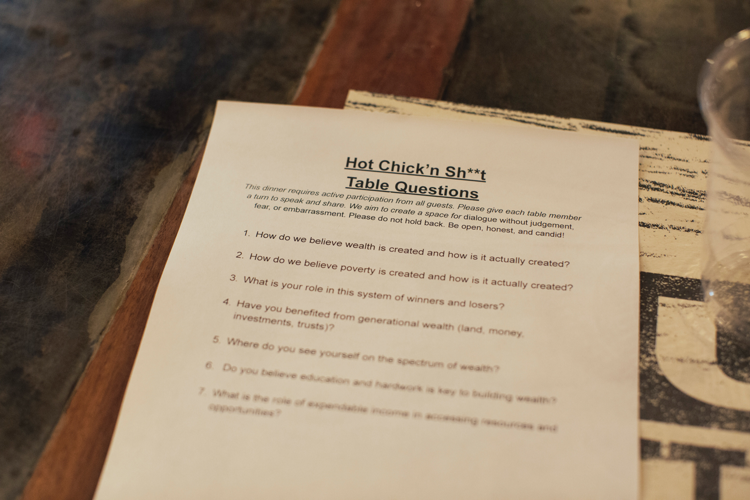
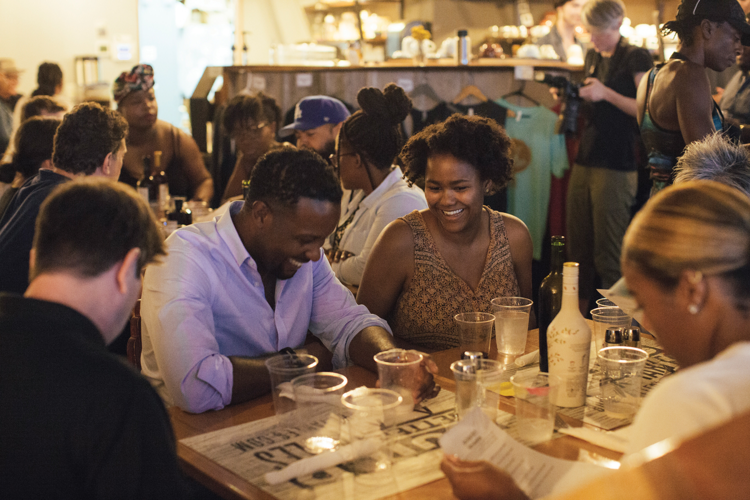
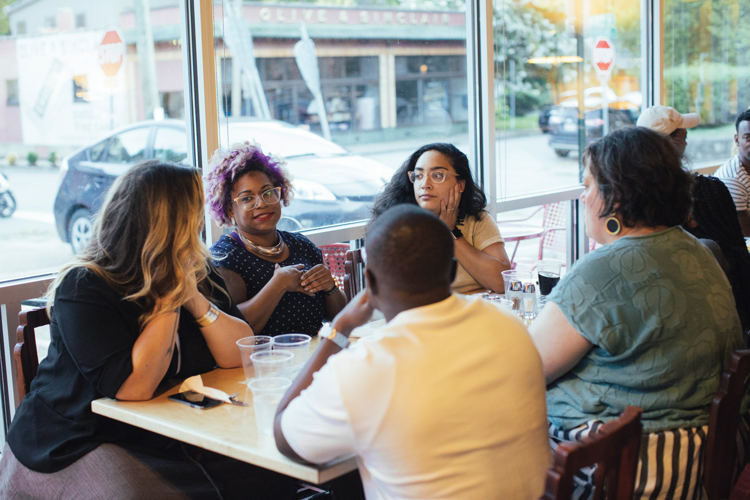
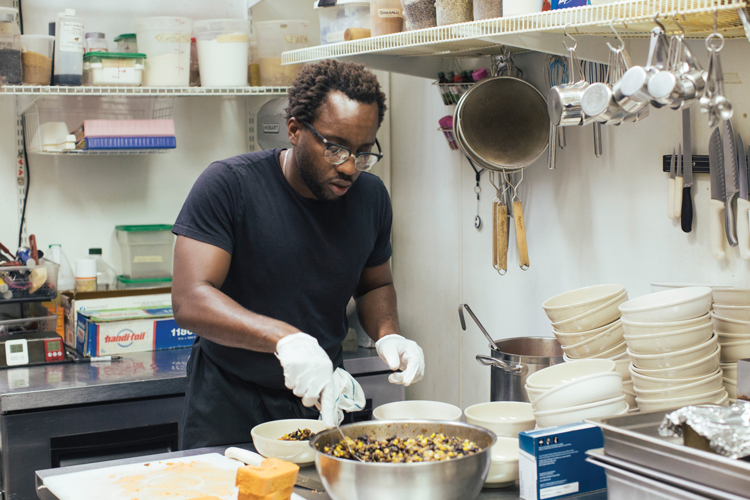
Each attendee opened their Post-it and sat at a table corresponding with the letter on the piece of paper. Each table had a list of the same seven discussion questions about wealth, poverty and individual responsibility. While affordable housing wasn’t specifically on the question list, it came up repeatedly as one of the issues affecting everything else — education, jobs, commute times and other topics all pointed to housing as a linchpin. Participants took to the questions like honors students to homework, earnestly debating the issues, while a team served Wey’s bean-centric dishes, inspired by food his mother cooked. The spicy courses were devoured while conversation heated up.
“This is consistent with the aims of the Build Better Tables exhibition,” the exhibit’s curator, Nicole J. Caruth, told the Scene via email. “I use the platform(s) I have to amplify voices, raise awareness of social issues, inspire hope for better or different futures (especially among youth), and motivate people to action.”
More than an hour after diners were served at The Post, Wey came out of the kitchen and took the microphone. He asked guests what they thought of their meals, at which point it was revealed that those at A tables received more courses and larger portions than those at B tables. But significantly, those at the A tables didn’t notice the disparity — they didn’t notice that other people didn’t have as much as they did. And even the folks at the B tables, who did notice that the A tables were served more courses, didn’t speak up.
This was Wey’s analogy for how suffering in Nashville communities can be overlooked.
The Next Course
As the B tables were promised their missing dishes would soon be served, Wey talked about his belief that whatever one does to equalize disparity in the community is righting a wrong, not an act of charity. Then Wey announced the second phase of his project, which is also part of the Build Better Tables temporary art program. On Aug. 23-25, Wey will cook a series of pop-up dinners, this time at Westwood Baptist Church on Albion Street in North Nashville. The menu will feature takes on hot chicken, which Wey sees as a metaphor for the appropriation of black culture. The menu, which will again be influenced by Wey’s background, will feature stewing hens brined for 24 hours with a Nigerian spice blend called yaji. Diners, he announced, will be asked to pledge funds or land in one specific census tract area (TRACT 143) in North Nashville to attend.
The room fell silent as Wey talked about his vision to have folks who own property in the area transfer it to the community, where it can be used to address the kinds of issues that had been discussed all night.
“I think this is the brilliance of [Wey] ... that he is able to make these things tangible,” says Caroline Vincent, interim director of Metro Arts. “He is getting people interested and thinking about ways they can help.”
For the Westwood Baptist pop-up dinners, attendees won’t write checks, but instead will make pledges, from $100 to $50,000, either of local property in the census area or cash to acquire said property. Eventually, these pledges will be collected in a community land trust, an instrument that allows residents to buy affordable homes while the land is owned by a nonprofit in the community. There are about 280 CLTs across the United States.
Specifics on how the CLT will be set up are still being ironed out, says Marshall Crawford, president and CEO of The Housing Fund, a private 501(c)(3) that works to finance affordable housing and neighborhood revitalization projects in Middle Tennessee. Through the Barnes Housing Trust Fund — a grant program within the Mayor’s Office of Housing — The Housing Fund was selected to create Nashville’s first CLT in 2017.
“What we are trying to do is making housing more attainable throughout the city,” says Crawford. “[Metro Arts and Wey] invited us to that table, and we think [a CLT] could be a part of the tool kit that helps sustain affordability in the North Nashville community.”
Crawford, one of the attendees at the July dinner, says he likes Wey’s creative approach in talking about gentrification and proposing solutions. CLTs, he says, aren’t right for every situation, but he adds that there are a number of different tools to make financing and home ownership viable in neighborhoods that are at risk of gentrification. Some programs focus only on single-family housing, while others also address multi-unit residential and commercial properties that can aid local entrepreneurs. Some programs allow investors to participate while still ensuring that profits are invested back into the community. Homeowners who purchase through a CLT generally see some of the appreciation when they sell, and some of it stays in the program for the benefit of the next buyer.
The Housing Fund, Crawford says, is still in the due-diligence phase, looking at what will work for the particular blocks that Wey and his team in the community have identified. Having The Housing Fund eventually accept pledges allows a known entity to do the financial work, rather than forcing Wey or Metro Arts to enter real estate financing.
People who live in the neighborhood — and others who want to participate in the conversation but don’t have funds or property to pledge — are welcome to attend the upcoming pop-up chicken dinners for free. Wey says the H*t Chicken Sh**t dinners, which will last from 6-9 p.m. Aug. 23-25, will have more informal, open-ended conversations than the more choreographed event in July.





