
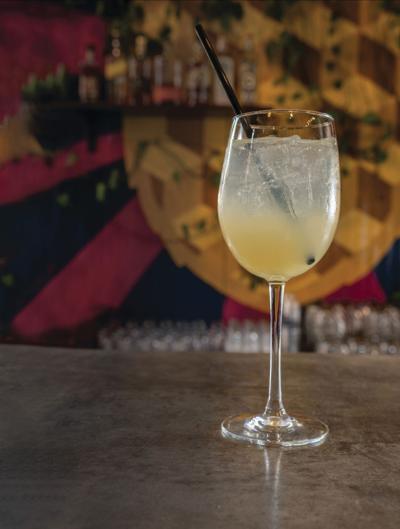


Limoncello Spritz at Monday Night Brewing
If I could get away with telling people I came up with something as good as limoncello — a tart, sweet digestivo that tastes like liquid summertime — I sure would. Indeed, both Sicily and Italy’s Amalfi Coast have staked a claim as its birthplace. Limoncello’s medicinal properties have been touted on occasion, though they are probably exaggerated: After all, the liqueur is primarily alcohol and sugar with fragrant, flavorful essential oils extracted from fruit zest suspended in it. But I do believe in the ability of limoncello and its cousins to cement new memories and evoke old ones. And that’s as important to me as the medications prescribed by my doctor.
One treasured memory includes three things from the dinner my wife Sarah and I enjoyed on the first anniversary of our first date, at the sadly now-shuttered 404 Kitchen: her warm smile, a phenomenal Korean wing appetizer and my first taste of limoncello, which was house-made. Today in Nashville, you can find limoncello at many wine shops and liquor stores, and fairly often in the form of a limoncello spritz — sometimes called an Amalfi spritz, it’s usually a blend of limoncello, sparkling wine and/or soda water, often with some aromatics — on the cocktail menu at bars or restaurants, usually those with Italian lineage.
East Nashville bar Strega has a limoncello spritz, as does Monday Night Brewing’s taproom in Germantown’s Neuhoff complex. Monday Night makes its spritz with housemade limoncello and cava. It’s a perfect patio drink, with a pleasingly light taste that leans into the sweet part of limoncello’s flavor profile without overpowering the invigorating zing. New York restaurateur Anthony Scotto’s Luogo and Pelato restaurants offer a limoncello margarita. I’m particularly curious to get to one of the periodic feasts at Mangia Nashville and try their sgroppino, a kind of spritz that uses housemade limoncello granita (a frozen, flaky concoction akin to sorbet).
My favorite way to enjoy limoncello is on my porch, out of a rocks glass with a generous splash of tonic water. I also love that I made it myself (with a kit Sarah got me that includes nice bottles). You don’t need any special gear though, since recipes are abundant online and the process is straightforward.
Pour 750 milliliters of your favorite vodka into a tight-sealing glass jar that will accommodate it with a little room to spare. Thoroughly wash eight big lemons and use the sharpest peeler you can find to zest the skin in big strips — you want to remove the outer peel, or zest, with as little as possible of the white part, or pith, to keep from making the finished product too bitter. (This works great with other citrus fruits including limes and grapefruit; arancello, made with oranges, is my new favorite. There are also intriguing recipes using berries.) Let the zest soak in the vodka in a cool, dark place for at least four weeks, or as many as eight.
When it’s time to decant, prepare 2 cups of simple syrup; recipes vary on the proportions, but rather than the standard 1:1 ratio, I like 0.75 cups sugar to each cup of boiling water. Divide the syrup evenly between the new vessel(s) that will house your limoncello — Mason jars are great. Add the liqueur base, which will now be a rich golden color, and then use a big funnel, a spoon and a cheesecloth (or even a couple coffee filters) to squeeze as much liquid as possible out of the zest. Chill and enjoy.

Plus, quenching our thirst for limoncello, issuing our first Malört Repört and sampling Tío Fun’s soft-serve margaritas



Post a comment as anonymous
Report
Watch this discussion.
(0) comments
Welcome to the discussion.
Log In
Welcome to the discussion.
Keep it clean. Please avoid obscene, vulgar, lewd, racist or otherwise abusive language. Comments featuring hate speech or threatening or violent content will not be tolerated.
PLEASE TURN OFF YOUR CAPS LOCK.
Be truthful. Don't knowingly lie or mislead.
Be proactive. Use the “report” link on any comment that violates our comment policy.
Share with us. We'd love to hear your feedback.