

First off, a couple of caveats. We’re still going to share the latest restaurant news and events here at Bites, but in these turbulent times, you need to expect frequent cancellations and reschedulings as conditions change. You have to determine your own risk tolerance as to whether you want to get out of the house and into crowded areas, but understand that many of these events are charitable and that much of the community is hurting right now.
The right cross and left hook combination of the recent tornado and ongoing Covid-19 crisis has buckled the knees of the Nashville culinary community, and potentially many of your favorite restaurants may find themselves going down for the count. If you need an idea of how dire the circumstances are, consider that just last week Seattle restaurateur Tom Douglas shut down a dozen restaurants for at least two to three months with little notice, and the respected Union Square Hospitality Group in New York shuttered an amazing 20 restaurants for the duration of the current health crisis, and then who knows when after that? And these guys didn’t even have a tornado to recover from.
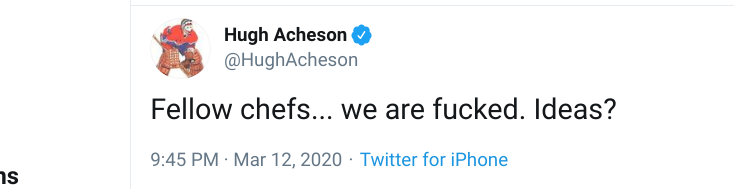
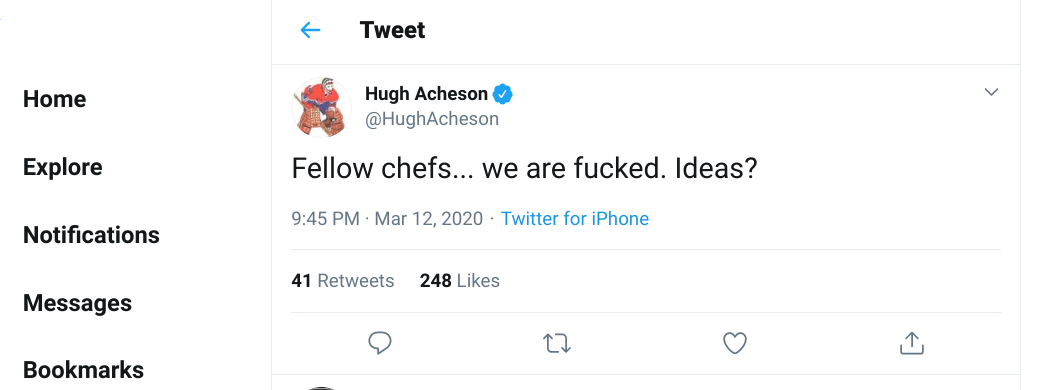
So let’s spend the next few days talking openly about the situation, and what we as Nashvillians can do to take care of ourselves and our friends in the restaurant business. First, the hospitality industry. Acclaimed Georgia-based chef and restaurateur Hugh Acheson could not have stated the current situation more succinctly when he tweeted last week, “Fellow chefs... we are fucked. Ideas?”
The thread of responses underneath this particular tweet was painful to read as restaurants and chefs from across the country admitted the strain they were feeling and posited potential solutions to get through these uncertain times.
The suggestions were very similar, concentrating on tightening staff and operations, focusing more on carry-out or delivery options and encouraging civic-minded patrons to buy gift cards in advance as sort of a short-term cash flow microloan. While this last solution is certainly admirable (and local pitmaster Carey Bringle is even offering to throw in a free roll of toilet paper with a $100 gift card purchase), it’s really just kicking the can about six inches down the road instead of some sort of real solution. And what are you going to do with all those gift cards if the restaurant doesn’t make it? They still live on the business’ balance sheet as a liability even after they offer that tiny bit of float.
Other suggestions were certainly altruistic, like cooking for retirement communities, shut-in seniors, furloughed hourly workers and kids missing out on meals at school. The positive public relations and genuine concern these efforts show to the community would be great, providing that the restaurant is in a strong enough cash position to take care of its own employees while giving away food.
Another idea that might have legs is local meal-prep service, instead of the national box delivery companies. If residents truly take self-quarantine seriously, there could be a real benefit to dropping off a week of packaged meals that are ready to reheat and eat, or just the ingredients already mise en placed if folks want to do a little more work for themselves and save some labor costs.
While food trucks are a difficult enough enterprise, several chefs said they might take their show on the road to feed the people where they live. It’s important to note that there has been no evidence (at this time) of any food-borne transmission of the Covid-19 virus, so the major risks to the public are from contact with restaurant staff and fellow patrons. This is a critical message for the industry to hammer home, but that comes with the responsibility to be even more fanatical about cleanliness. If a business expects to be at most 50% full for the next few months, it makes at least some sense to yank out half the tables as Metro Health has dictated, so diners will at least feel like they can maintain some additional social distancing? Of course, more drastic actions may soon be called for by the government which will force restaurant hands even more dramatically. And it's important to remember that individual diner's choices can go far beyond their own health as the rate of infection increases. This is certainly an ethical dilemma.
Culinary Accountants Inc. is the nation’s largest restaurant-focused financial firm. The Washington, D.C.-based company offered a list of suggestions as part of the responses to Acheson’s query, but the most striking one revolved around a single number: 40%. They suggest tracking year-over-year receipts each day instead of worrying about recent trends of before Covid-19 arrived on our shores and after the nation started fumbling around trying to figure out how to deal with it.
That critical 40% figure represents the tipping point in sales decline for most hospitality businesses. At 60% of regular sales number or above, a restaurant can make some draconian cuts while focusing on capital preservation and still hang in there for at least a little while. But at a greater than 40% sales decline, the model changes to where a restaurant will lose more money in utilities, rent and owner salaries staying open than by closing. At this point Culinary Accountants suggests that a restaurant should strongly consider closing, at least temporarily, and try to wait out the storm, just like Douglas and Union Square's Danny Meyer did.
So Nashville diners, if you do read here or somewhere else that one of your favorite restaurants has thrown in the towel (what is it with all these boxing metaphors?), understand that it might not be forever. Sometimes these difficult times call for drastic measures, but there will likely be better times ahead after the storm has passed.
Tomorrow we’ll talk about what you as diners can do to help sustain these important parts of the community during the downtime.



