
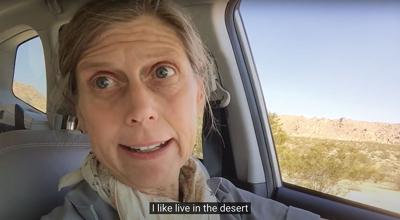


Still from Anonymous Was a Vlog, Mary Addison Hackett
About three-fourths of the way into Mary Addison Hackett’s Anonymous Was a Vlog video series, she confesses that she’s put a moratorium on her painting practice. “I’ve put a moratorium on my painting practice,” she says. For those of us who have known and loved Hackett’s wild, diaristic paintings, this is potentially devastating news. But it’s delivered with such a singular charm — a combination of choppy editing and deadpan delivery that becomes familiar after watching several minutes of the videos — that, instead of mourning the loss of her paintings, you really just can’t wait to see what it is that she’ll do next.
Anonymous Was a Vlog is around 45 minutes of 20 video vignettes that are played on a loop in the Unrequited Leisure gallery space. Aside from the artist and an occasional appearance from her Jack Russell terrier Agnes, the main character in the videos is the Mojave Desert, where Hackett was living at the time. The heat and the wilderness are overwhelming but compelling specters. At one point, she discusses the possibilities of creating an outfit out of the blue cooling packets you can keep in your freezer. In another video, she explains away the darkness as a way to cool her home: “I’ve covered the windows with aluminum foil.” She moved to the desert from her home in Nashville after the 2016 election.
“Looking back, I might have overreacted,” she says dryly in her artist’s statement, “but after the 2016 presidential election, I had a ‘Heads we stay, tails we go’ moment. Even though I come from a privileged background, I no longer felt buffered by that privilege. Politically speaking, my home state of Tennessee felt either cruel or apathetic. In 2017, I sold most of my belongings and relocated to a rural parcel of land in the Mojave Desert and began practicing modern-day homesteading.”
The series takes its name from a line in Virginia Woolf’s A Room of One’s Own — “For most of history, Anonymous was a woman.” — and undercurrents of feminism and self-sufficiency exist throughout. In one video, Hackett claims that the project is apolitical, but the confounding, exasperated anger and despair around the Trump presidency is hard to shake, much like how artwork made during the COVID pandemic can’t really escape being at least partially informed by it. Speaking of the pandemic, the timing of Hackett’s decision to isolate herself in the desert for the two years is striking. The dateline at the end of each video reminds you that this is a time capsule of the years between Trump’s election and COVID, and Hackett’s fixation on simple coping strategies like making smoothies and sewing dog carriers seems strangely prescient.
Hackett describes the work in one of her vignettes, which she calls “really lo-fi down-and-dirty aesthetic/non-aesthetic videos.” It’s a welcome bit of self-reference — her awkward timing and banal subject matter would be funny regardless, but knowing that Hackett is in on the joke ensures that it’s a shared joy. Her monologues are off-the-cuff, but she’s always charming and astute — like a Spalding Gray for 21st-century women artists.
In one video, she says she plans to Google how to quit social media, then questions whether it’s possible to exist without it. “Those of us who are, like, cultural producers — we don’t exist without the internet,” she says. “It’s not 2006 anymore. I’m tired of trying to be talented, funny, skillful, charming. Tired of having labels. Someone once told me that the art world doesn’t really like funny. The art world can handle tacky, shallow, overly academic. Funny doesn’t really do it.”
At the collection’s halfway point there’s an unusual installment called “Nature Girl” that acts kind of like an interlude. In it, Hackett has edited herself into a stilted CGI green-screen background with the soundtrack for Jesus Christ Superstar playing over her. After she spends a few videos speaking about her migraines and fantasies about trepanning herself, the refrain — which she’s edited to trip over itself like a broken record, “Jesus Christ! Jesus Christ! Jesus Christ!” — seems less like a religious reference and more like a series of exasperated cries.
The series begins with Hackett filming herself with her phone in her car, looking at herself instead of directly into the camera with that off-center look that’s familiar to all of us who’ve grown uncomfortably familiar with Zoom. When Hackett squints to keep the sun out of her eyes, I’m reminded of other strong women in documentary cinema — namely, the Beales of the Maysles brothers’ classic Grey Gardens. Hackett shares the Beales’ vulnerability and strength, and the confessional center of the work is just as indescribably captivating as watching Little Edie talk about wearing pantyhose over a skirt.
By the time Hackett’s series is over, we’ve seen her move from a strange quirky recluse to a spirited frontierswoman. She sings along to David Allan Coe’s “You Never Even Called Me by My Name” with the spunk of Little Edie’s Fourth of July choreography. The video, titled “Slutty Sunday Lip Sync,” closes the series with an uplifting tone.



