
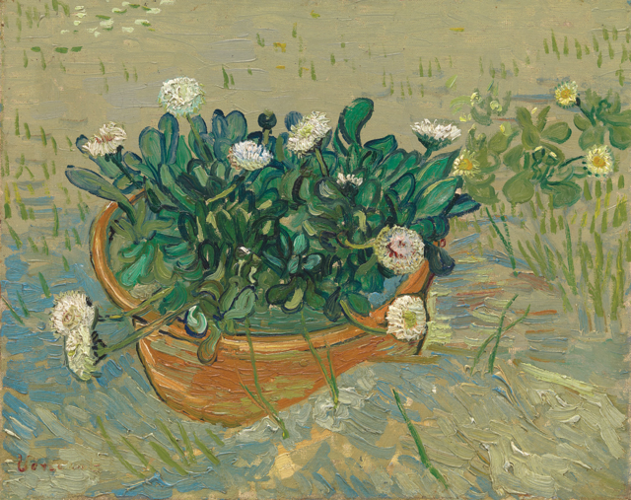


“Daisies, Arles,” Vincent van Gogh. Virginia Museum of Fine Arts, Richmond, Collection of Mr. and Mrs. Paul Mellon, 2014.207. Image © Virginia Museum of Fine Arts.Photo: Travis Fullerton
When Paul Mellon and Rachel “Bunny” Lambert Lloyd married in 1948, their tastes in art diverged significantly. Bunny, a Francophile at heart, adored Impressionist and Post-Impressionist works that reflected her interests in horticulture, interior design, people and Paris. Paul, however, sought art that satisfied his fascinations with horses and English gentry. The exhibitions open now at the Frist Art Museum — Van Gogh, Monet, Degas, and Their Times: The Mellon Collection of French Art from the Virginia Museum of Fine Arts, and A Sporting Vision: The Paul Mellon Collection of British Sporting Art From the Virginia Museum of Fine Arts — demonstrate what a couple armed with seemingly endless resources could accomplish when their tastes came together.
The affluent pair frequented galleries in New York and Paris, pursuing works that spoke to them. The exhibitions in the Frist’s Ingram Galleries create a portrait of a couple who enjoyed luxury and avoided art with overt political overtones or challenging aesthetics.
“These paintings and sculptures reveal their tastes for the intimate, for jewel-like works of art,” the Frist’s chief curator Mark Scala tells the Scene via email. “Often these were studies or sketches, showing their appreciation for the artistic process and reinforcing a casual aesthetic they maintained in their home and environs.”
The Mellons’ penchant for acquiring art by significant 18th-, 19th- and 20th-century artists indicates the couple’s connoisseurship. The French section contains more than 70 works by artists such as Vincent Van Gogh, Claude Monet, Edgar Degas, Paul Cézanne, Odilon Redon, Pierre Bonnard, Henri Matisse and Pablo Picasso. Meanwhile, the Sporting Vision exhibition features more than 65 works by artists including George Stubbs, Sir Francis Grant, John Frederick Herring, Benjamin Marshall and George Morland.
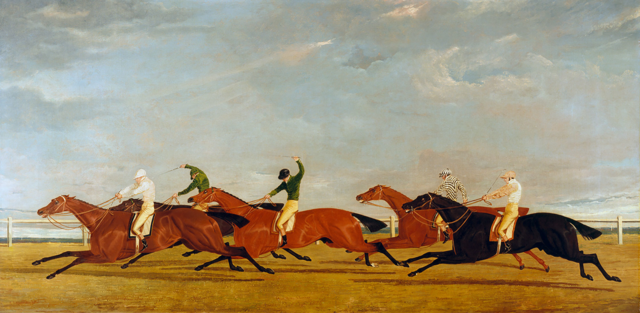
"The Final Lengths of the Race for the Doncaster Gold Cup," John Frederick Herring, Sr. Virginia Museum of Fine Arts, Richmond, Paul Mellon Collection, 99.79. Image © Virginia Museum of Fine Arts.Photo: Katherine Wetzel
The exhibits are organized thematically rather than chronologically, which invites viewers to compare how artists approached similar subjects over 150 years. A group of French equestrian paintings showcases myriad aspects of horsemanship. Théodore Géricault’s “Mounted Jockey” depicts a horse and rider recovering from a run. Géricault shows the animal’s mouth covered in white foam from exertion, feet lifted in motion and eyes wide open, imbuing the horse with the drama often seen in Romantic period paintings. Degas’ “Jockey in Blue on a Chestnut,” which was created 68 years later, lacks the same emotional tone. His impulse was to present a horse changing directions from behind. The twisting animal harmonizes with the landscape through line and color. The asymmetrical balance of the composition suggests the potential energy of the horse to gallop away into the expanse.
An array of portraits and figures explores representations of identity and personality. Degas’ “The Little Dancer, Aged Fourteen” exudes charm. The model holds a formal ballet pose, but her facial expression, relaxed upper body and clasped hands suggest a childlike defiance of elegance. Nearby, Berthe Morisot’s painting of her sister in the family garden exemplifies the radical-at-the-time Impressionist mission of elevating everyday scenes and using experimental painting techniques. Morisot was a woman in 19th-century France, and many of her observations came from her daily experiences at home. In “Young Woman Watering a Shrub,” she presents an exuberant combination of loose brushstrokes and subtle, shifting colors to capture a sense of the fleeting moment. At the time it was made, this painting would have been dismissed as unfinished because of its sketch-like quality. Today, Impressionist art allures the public, and these types of images can be found on mass-produced objects from socks to stationery.
Nature inspired the Mellons, and significant portions of the art in both exhibitions evoke bucolic escapes. The French exhibit contains whimsical landscapes like Monet’s “Field of Poppies, Giverny” and carefree floral arrangements such as Van Gogh’s “Daisies, Arles.” While Henri Rousseau’s “Tropical Landscape” fits within a discussion of nature motifs, the inclusion of a Native American fighting a gorilla contrasts with the otherwise genteel vistas. This type of subject is offensive now, but what did it mean then?
Unraveling the perplexing imagery, Scala explains: “There was a cultural fascination [in Paris] with both Native Americans (who for many embodied the philosophical premise of the noble savage) and gorillas (which were often assumed to be brutal killers, or alternately to represent the ‘missing link’ that people deduced from Darwinism). These exotic aspects of the world were often brought back to Paris to be displayed in zoos, both animal and human.” Unfortunately, clarifying the cultural context of this art provides no solace, and this presentation of racist imagery reminds viewers today that stereotyping is deeply embedded in Western culture.
A Sporting Vision features art devoted to Paul’s interests in leisure activities in nature, particularly those enjoyed by British landowners. Paul’s elite lifestyle in Pittsburgh and frequent travels to the English countryside ignited his obsession with uppercrust English culture. After studying English literature at Yale, he continued his education at Cambridge University, and during his studies he took up foxhunting — a sport he relished for the next 50 years.
Multiple paintings depict English fox hunt scenes presenting key moments of the sport. “Fox Hunting: Full Cry” by John Cordrey evokes the excitement of the pursuit by showing the huntsman and hounds chasing the fox at top speed. “Sir Mark Masterman Sykes’ Hounds with Huntsman” by Henry Bernard Chalon highlights the sport’s reliance on defined roles. He includes a drably dressed terrierman whose job included blocking fox holes before and during the hunt. The servant stands by with his shovel ready to support the elegantly attired huntsmen mounted on horses. The juxtaposition emphasizes the class hierarchy, and also documents traditions. “The artworks tell as much about customs and manners, class and colonialism as about horses and foxhunting,” says Scala.
Like the fox hunt paintings, the fishing and shooting scenes exude wealth and diversion. They feature white men wearing top hats and suits while sporting. It’s an odd sight, since today’s sportsmen seem to prefer comfort and practicality. At the time of these paintings, laws limited hunting of some animals to landowners only. The guns they carried, the clothes they wore, the cultivated dog breeds they owned and the animals they hunted all indicated status.
A standout series, Count Sandor’s Hunting Exploits evokes feelings of schadenfreude. The 10 paintings depict the count’s dismal attempts to practice horsemanship. Seeing the images of a man repeatedly falling off horses is harrowing, but imagining the count commissioning these paintings of his failures is hilarious. The comedy subsides when you learn that the count eventually died from brain damage resulting from his numerous falls. It’s impossible to say, but these spectacularly ungraceful efforts may have entertained Paul.
The exhibitions at the Frist represent the tip of the Mellon’s collection. The couple gave more than a thousand artworks to the National Gallery of Art and supported other institutions such as the Virginia Museum of Fine Arts and the Yale Center for British Art. The Mellons’ lives are an unattainable fantasy for most art lovers, but their gifts provide public access to significant art. Complete with romantic undertones, the exhibitions reveal the couple’s mutual appreciation for art and for each other.



