
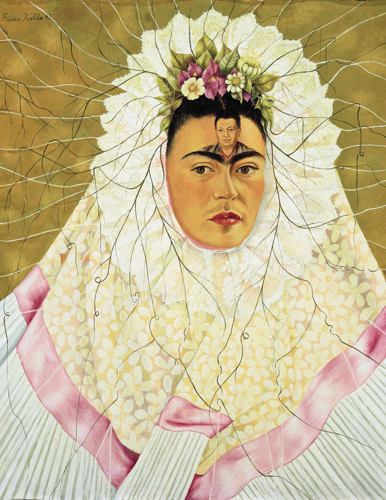


“Diego on My Mind (Self-Portrait as Tehuana),” Frida Kahlo. The Jacques and Natasha Gelman Collection of 20th Century Mexican Art and the Vergel Foundation. © 2019 Banco de México Diego Rivera Frida Kahlo Museums Trust, Mexico City / Artists Rights Society (ARS), New York
Today, the star of any early-20th-century Mexican art show is Frida Kahlo. This is evident in Frida Kahlo, Diego Rivera, and Mexican Modernism From the Jacques and Natasha Gelman Collection, open at the Frist Art Museum now through Sept. 2. The show features numerous seminal Mexican artists, such as Diego Rivera, Manuel Álvarez Bravo, María Izquierdo, Rufino Tamayo, José Clemente Orozco and David Alfaro Siqueiros, but most of the exhibition is dedicated to Kahlo. Fans who are fascinated by her biography, her fashion, her artwork, her gardens, her feminism, her politics and her cuisine will flock to the Frist — but Kahlo was not as universally known during her lifetime. She won many awards and exhibited internationally, but at the height of Kahlo’s art-making, her husband Diego Rivera’s name was gold.
Mexican Modernism includes several movements. After the Mexican Revolution, which lasted from 1910-20, the newly formed government commissioned murals meant to unite the public through explorations of Mexico’s cultural ancestry. Artists in all media created sociopolitical art that contributed to this conversation. The dominant theme of the time was mexicanidad, which is recognizable in art that embraces Mexico’s indigenous roots, natural environment, culture and people. Some works give damning presentations of the abuses that native populations suffered at the hands of the Spanish. But not everyone shared these motivations. Some artists rejected the nationalist ideology and added surrealist, personal and formalist perspectives to the history of Mexican art. A benefit of the exhibition is that it highlights various approaches.

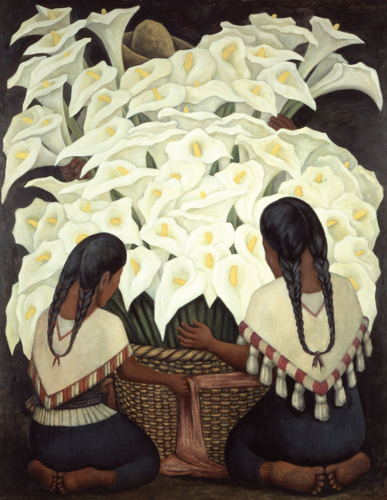
“Calla Lily Vendor,” Diego Rivera. The Jacques and Natasha Gelman Collection of 20th Century Mexican Art and the Vergel Foundation. © 2019 Banco de México Diego Rivera Frida Kahlo Museums Trust, Mexico City / Artists Rights Society (ARS), New York
“Calla Lily Vendor” by Rivera stands out as an elegant example of incorporating mexicanidad through a scene of everyday life. This well-known artwork features two children of native descent bundling flowers for a man who will walk the streets selling them from his back. The painting elevates the people performing these common tasks and presents them as essential to Mexican culture.
Connecting to her indigenous heritage, Kahlo selected the Tehuana dress as her signature attire. The colorfully patterned and elaborately embroidered dresses accented with starched-white laces are worn by Tehuantepec women, mostly of Zapotec descent, who live in the Oaxaca region of Mexico. Kahlo selected Tehuana clothing in particular because her mother was from Oaxaca, but she also certainly embraced the dresses as a symbol of female empowerment. The culture is known for its matriarchal society, wherein women make public decisions and earn more than men. You can explore Kahlo’s fashions in the exhibition through her paintings and a collection of Tehuana-style sets that include the huipil (tunic), resplandor (headdress) and bolan (flounce).
Of the 10 paintings by Kahlo in the exhibition, seven are self-portraits. You may wonder why Kahlo produced so many paintings of herself, and she addressed this directly: “I paint self-portraits because I am so often alone,” she was quoted as saying, “because I am the person I know the best.” After surviving polio as a child, and suffering a broken spine, pelvis, foot and collarbone in a bus accident as a teenager, she spent much of her life bedridden and in chronic pain. She underwent approximately 30 operations to repair her body, but she never fully recuperated. Portraits by photographers including Lola Álvarez Bravo and Graciela Iturbide document the tortuous body casts, wheelchairs, crutches and hospital rooms that were part of her life.
The impact of the accident appears in the subject and size of Kahlo’s art. A rod pierced her womb, leaving her unable to bear children. Evidence of her anguish appears in “Frida and the Miscarriage.” The intimate lithograph reveals an attempt to process the traumatic life event through a scientific-style illustration. This work, like many of her drawings and paintings, is relatively small — the dimensions of these works recall the restrictions Kahlo faced making art while spending weeks in bed recovering from surgery.
The pain Kahlo confronted each day was matched by her relationship with Rivera. Take her recollection: “I suffered two grave accidents in my life,” she is often quoted as saying. “One in which a streetcar knocked me down. … The other accident is Diego.” Rivera’s constant flow of mistresses, including Kahlo’s sister, irreparably wounded Kahlo. The show’s poster image “Diego on My Mind (Self-Portrait as Tehuana)” distills a difficult moment of their relationship. In the painting, Rivera appears on her forehead as her third eye, which suggests he is central to her thoughts. Her penetrating gaze and the vines that have overgrown her headpiece are like spiderwebs that trap her prey, Diego.
Kahlo’s art can suggest that her identity was wrapped up in her marriage with Rivera, and this was certainly part of public perception. Their relationship even seeped into reviews of her art. In a critique published in Vogue about The Two Fridas, an exhibition on view at the New York Museum of Modern Art in the 1940s, Frank Crowninshield wrote: “The most recent of Rivera’s ex-wives was a painter apparently obsessed by an interest in blood.” This reductive quotation does not resonate today. Kahlo developed her own style and subjects that have captured the imaginations of generations. Today we can stand back and applaud her bravery for creating vulnerable artworks in which she processes the messy details of life and expresses the beauty she experienced.
The exhibition of Jacques and Natasha Gelman’s collection, while presenting a rather tame view of Mexican Modernism, excels as a starting point for appreciating Mexico’s art and culture. The Gelmans, an immigrant couple who met in Mexico after fleeing Eastern Europe during World War II, surrounded themselves with art that had a somewhat familiar European format — but with a Mexican feel. Their purchases supported contemporary artists and have created lasting artistic legacies. With a roster of significant artists and the emphasis on Kahlo, this show curated for the Frist by Trinita Kennedy warrants the crowds it is already drawing.



