

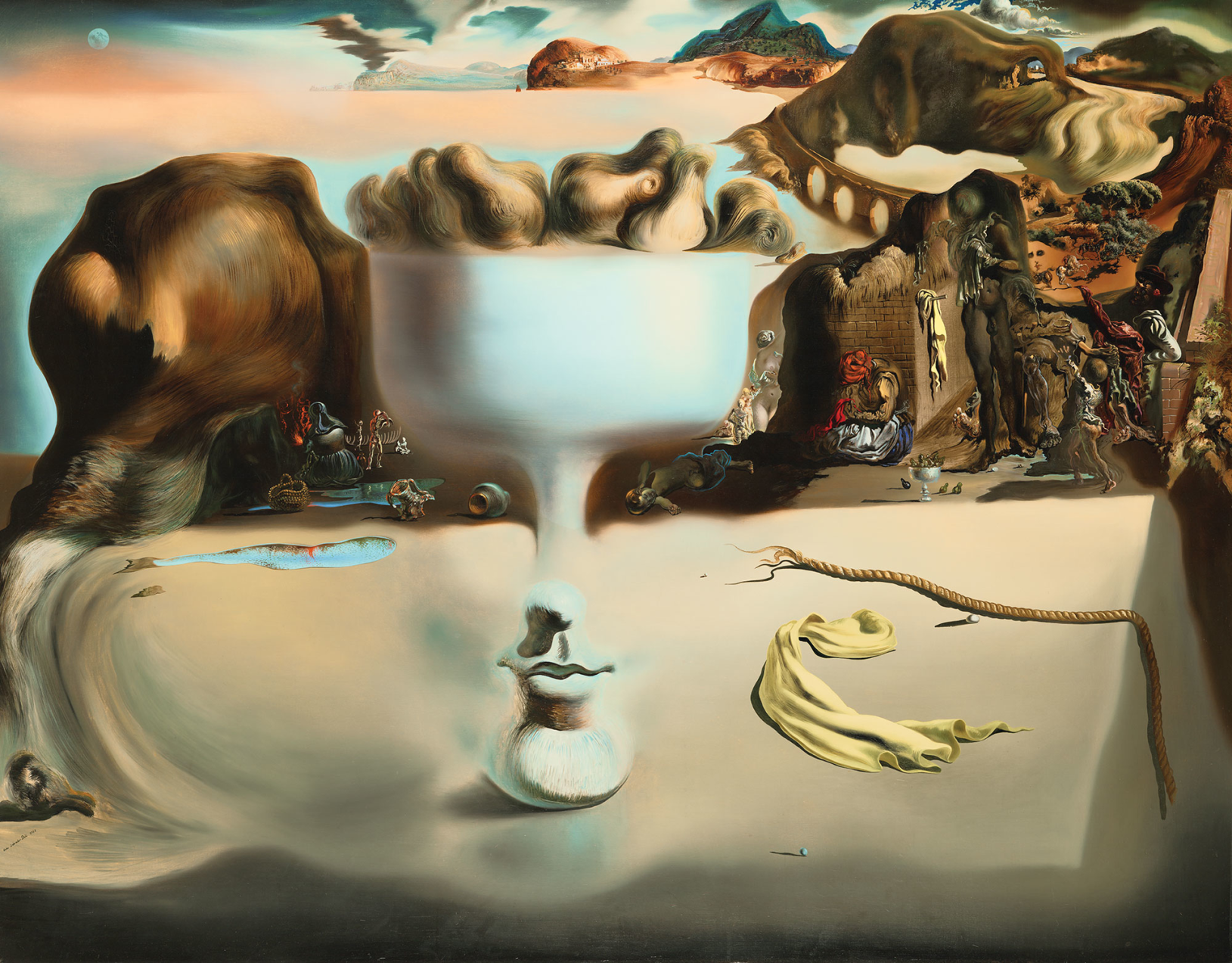
"Apparition of Face and Fruit Dish on a Beach,” Salvador Dalí
In the lead-up to WWII in Europe, artists struggled to respond to a culture that had blown itself to hell during the so-called War to End All Wars, and was about to do it all over again just two decades later.
Dadaism answered the savage, mechanized carnage of World War I with disgust expressed in irreverent artistic absurdities. The Surrealists borrowed attitudes and techniques from Dada, and added new insights informed by Sigmund Freud’s groundbreaking theories about the subconscious mind. The results were idiosyncratic, individualistic artworks filled with dreamlike images and teeming with creatures. Surrealism made its stand against the rise of fascism in Spain and Germany by tapping both modernism and the mythic heart of Western antiquity. Monsters & Myths: Surrealism and War in the 1930s and 1940s opened at the Frist Art Museum June 20 — just in time for the summer solstice. And it seems fitting that such a dark, disturbing exhibition debuted in counterpoint with the longest day of the year.
Featuring works by Salvador Dalí, Luis Buñuel, Max Ernst, René Magritte, Joan Miró and Pablo Picasso, Monsters & Myths includes nearly 80 paintings, drawings, prints, photographs, sculptures and periodicals, mostly drawn from the collections of the Baltimore Museum of Art and the Wadsworth Atheneum Museum of Art. The exhibition presents its monstrous menagerie in themed gallery groupings that bring historical, political and sociological context to the story of Surrealism.

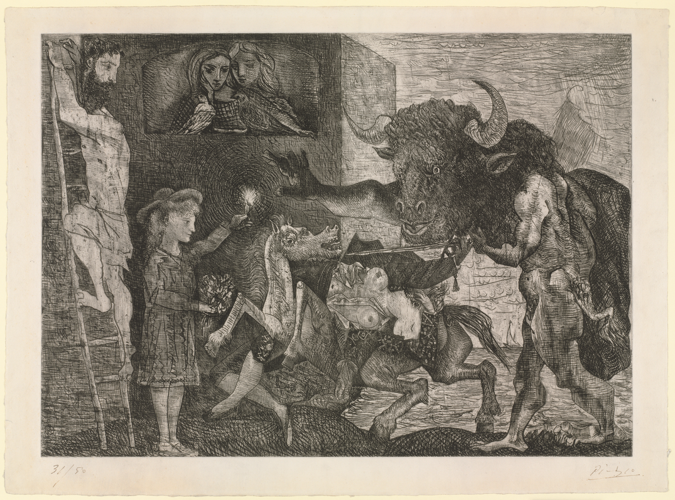
The Baltimore Museum of Art: Gift of Israel and Selma Rosen, Baltimore, 1979.72. © 2019 Estate of Pablo Picasso / Artists Rights Society (ARS), New York.
Entering the gallery titled The Emergence of Monsters, viewers are immediately confronted with just how creepy-creature-forward this exhibition really is. At the time of the works’ creation, the Surrealist artists’ deformed hulks, grinning demons and colorful chimeras stood in for real-life monsters like racism, nationalism and the easy violence of fascism. Also reflected in the works are the struggles of traumatized former soldiers searching for a place in peacetime Europe after World War I. A highlight here is André Masson’s 1938 painting “In the Tower of Sleep,” which features a creature composed of red, raw, writhing musculature supporting a head with a triangular mouth that simultaneously resembles a bird’s beak and a section of pomegranate — a darkly fantastical figure inspired by the violence Masson witnessed as World War I soldier. This work predicts the body horrors of Francis Bacon while also dreaming up a Demogorgon almost four decades before the demon prince first slithered through the Dungeons & Dragons universe.
Masson’s monster is personal, but most of the beasts and apparitions in the exhibition borrow from the Western mythological canon, and the bull-headed Minotaur is especially well-represented. Classical art celebrated the hero Theseus as a murderer of monsters like Medusa and the Minotaur, but for Surrealists, the man-eating Minotaur in his underground maze was more inspirational: the embodiment of the darkest urges dwelling in the subconscious mind. Pablo Picasso’s etching “Minotauromachy” depicts a mythological bullfight featuring bull and wounded-horse imagery that would later reappear in the artist’s war-protest masterpiece “Guernica.” Minotaure was also the title of an art magazine published between 1933-1939. The publication was the public face of Surrealism in the 1930s, and Monsters & Myths includes several of the colorful zine-like journals.
Like Picasso, other Spanish artists wielded Surrealism’s strange magic in the fight against fascism. Salvador Dalí’s “Apparition of Face and Fruit Dish on a Beach” is a remembrance of Dalí’s late friend, the poet Federico García Lorca, who was killed by fascist forces shortly after the Spanish Civil War began in 1936. Here Dalí employs the painterly illusions that are his signature: The canvas pictures the titular fruit dish, but the negative space defined by its tall, curving stem evokes the face of the poet.
In another corner of the gallery, a quartet of works by Joan Miró features the artist’s unmistakable bold palette and compositions of dancing abstracted elements. One poster image created by the artist in 1937 was meant to rally the Spanish people against the rise of the dictator Francisco Franco. “Aidez l’Espagne (Help Spain)” features colors from the Spanish and Catalan flags, and it pictures a Popeye-like prole raising his right fist and oversized forearm in solidarity with the Spanish Republic. The inclusion of the “1 FR” price tag in the design reveals that the poster was originally commissioned as a French postage stamp.
As World War II began, Surrealists who’d stood up to the rise of Franco were now faced with Hitler and the Third Reich, the German annexation of Austria, and the Nazi invasions of Poland and France. Works from this period offer a window into the circumstances of these artists’ lives — many of the Surrealists fled Europe for America, still continuing to fight the good fight on the surfaces of their canvases. The best painting in the exhibition is Max Ernst’s stunning “Europe After the Rain II” — an infinitely textured scene of bizarre figures melting into an alien landscape. The work emanates the air of paranoia of the place where it was begun (in France at the outbreak of the war) and the colors and shapes of the place where it was completed (among the otherworldly chromatic rock formations in Sedona, Ariz.).
When the Surrealists came to America, they made an impression on the Stateside art scene, and Monsters & Myths includes a number of works by American Surrealists, including Max Ernst’s American wife, Dorothea Tanning. My favorites in this section include Mark Rothko’s “The Syrian Bull” — a Lovecraftian depiction of a mythological creature, and Robert Motherwell’s action-packed lithograph of a reptilian menace, “Monster.”
Monsters & Myths admirably feels more like a spooky autumnal affair than a summertime attraction catering to Nashville’s warm-weather tourists. That said, the current re-emergence of neo-fascists across the West makes the exhibit’s themes timely. 2019 is not 1939 or even 1969 in terms of cultural turmoil or authoritarian threats. But this exhibition reminds us that art — like the thread in the Minotaur’s maze — can connect us to the daylight even as we confront our monsters.



