


Louisiana Bendolph
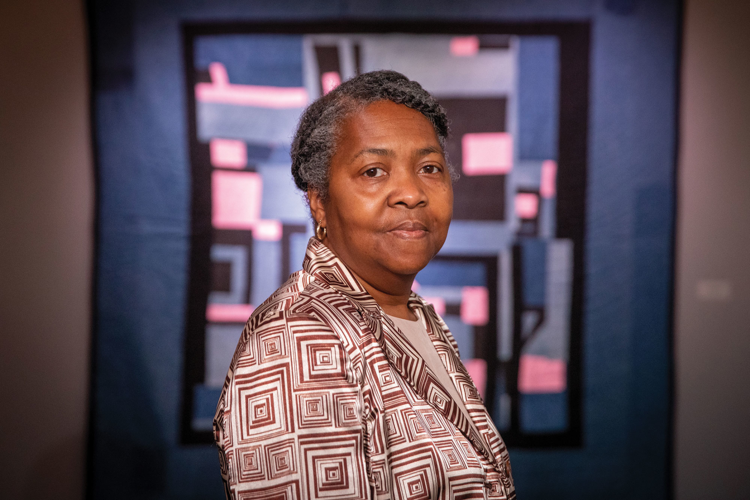
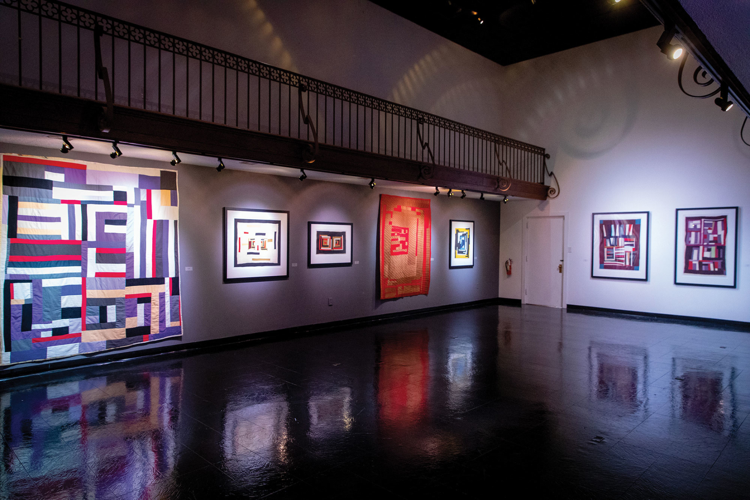
Walking through the dimly lit University of the South art gallery, it’s easy to forget just where the Gee’s Bend quilts hanging throughout the gallery came from. Each one is brightly spotlit and reflected on the glossy black floors beneath. But if you’re lucky enough to have quilter Louisiana Bendolph as your guide, you might begin to come close to understanding what Gee’s Bend is like.
Gee’s Bend is a small rural community in Alabama’s so-called Black Belt that became recognized for the unique quilting style of its inhabitants. The asymmetrical, intuitive presentation is immediately recognizable, and is considered by many to be among the most influential contributions in contemporary American art history.
Bendolph, who grew up in Gee’s Bend but now lives in Mobile, Ala., is the great-granddaughter of one of the original Gee’s Bend quilters, Annie E. Pettway. Bendolph came to Sewanee to participate in a group sewing circle and speak to students about her experience as a Gee’s Bend quilter. Before she did that, she led me through the exhibition in the university’s gallery, which puts quilts and prints by Louisiana and her mother-in-law Mary Lee Bendolph alongside mixed-media work by Lonnie Holley and the late Thornton Dial. The four artists are represented by the Souls Grown Deep Foundation, a nonprofit that promotes the art of contemporary African Americans from the Southeast. To help explain how the quilts fit into her life, Bendolph started at the very beginning.

How old were you when you first started quilting?
I was 12, but I didn’t want to — it was expected of you.
Right, because your mother does it, your aunts do it.
And my great-grandmother did it. So I was expected to do it.
Do you have daughters?
I have four daughters, and before you ask — they don’t.
They don’t quilt?
No, they don’t. They just didn’t want to, and now they don’t want to. Because, really, they never saw me making quilts — because when I got married, I had stopped. ... I just didn’t really want to. For a long time, I stopped. Then, maybe about every five years or so I would probably pull out something and work a little bit. But then I went back to it in 2002 ... and I saw my great-grandmother’s quilt, that’s when I went back.
So what was the first piece that you made when you came back to quilting? Was it a lot of pressure?
You know what? I can’t remember the first one I made when I came back to quilting. Because I went on a sewing spree.
Gee’s Bend quilts obviously have a style, but the individual quilters do too. There’s a lot of color-blocking with your work. Do you feel like you have a specific style?
I call it a new generation of housetop quilts. It’s housetop, but broken into something new.
Are there any colors or fabrics you’re drawn to that you find yourself returning to over and over?
Sometimes there’s going to be black just about everywhere.
How do you feel about having your work shown with work by Lonnie Holley and Thornton Dial?
You couldn’t be in better company. I love the people they are, not just the work, because their work really speaks for them. And it tells how deeply they feel.
You’ve said that you think Dial and Holley would bring events from their lives into their art. We’ve talked about your quilts on a visual plane, but do you feel like there’s another meaning? Does the work pick up on what you’re going through at the time?
I think so. Because like I said, I was using a lot of black at one point. You know, we just had so much going on — not good stuff. And it just kind of like —
Darkens it a little?
Yeah. And you think about your life, and you think about where you came from, how far you’ve gone. And then you think about how blessed you’ve been. I think about my great-grandmother, and all the older women in Gee’s Bend. All the things they went through. And then to see them be able to experience all this — I mean, my great-grandmother never left Gee’s Bend, so to know that her quilt has just been all over.
Your great-grandmother was one of the original quilters, and you were very young when she died, right?
I’ll never forget — I think I was around 12, and I remember my brothers and my sister, we were sitting on the front porch. And to this day I can still see her — ’cause you know, back then they would carry people out in the black bags. They would zip them up and take them out. And I will never forget that day. I remember we were sitting on the porch and we were swinging our legs, and she was leaving.
How do you feel about the way your work is exhibited now? Is there anything about this installation that you’d like to point out?
Did you see the reflection? Did you see the reflection, and the prints, they’re shining. It’s not just about where you come from, but who you become, and who you are. And that just being kind to people and respecting people, and really feeling. Have you ever been at a place where you can truly feel the pain of somebody else? I think a lot of the time if we as people put ourselves in that position to feel somebody else’s pain, we wouldn’t do as many bad things that we do. I think the world would be a better place if we would just feel a little bit more.



