

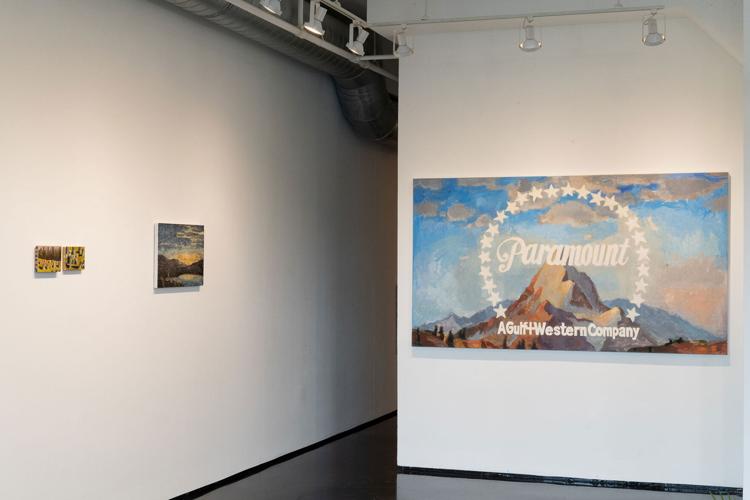


I’m kind of a sucker for all the bright bouquets of botanical art we inevitably see in galleries every spring. It’s a predictable programming choice, but it really does scratch the itch for vibrance and color, especially after enduring months of dark and cold. One of the highlights of the spring art season is Suspect Terrain, which speaks to the idea of a primavera landscape display while also turning that idea on its head. It’s a group show of three artists who replace bursting blossoms and growing gardens with references to pop and consumer culture. That replacement undercuts the idealized visions of historic landscape painting, and even calls into question what landscape painting can be as a living category of contemporary art.
Suspect Terrain at Tinney Contemporary brings together Ripley Whiteside, Morgan Ogilvie and Caitlin Blomstrom, three Nashville-area painters who share a preoccupation with unstable ground: ecological, psychological or perceptual.
Whiteside’s paintings, drawings and prints engage with the dynamics of ecology in motion, haunted by the premise that we cannot fully comprehend our impact on a rapidly changing natural world. It’s a smart take on a big subject, and Whiteside often uses watercolor and ink to capture the vast and complex questions he explores in his studio.
The artist lives and works in Nashville, and teaches painting and drawing at Belmont University. In Suspect Terrain, Whiteside copies the paintings of the Hudson River School painters who helped define American art in the early 19th century. Thomas Cole was the group’s founder, and Whiteside’s “After Thomas Cole’s Catskill Creek” takes its inspiration from about a dozen paintings Cole made of the eponymous waterway.

“After Frederic Church’s Hudson Valley, New York at Sunset,” Ripley Whiteside
Likewise, “After Frederic Church’s Hudson Valley, New York at Sunset” offers Whiteside’s own take on the landscape that inspired one of the earliest art movements in the United States. Whiteside finishes these works with varnish and wax before pressing blocks of Styrofoam into the surfaces. The impressions they leave create a vintage look for these period-provoking pieces. The Styrofoam itself is sort of a punch line about how the consumer-industrial complex has spoiled these natural spaces with development and forever garbage.
Blomstrom is a Nashville-based artist, curator and arts administrator whose oil paintings recontextualize quiet, mundane encounters into compositions that upset the expectations of landscape painting, rendering the everyday simultaneously familiar and uncanny. Works like “Skeletons for Lumin” are inspired by the giant inflatable Halloween lawn monsters you can buy at Home Depot. But in the context of Blomstrom’s small linen-covered panels, these bony portraits read like memento mori wandering into the midst of these renderings of the bucolic ideal.
Blomstrom’s two paintings of Temple Cemetery are similarly focused on the dark side of the idealized natural, picturing the historic 9-acre green space — and Tennessee’s oldest Jewish cemetery — in the shadow of looming urban sprawl. Even death may not save these Nashvillians from the turbulence of runaway growth.

False Flags opens Feb. 10 at PRPGMX
Ogilvie’s deliciously loose and gooey paintings are typically populated by misunderstood female antiheroines drawn from film and cultural history — think Dorothy from The Wizard of Oz and Rosemary from Rosemary’s Baby. The artist is a Nashville native currently living and working in Franklin. She regularly pictures iconic unreliable female narrators whom she explicitly declines to rescue. Her contributions to Suspect Terrain take a different approach and trade figures for thresholds. A series of close-ups of cracked-open doorways borrows from films that have become landmarks in contemporary cinema and mass psychology. “There’s no place like home” pictures the doorway Dorothy opens to enter Oz in one of cinema’s most magical moments. “This is no dream (door ajar)” pictures an open door clanging against a security chain from a frame of Rosemary’s Baby. These works argue that psychological landscapes are landscapes too, and that suspense, dread, wonder and terror can loom on the other side of a doorframe as well as beyond the dark tree lines of a painted horizon.

Suspect Terrain installation view
The closest Ogilvie comes to a traditional landscape is on a large rectangular canvas, where she offers her impasto take on the mountain peak in the star-spangled Paramount Pictures movie studio logo. It’s not a landscape Thomas Cole would have understood, but Andy Warhol would have loved it.
Suspect Terrain is not your usual springtime art exhibition — and that’s why it’s a must-see. It’s full of work by talented painters, but it’s also a display brimming with irreverence and a rascally sense of play. Art is always in danger of taking itself too seriously, but Suspect Terrain sends up the historical canon and the idealized narratives it’s built, then refuses to play by the rules when it comes to the tropes that define landscape art as a genre.
The exhibition avoids the clichés of spring season art programming, but somehow still manages to deliver a display full of colorful personalities and vibrant ideas. It’s a show that knows exactly where it stands — even as it keeps viewers off balance.



Post a comment as anonymous
Report
Watch this discussion.
(0) comments
Welcome to the discussion.
Log In
Welcome to the discussion.
Keep it clean. Please avoid obscene, vulgar, lewd, racist or otherwise abusive language. Comments featuring hate speech or threatening or violent content will not be tolerated.
PLEASE TURN OFF YOUR CAPS LOCK.
Be truthful. Don't knowingly lie or mislead.
Be proactive. Use the “report” link on any comment that violates our comment policy.
Share with us. We'd love to hear your feedback.