


A mirror is never neutral. It returns your gaze, but it also distorts and narrates. In Cut Out the Tongue, a mixed-media group exhibition curated by Alexis Özden (Öz), mirrors are everywhere — both literally and in symbolic reflections. There are reflective materials, dualities and repeated patterns. And where there isn’t a mirror, there’s often an eye — itself a type of mirror.
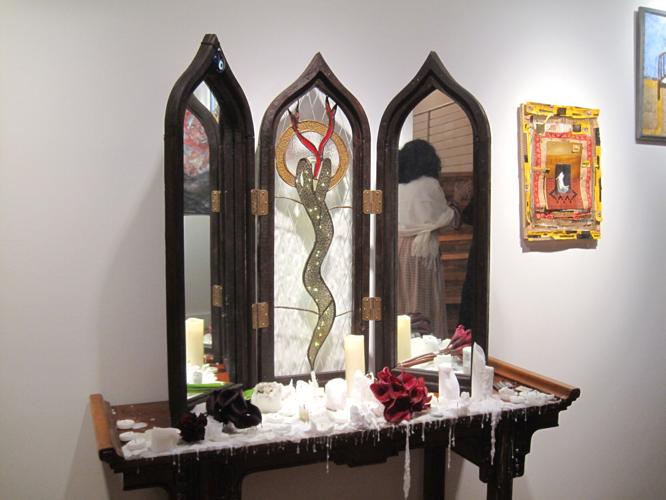
The central object of the show is a trifold mirror shrine made by Öz titled “It’s Not a Sin but Shame That’s Unholy.” The shrine’s inner panel has been replaced by a stained-glass snake with a bifurcated tongue, its fanged head ringed in a golden halo. As the viewer stands before the piece, they may feel like they’re a part of the story, but they’re certainly not its final word. Mirrors beguile with their immediacy, only to reflect difference.
On view at Random Sample through Jan. 18, Cut Out the Tongue displays works by Öz along with four other queer artists of Southwest Asian and North African (known collectively as SWANA) backgrounds: Ali El-Chaer, Amel Abdalla, AB Bedran and Diluvio Palazzolo. According to the exhibition statement, the pieces are “in direct opposition to the colonial model,” celebrating “the individual reclamation of cultural resistance through art, providing perspective on community, spirituality and queerness.” Perspective is important here, and is evident in terms like SWANA. Unlike the term “Middle Eastern” — a label based on Eurocentric perspectives — SWANA emphasizes the region’s own geographic framing, a sloughing off of political and colonial baggage.
Mixed media is the ideal approach for such a purpose. Much of the work in Cut Out the Tongue is collage, but even the pieces that aren’t technically collage contain a similar overall effect. There’s so much going on here — embroidery and crochet from Bedran; oil, chalk, crochet, gouache and even blood from Abdalla; screenprinting and goldleaf from El-Chaer; stones, sequins and clippings from Palazzolo; and infinite ephemera — everything from wax to shattered CDs — from Öz. The end result is not unlike a quilt put together by everybody at the party.

The beloved local gallery and music venue has relocated to a bigger space on Charlotte Avenue
At the show’s entrance, it seems like tears transform into poppies as Palazzolo’s masked collage face — with its silver mirrored eyes — drops liquid reflective tears out of its frame. Underneath is a piece composed of poppies — the poppy is a symbol often used in solidarity with Palestine, its petals, stems and stamens encompassing all four colors of the Palestinian flag. The poppies burst out and droop down the side from dangly strings. Palazzolo sets the tone here, and continues to do so throughout much of the show. Their mixed-media compositions include text, and found poetry is collage of the most expressive kind: “With respect and awe / we scream from / within our souls / this is my land!!!”
From here, Öz begins to call viewers to prayer with pieces that contend with the sacred and the damned. “House of the Lord” contains the image of a church surrounded by scratched-out eyes, embedded within a scarred golden frame that could’ve held a mirror in another life. From this frame, strings tether eyes made of melted wax. In other pieces, bodies shrink before towering forces, as in “Witness,” a textual masterpiece of woven wire and strips of fabric and paper, with a plastic sheet casting a sheen over a hooded person in meditation. The sculpture “SHAMARAN” — a half-snake, half-woman mythical creature — is crumbling on its pedestal. In “Culture of Convenience,” what appears to be an orange sofa sewn in soft, silky fabric has caught fire, a pyre surrounded by eyes.

“It’s Not a Sin but Shame That’s Unholy,” Alexis Özden (Öz)
Finding the mirrored elements within Bedran’s work is particularly rewarding. Their predominant mediums are crochet and tatreez — a traditional kind of Palestinian embroidery — and their geometric, repeating patterns (in particular “Four Ducks,” which is reflected into eight ducks) are reassuring in their precision and work as a kind of grounding force over the entire exhibition. However, in a moment that returns to the destabilizing nature of mirroring, Bedran’s hollow-eyed sea-blue painting “Artemis in the Woods” seems to share a haunted stare with Abdalla’s large-scale “The Genocide,” an overwhelming, shadowy portrait of a family’s destruction in Gaza. In it, an older woman is holding a child against a scene on fire — green earth turned brown, the outlines of martyrs lost. Abdalla points to Gustav Klimt as part of their inspiration, and that’s evident in the way people clutch at the bodies of their beloveds.
You could argue that collage is a quintessentially queer art medium, providing artists with so many possibilities to construct new worlds and identities — particularly by slicing up and rearranging symbols of violence into images that work like armor for the artists. Likewise, mirrors are iconic within SWANA art, from the craft of ayeneh-kari (an Iranian art form that involves decorating with mirrors in geometric patterns) to the contemporary installations of artists like Shirin Abedinirad. With Cut Out the Tongue, the shrapnel of mirrors hasn’t had its jagged edges softened. Rather, the pieces have been fitted together as these five artists construct their own self-defense systems without also shoring up their borders.
This is the best kind of group show — excellent for the individual artists, but even better all together.



Post a comment as anonymous
Report
Watch this discussion.
(0) comments
Welcome to the discussion.
Log In
Welcome to the discussion.
Keep it clean. Please avoid obscene, vulgar, lewd, racist or otherwise abusive language. Comments featuring hate speech or threatening or violent content will not be tolerated.
PLEASE TURN OFF YOUR CAPS LOCK.
Be truthful. Don't knowingly lie or mislead.
Be proactive. Use the “report” link on any comment that violates our comment policy.
Share with us. We'd love to hear your feedback.