

What does it mean for surrealism to turn 100? Though the boundary-breaking movement’s fascinations with dreams and the subconscious strike at something universal, its artistic definition has historically been narrow. Confined to a specific scene in 1920s Paris, we often associate surrealism with familiar names — Joan Miró, René Magritte, Salvador Dalí.
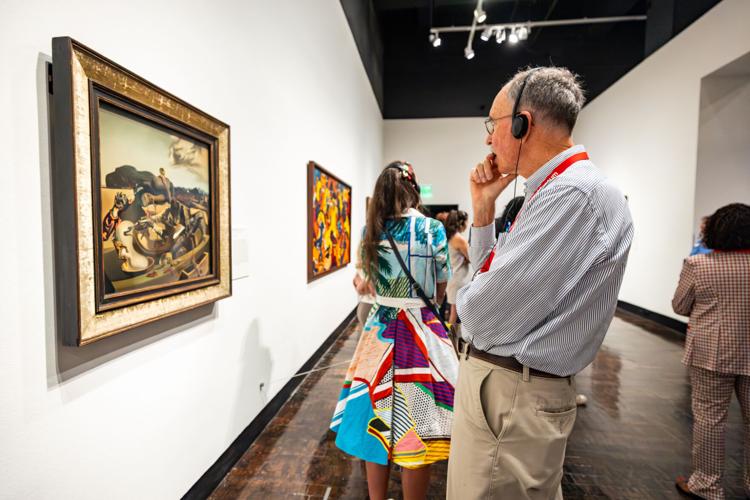
But these men aren’t the only dreamers, and recent explorations have sought to place surrealism in a more expansive context. In 2021, renowned London gallery Tate Modern launched Surrealism Beyond Borders, which broke the movement out of its preconceptions to explore its influence on a global scale. That exhibit laid the groundwork for International Surrealism From Tate: Fifty Years of Dreams — on view at the Frist until Aug. 30.
Fifty Years of Dreams pairs icons with underrecognized contemporaries of the surrealist movement, along with later artists whose work connects with its philosophies. Malangatana Valente Ngwenya, a Mozambican painter whose work is often exhibited under the mononym Malangatana, said he “found himself” in the tenets of surrealism. His “Untitled” from 1967 is like a technicolor Guernica — a roughly 50-by-75-inch canvas of contorted bodies grimacing and eating each other. Meanwhile, the Hungarian Mexican artist Kati Horna’s photograph “Untitled From Ode to Necrophilia, Mexico City 1962 (Leonora Carrington)” captures a haunting rest.
Instead of arranging these works chronologically or regionally, Fifty Years of Dreams structures each room by loose themes — a nonstrict organization that allows the pieces to speak with each other. The room titled “Desire: Sleeping Venus” considers the politics of desire and the gaze. In a 1944 painting by Paul Delvaux, also called “Sleeping Venus,” naked women writhe and pose as a skeleton watches. One figure — the only woman wearing clothes — seems to look directly across the room at Dorothea Tanning’s 1976 painting “Murmurs,” where monstrous feminine forms curl and drape into a crescent moon. Elsewhere in the exhibition, young girls float through a hallway like they’re underwater in Tanning’s 1943 “Eine Kleine Nachtmusik.”

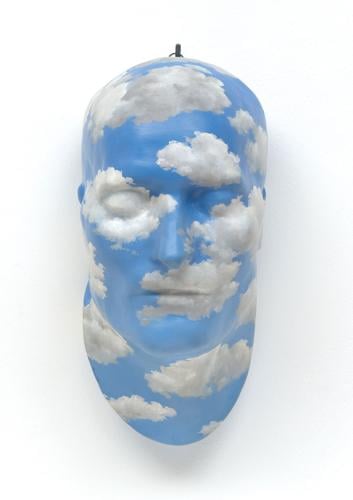
“The Future of Statues,” René Magritte
It’s an exhibit that holds a lot at once, shedding a particular new light on surrealism’s thorny elements. Dalí’s embrace of fascism, which placed his work in direct conflict with the movement’s liberatory roots and led to his exclusion from the Parisian group, is a fascinating context from which to consider his gruesome 1936 work “Autumnal Cannibalism.” But there’s room for humor too: Magritte’s 1937 work “The Future of Statues” takes the viewer’s gaze to the ceiling, where a sky-blue bust floats, bedecked with puffy white clouds.
The expansive reckoning creates a potent conversation with contemporary artist Anila Quayyum Agha’s exhibition Interwoven, located in the gallery next door. There, the Pakistani artist plays beautifully with light and shadow, literally illuminating invisible forms of women’s labor through full-room installations with handicraft techniques.
In their own ways, both exhibits ask us to peer through the veil — and to sit with what you find there.



Post a comment as anonymous
Report
Watch this discussion.
(0) comments
Welcome to the discussion.
Log In
Welcome to the discussion.
Keep it clean. Please avoid obscene, vulgar, lewd, racist or otherwise abusive language. Comments featuring hate speech or threatening or violent content will not be tolerated.
PLEASE TURN OFF YOUR CAPS LOCK.
Be truthful. Don't knowingly lie or mislead.
Be proactive. Use the “report” link on any comment that violates our comment policy.
Share with us. We'd love to hear your feedback.