
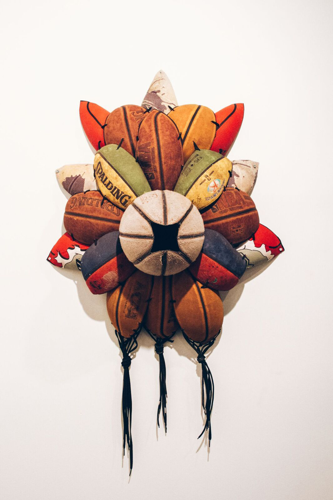
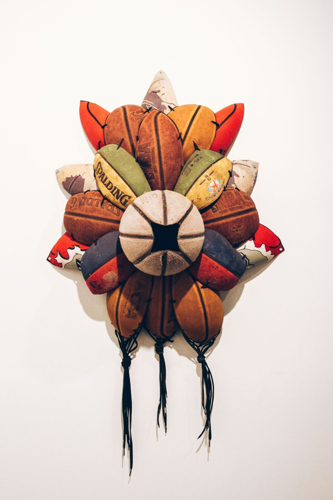


"Basketball Bloom," Brandon Donahue
On a rainy day, right before the turn of the 20th century, James Naismith nailed a peach basket onto the edge of the 10-foot-high elevated running track circling the gymnasium at the YMCA in Springfield, Mass. Naismith was a Canadian physical education professor and instructor at the Y, and the basket was his solution for keeping his classes active during the inclement New England winters. Naismith had created the very first basketball court.
Naismith drove that nail in 1891 — less than three decades after Union forces defeated the Confederate Army, ending the Civil War and freeing Southern blacks from slavery. The story of basketball gives us a unique lens on the story of black Americans after Emancipation, and the intertwining history of the people and the game provides an illuminating context for the latest exhibition by Nashville artist Brandon Donahue.
Donahue’s Foul Shot at Seed Space is an interactive exhibition of basketball-centric art. The artist’s half-court installation includes a key — the free-throw lane — taped to the floor and surrounded on three sides by a trio of rims and nets mounted on backboards, each hung on its own separate wall. There’s a kid-sized toy basketball in the gallery that visitors are free to shoot hoops with. The backboards are made of bamboo that’s been spray-painted with vibrant, colorful abstract designs and geometric shapes. The nets are made of shoestrings, and the rims are colorful plastic toilet seats.
The toilet seat rims aren’t making a comment about waste or implying that a perfect all net “swish” should now be called a “flush.” The toilet rims are just kind of funny, and they’re important because they’re found materials: Donahue’s practice is centered on the transformation of found objects, whether that means toilet seats or the “found” urban spaces he remakes and reinvigorates with the murals he’s created throughout Tennessee. Donahue built his bamboo backboards with materials harvested from the garden of Seed Space curator Rachel Bubis’ parents.
Basketball was invented by a white man and was primarily played by whites until 1904, when black Americans were introduced to the sport for the first time by Edwin Bancroft Henderson. Known as the “Father of Black Basketball,” Henderson was educated at Howard and Columbia, and he learned about basketball during his summer sessions at Harvard. When Henderson became a physical education instructor at the all-black preparatory M Street School in Washington, D.C., he taught his students the game, and it spread quickly, as “Black Fives” — the label referenced roundball’s five-man lineups — flourished in cities across the country prior to the NBA’s integrating in 1950.
Henderson’s introduction of basketball to black culture happened in the run-up to the Great Migration, which saw waves of rural Southern blacks seeking work in industrial centers like Chicago and Detroit. Making the move meant transitioning from stooping in flat fields to standing up at huge machines in high-ceilinged factories surrounded by the massive, upright structures of the new and urban 20th century. In these crowded city environs, pastoral games like baseball weren’t as suitable as small boxing rings and basketball courts. Participation in urban sports like boxing and basketball was an indicator of an athlete’s low social status, but both offered narrow avenues to economic success.
Young black men and boys recognized basketball as a way out of wage slavery and urban poverty, but in black culture at large, the sport itself became a signifier of status that garnered respect and acknowledged mastery. In his 1997 Sports Illustrated piece “Whatever Happened to the White Athlete,” author S.L. Price chronicles the ascendency of black players in the pro game and quotes William Ellerbee, former head coach at basketball powerhouse Simon Gratz High School in Philadelphia: “Suburban kids tend to play for the fun of it ... but inner city kids look at basketball as a matter of life and death.”
Donahue is an educated artist who spent a year at Lorenzo De Medici School of the Arts in Florence, Italy, before taking his MFA at the University of Tennessee. In Nashville he’s best known for the graffiti-inspired community street-art murals he’s created for Norf Wall Fest and the Nashville Walls Project. Donahue’s practice is built on playful contradictions: He’s a highly trained fine artist with a dedication to street aesthetics. He encourages visitors to run and jump and throw a ball in a cultural space reserved for quiet talking, slow walking, squinting and chin scratching. Donahue uses random, unconnected materials to make common, familiar objects that he then presents as art. He also uses common, familiar objects to create unique and dazzling ones.
The best works in the show are the “Basketball Blooms” made up of segmented basketballs that are sewn together using shoelaces, creating formally gorgeous flower-shaped wall sculptures. Make no mistake: These are the most iconic signature objects being made by any artist in Nashville — these can only be Donahue’s. As you might imagine, sewing together basketballs with shoestrings is a necessarily imperfect process, but Donahue is at the height of his powers when he nails the symmetry, colors, lines and overall shapes of these beautiful bouncing blossoms.
Foul Shot is a fun, irreverent display that offers energetic engagement with art as well as flourishes of formal beauty, reflecting a century of black basketball. And in a national climate crackling with issues of race and status, Foul Shot charges the lane and plays for keeps.
Email arts@nashvillescene.com



