

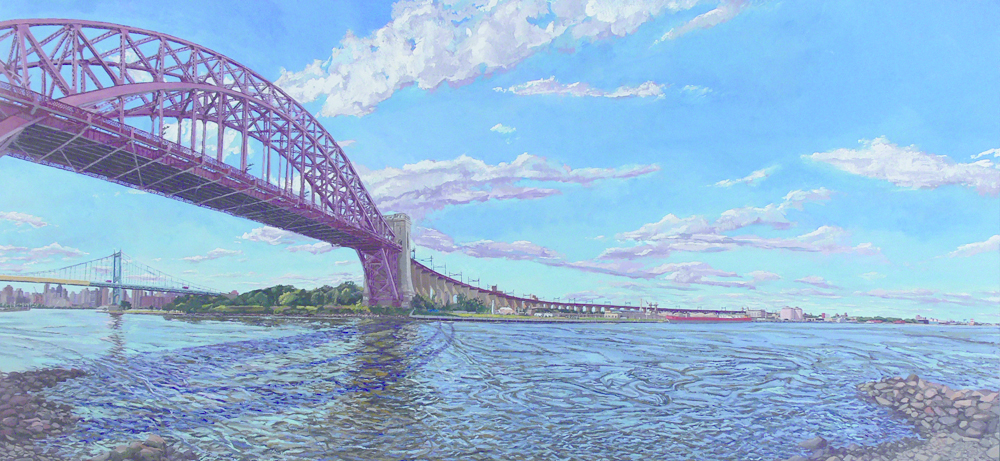
Last month, the MacArthur Foundation conferred upon Rackstraw Downes a "genius" grant, now one of the ultimate signs of cultural affirmation. There was a time when this would have been odd, as Downes worked for years outside the mainstream, painting landscapes in a traditional manner during the '60s and '70s while the art world was preoccupied with other concerns. He wrote about his experience during those years as a kind of alternate history—he was in New York, but experiencing a different art world than the one reported and recorded.
Nashville has no plans for a major retrospective of Downes' paintings, but Tinney Contemporary's current show features Todd Gordon, a painter of forlorn urban spaces in Downes' spirit. Of course in this day, when anything goes, Gordon's naturalism is less unusual. Tinney has paired him with Julyan Davis, an English painter transplanted to the American South who gravitates to similarly marginal landscape spaces. Both painters can be described as realists, although their aesthetics are quite different. Gordon has an objective bent, while Davis touches on a turn-of-the-20th-century brand of mysticism.
Gordon selects his subjects from the workaday but not always visible parts of New York City, mostly outside Manhattan. There are several typical views—urban rivers and creeks, the undersides of bridges, loading docks, alleys, industrial sites and rooftops. In his paintings of waterways, linear features such as the waterline or a bridge bend slightly at the edges—Gordon is committed to recording what he sees literally, down to the perspective distortion, instead of translating it back into the straight line he knows it to be, an adjustment we make in our own perceptual processes. Other subjects, like the supports under a bridge or the auto repair shops and junkyards in the Iron Triangle section of Queens, are the kinds of things you see but don't notice when you go through the outer boroughs. Gordon insists on seeing the in-between spaces as well as the horizon's curve.
But Gordon's objectivity is also a game. These paintings are, after all, hardly accidents. He chooses sites for reasons. Some are fairly obvious, like the way a few elements of color—the yellow wall in "August Ridgewood" or the graffiti on corrugated metal in "Leviathan"—work into a design when he frames the scene. Others require a little background knowledge—for instance, the significance of those Iron Triangle auto shops in current debates about Mayor Bloomberg's proposals to develop sections of the city, which would drive out the vestiges of their industrial character.
In one trope that appears several times in these paintings, a component such as the span of a bridge frames a distant, hazy view of the Manhattan skyline. You run across these skyline glimpses all the time in New York, but the way Gordon frames them is definitely artifice: These paintings address a certain kind of romantic mythology about New York City—a land of tough places and people aspiring to the dreams represented by the great towers visible in the distance, yet hard to reach.
Davis' Romantic impulses are more explicit. The show at Tinney includes two bodies of his work—a set of landscapes of iconic Southern scenes, and several works with figures that are inspired by old Appalachian folk songs. The landscapes include empty rooms and alleys, often the neglected spaces. His painting style shares much with early 20th century realism, but a work like "Green Buildings," which catches the back entrances of a row of commercial buildings in Greensboro, Ala., tips its hat to the photographs of William Christenberry. Christenberry took photos in the same town and is best known for a series of photos of a green warehouse. Davis quietly slips in these references to the history of artistic depictions of his adopted Southern landscape.
The song-inspired pictures are florid, with an old-fashioned feel that comes out best in a triptych based on the song "Tom Dooley." Davis casts himself as the murderer of the title, his wife as the victim, and places them apart from each other on the left and right panels. The middle panel shows a moon over the railroad tracks, rendered in the Milky Way texture of a humid night. It recalls the work of Ralph Albert Blakelock, a painter extremely popular in the last decades of the 19th century but who is largely forgotten today. Like Blakelock, Davis' work comes across as sentimental, but with a dark, even mystical side, a combination descended from the spirit of German Romantics, though without as much wildness and bite.
As Rackstraw Downes has shown, painting that refers to an older style can find a successful voice in any age, no matter what the spirit of the time seems to demand. Davis and Gordon both aspire to that achievement, although Gordon meets with more success. Familiar in content and technique, Gordon's paintings hold simple, undeniable pleasures: They make New York City vividly present and concrete, and encourage you to consciously look at parts of the environment that you would otherwise just pass through. These seemingly mundane places are sights that can be enjoyed, not just endured.
Email arts@nashvillescene.com



