
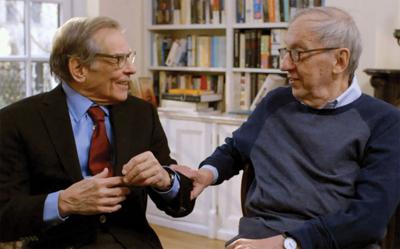


Robert Caro (left) and Robert Gottlieb
Fifty years, five books, 4,488 pages and counting. Those are the cold numbers that speak volumes, forgive the pun, of one of the great relationships in publishing history. Author Robert Caro is 86 years old and still working on the final volume of his masterpiece. His longtime editor, Robert Gottlieb, is 91 and plans to read it. Both men are determined to get the tome to publication. Neither wants to rush the job.
In Turn Every Page: The Adventures of Robert Caro and Robert Gottlieb, Lizzie Gottlieb (Robert’s daughter) presents a portrait of the relationship between the two men that is tender, funny and moving. In his long career, Robert Gottlieb has edited, he says, between 600 and 700 books by the likes of Toni Morrison, Joseph Heller and Doris Lessing. Caro is the eminent political biographer of our time. His first book, Pulitzer Prize winner The Power Broker, chronicles the life of the formidable city planner Robert Moses, who is responsible for New York City as we know it today, for good and bad. Caro’s five-volume series The Years of Lyndon Johnson — the final volume of which he is still writing — covers not just LBJ’s time in politics, but all the years of the 36th president’s life.
When people think about how power is located and maintained, they think of Caro’s books. “If we understand power,” says publisher Lisa Lucas in the film, “then maybe we can imagine a better future.”
Lizzie Gottlieb’s father — witty and garrulous — was willing to appear in the film from the start, but Caro needed some convincing. The relationship between publisher and editor, he says, is too intimate. The word that comes to mind for me is “sacred.” The director finally convinced him to take part on one condition: that he and Gottlieb not appear together in the film. The result is kind of miraculous. We come to understand each man through the other’s point of view; in doing so, we also understand the relationship between editor and writer.
Editing, Robert Gottlieb says, is “an intelligent and sympathetic reaction to a text,” an act of “making public your own enthusiasm.” Would Caro have written The Power Broker and the LBJ series without Gottlieb? It’s possible. But Gottlieb gave him the time and financial support that the books needed — and that the final book needs. His relationship with Caro is one of equals — he neither commands the writer nor acts subserviently. Reading a text sympathetically means uncovering what the writer is doing, not shaping what he’s doing. It’s certainly not the relationship between every duo, but for Gottlieb and Caro, it has worked for five decades.
That’s not to say the two don’t quarrel. Their main point of contention is so banal that it becomes comical — it’s the punctuation mark second only in its controversy to the Oxford comma. For Gottlieb, Caro deploys the semicolon too often; for Caro, the mark creates an indispensable connection between ideas. Their sessions sometimes lead to standoffs that require Caro to take a time-out in the restroom while the editor tends to the long line of colleagues standing outside his office. Despite these spats, the relationship endures productively, tenderly, respectably. The film reveals their quirks — Gottlieb collects plastic women’s handbags; Caro writes on a typewriter with a carbon sheet between pages. He stuffs the copied pages — all of them — in a deep cabinet in his New York home.
It might be assumed that Lizzie Gottlieb is “too close to her subjects” for a documentary. But that intimacy lends itself to an ease, naturalness and charm that make Turn Every Page a joy to watch.



