
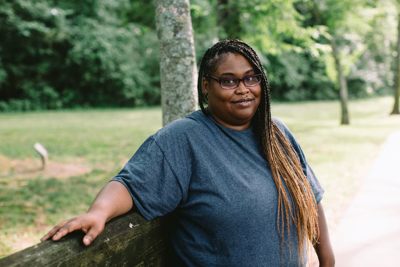


Danielle Bigsby
Jocques Clemmons “always had a smile,” Danielle Bigsby says. She remembers his well-trained pitbull, who the neighborhood kids loved to visit, and how he loved the Dallas Cowboys. He lived in an apartment behind Bigsby’s in James A. Cayce Homes. In 2017, Clemmons was shot and killed by a Metro police officer on the property, spurring citywide protests and a movement to establish a board of community members to oversee MNPD. Bigsby wrote about Clemmons in the third volume of her anti-gun-violence poetry series, Hood Love:
An unfortunate tragedy is what they called it,Murder is what I say;
And as usual,
White cop,
Black male victim,
Not guilty at the end of the day.
“When that touched home, I needed to emphasize that just because you have a badge doesn’t give you permission to kill,” Bigsby says in regard to Clemmons. “I wasn’t fearful when I decided to write about that one. I thought I would be, but now I understand that whether you have a badge or whether you’re a criminal pulling the trigger of a gun, it’s gun violence either way, and it needs to be spoken about.”
Bigsby, a self-published author, is now working on her seventh volume of poetry, which will include a poem about Daniel Hambrick. Hambrick was shot and killed by Metro police Officer Andrew Delke 2018, and Delke is now awaiting trial on first-degree murder charges. The names of Hambrick and Clemmons may sound familiar to many Nashvillians, but Bigsby also remembers victims of gun violence who weren’t shot by officers and those whose deaths were not met with public outcry. She’s known many of these victims since childhood. Her first volume of poetry featured six victims, and she’s added six more with each new volume. Hood Love 7 will bring the total number of gun violence victims Bigsby has commemorated to 42.
Bigsby says there’s a lot of distrust of the police in her neighborhood. She wants to put the reader in the shoes of the people who carry guns there. She sees neighbors afraid to call police for help. She sees people get out of prison and have few job options, so they go back to crime to provide for their families.
Bigsby was inspired to write poetry about this topic by her nephew Ronquez Bigsby. He was killed 10 years ago this month in Cayce Homes. A star athlete and the comedian of the family, Ronquez was just 14 years old — about to start high school the next day. No one was convicted for his murder, and the case has since gone cold. After Ronquez died, Bigsby says he came to her in a dream and said, “What are you doing with my story?”
Bigsby writes:
I’ve been reduced to nothing morethan a conversation piece,
And judging by the unsolved status of my case,
Many are talking,
Just not to the detective’s face;
Leaving my family to hope and pray,
That someone gains a conscience,
Leading them to finally speak up someday.
This personal connection to gun violence can make it challenging for Bigsby to talk to families who have experienced the same thing, but she interviews each loved one before getting the poem on paper. Sometimes she has to put down the pen for days or weeks at a time.
“This is not the story of triumph,” Bigsby says. “This is not the story of happy endings. I’m having to write about someone losing their life. I’m having to write about a mother crying over the loss of their child, or a child crying over the loss of their parent. It is heartbreaking. But I feel like I didn’t choose this mission. There’s a million other topics I could write about. Unfortunately, I personally know what it’s like to lose a loved one to gun violence.”
Bigsby most wants to see young people reading her books, so she offers them for $5 each to people under 18.
“It is clear as day that the youth are our future and the future leaders,” she says. “[Six] females led the peaceful [June 4 Black Lives Matter] protest here, and they were teens from Nashville schools. It’s clear as day that our youth are our treasure. So if I could save one, then I’ve done my job.”
Hood Love 7: Burying Treasure, is slated for release early next year. The book focuses on what connections could possibly prevent a person from being an eventual victim of gun violence, from a relationship with a parent to an after-school program.
“We’ve got to find out how to bridge the gap,” Bigsby says. “Because if not, we’ll continue to bury our treasure.”
Bigsby tires of people telling her, “It’s going to be OK,” as she mourns the loss of her nephew and others killed by guns. For Bigsby and the families she writes for, these are wounds that will never heal, she says. She’s also tired of the mentality that some people killed by guns have it coming.
“I’ve had some people say, ‘They was out there creating this havoc, they deserved it,’ ” says Bigsby. “And there were a couple people that I wrote about that I knew were in constant trouble. But nobody deserves to die at the hands of a bullet. … They weren’t given the chance to redeem themselves.”



Post a comment as anonymous
Report
Watch this discussion.
(0) comments
Welcome to the discussion.
Log In
Welcome to the discussion.
Keep it clean. Please avoid obscene, vulgar, lewd, racist or otherwise abusive language. Comments featuring hate speech or threatening or violent content will not be tolerated.
PLEASE TURN OFF YOUR CAPS LOCK.
Be truthful. Don't knowingly lie or mislead.
Be proactive. Use the “report” link on any comment that violates our comment policy.
Share with us. We'd love to hear your feedback.