

Lower Manhattan in the early 1970s was like the Fertile Crescent of the American art world. Composers like Philip Glass and Steve Reich demolished the once impenetrable wall separating high art from pop culture, performing their pulsating minimalist music in warehouses, art galleries, museums and even discos. Visual artists like Chuck Close, meanwhile, created the strikingly modern prints that advertised the concerts.
A young Columbia University art student named Laurie Anderson was naturally drawn to this vibrant arts scene, and she quickly proved she had the talent, imagination and perhaps most importantly, sheer chutzpah to get noticed. Her first performance piece, a 1969 symphony for car horn, was the kind of creation that would have made Frank Zappa proud. But even Zappa might have done a double take at her follow-up piece, Duets on Ice, which featured Anderson playing violin while wearing a pair of skates frozen in ice. The piece ended when the ice melted.
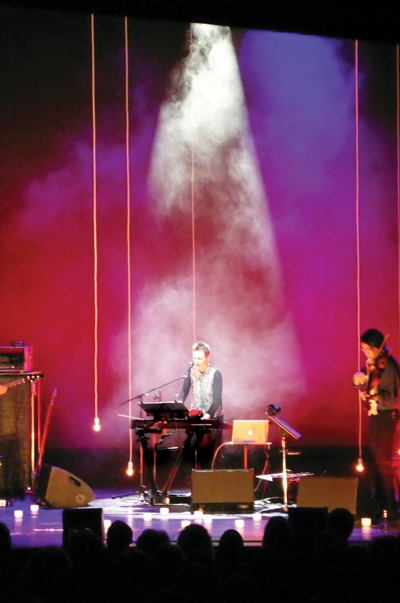
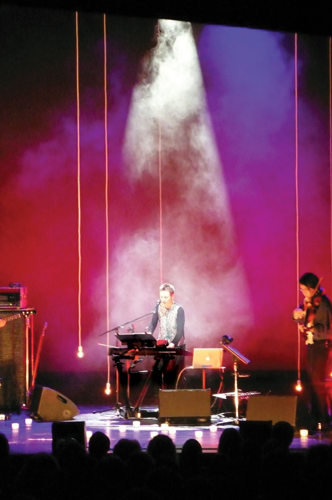
Anderson's two-night engagement at OZ Arts Nashville this Thursday and Friday will likely be more high-tech than her concert on ice. But don't expect it to be any less irreverent and entertaining. Her program, called The Language of the Future, is a darkly satirical miscellany of songs and stories that ponder the meaning of life in America. Anderson will remain at OZ to participate in Pi Day this Saturday, March 14 (for more information, see the Critic's Pick on Pi Day events). That event, which will feature visual art, live performances and discussion, will focus on the connections among science, art, engineering, technology and math.
OZ founder Cano Ozgener, a gifted engineer and visual artist in his own right, couldn't have found a better artist than Anderson with whom to celebrate Pi Day. Anderson has long incorporated cutting-edge technology into her artwork. "Technology is the campfire around which we tell our stories," Anderson likes to say. No wonder NASA selected her in 2003 to be its first artist-in-residence, a gig that inspired her to write her expansive, emotionally intense "The End of the Moon."
But Anderson doesn't fetishize technology. She considers it to be a useful tool, for sure, but one that can also be dangerous, especially when governments and large multinational corporations (the largest of which are wealthier and more powerful than many countries) use it to trample liberty.
The National Security Agency's vacuum-cleaner approach to surveillance is among the themes of Anderson's "Greetings From the Motherland," a piece she performed a few years ago at Toronto's Luminato Festival. Anderson sang the piece as a hip-hop duet with the celebrated Chinese artist and activist Ai Weiwei, who performed in real time via Skype from his studio in Beijing. "Let's hear it for the whistle-blowers," Anderson said in reference to such metadata leakers as Julian Assange of WikiLeaks and former CIA intelligence contractor Edward Snowden, winning the sort of easy applause in Toronto that would likely be harder to come by in Nashville.
But don't expect Anderson to avoid controversy, since government overreach is one of her favorite subjects. Big Brother is her nemesis. She has embodied her fear of an Orwellian future in the form of her best-known character, a voice of authority who goes by the name Fenway Bergamot, a nom de guerre suggested by her late husband Lou Reed. In concert, Anderson speaks through a voice filter to create the deadpan baritone of Bergamot. His creepy voice dominates such numbers as "Another Day in America," where he offers an ominous warning that should terrify all those who fail to read the fine print in their Facebook accounts: "Your silence will be considered your consent."
Anderson's musical style has changed little over the decades. Her songs are mostly spoken-word stories, her velvety voice reciting the lines in a singsong sort of monotone. She usually accompanies herself on violin, and her arrangements often feature the pulsating, repetitive patterns of minimalism — a female voice repeating the syllable "ha" is one of the most instantly recognizable rhythmic features of Anderson's best-known song, "O Superman."
That song, which was once famously exhibited as a video at New York City's Museum of Modern Art, is one of dozens of numbers from Anderson's 1983 magnum opus United States. The Language of the Future draws much of its material from that larger work. Many of Anderson's stories deal with airplane travel, with looming disaster a constant motif. (Anderson's scenarios seemed all too real this month, what with airplanes skidding off runways and crash-landing on golf courses, even with pilots as skilled as Han Solo at the controls.)
Fortunately, some of Anderson's songs are more lighthearted. In "Let X=X," the speaker meets a guy who looks like a hat-check clerk at an ice rink. Turns out he is a hat-check clerk at an ice rink. "Oh boy," Anderson intones, "Right again." Later in the song, Anderson sings, "I can see the future and it's a place — about 70 miles east of here." That would place the future somewhere near Crawdaddy's West Side Grill in Cookeville. Oh boy, right again.
Email arts@nashvillescene.com



