

“I describe it as a flesh-and-breath sculpture.”
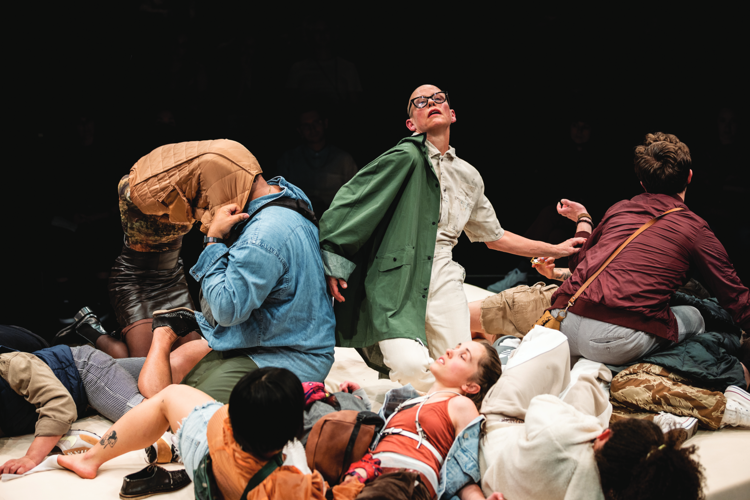
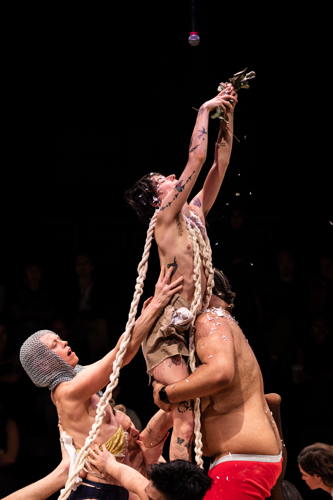
Faye Driscoll is a total original. Her work defies tidy descriptions simply because it is unlike just about anything you’ve ever seen before. And Weathering, which comes to OZ Arts April 24 through 26, might be her most original work yet. It’s a multidimensional sensory experience that’s part theater, part art installation. In the simplest terms, it’s a 70-minute performance made for 10 bodies, which move through a series of actions on a platform made from foam.
From her home in California, Driscoll describes the work as a kind of tableau vivant — an arrangement of bodies that are posed in a particularly theatrical way. Think of Géricault’s “The Raft of the Medusa,” or any of those memes of contemporary snapshots (erroneously) labeled “accidental Renaissance.”
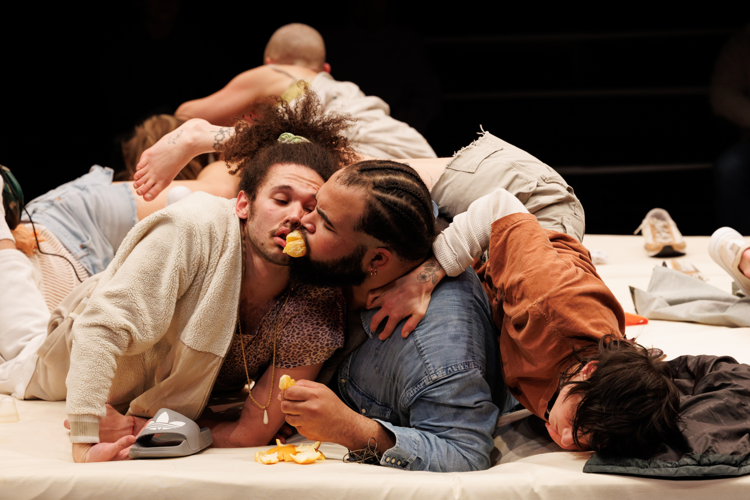
“It’s dealing with the body, and moments when our bodies reach outside themselves and into other bodies in ways that are more extreme than the everyday,” says Driscoll. “Often these are moments of violence or catastrophe or sex — some moment when the body is on edge.”
An important element of Weathering: Its audience is situated in the round, which allows the viewers to see details that might be overlooked in a more traditional arrangement. They can see the performers’ skin close up, their bodies and their sweat.
As the work progresses, the platform the performers are on begins to rotate — at first almost imperceptibly, then with more force.
“There’s drool, and intimate contact between mouths and bodies, and a slow peeling away of clothing.”

The meaning you can attach to the piece — to the performers, their movements and connections — depends on where you are situated in the audience, and what your view is at any given moment of action. That decentralized perspective lends itself to a more fluid understanding, like the parable of the blind man describing an elephant — you can perceive only what’s directly in front of you, and it’s rarely the whole story.
“The piece sort of rolls through all these images, and it doesn’t really fixate on one,” Driscoll explains. “So you can’t really stay in the story that you started to make, and you’re definitely going to make up a lot of stories about what you’re seeing and what’s happening. It lives in this indeterminate space, and I think that as a viewer, it asks you to do that as well — to question your own perception while perceiving. To watch and observe your own process of attaching meanings to things.”
Even the title of the piece allows for multiple interpretations. “Weathering” might describe the physical wear of a house after an intense storm, but it might also mean the process of surviving.
“There’s the idea of bearing something, or of moving through something, and that you’re being altered by the endurance it takes,” she says. “And then there’s literally weather, which connects to this time of an unprecedented acceleration toward what seems to be a death wish that we’re in, and living with that is very, very existential.

“We think of ourselves as humans as kind of separate from the environment that we’re in,” Driscoll continues, “like it’s a binary that we’re in with nature, with this thing that we try to manage and control. And I’m proposing that the problem is that we perceive ourselves as separate, and that, what if we instead considered ourselves — with every breath, every piss, every drink — we are weathering. We are active participants. We are of this world, and we are making this world.”
The importance of performances like Weathering — works that challenge and provoke their audience — is especially relevant today. It’s perhaps even more relevant than when it was first performed in 2023 at New York Live Arts in Chelsea. The increasingly polarized political climate makes it harder to push boundaries — people and institutions are often more reluctant to go against societal norms.
“I think of art as a space where we get to examine these [cultural norms and assumptions] in a ritual environment,” says Driscoll. “These are moments where we can have the opportunity to go through a kind of reckoning with our ways of being. There are so few spaces where we can do that now. It’s so important to be pushed outside of our comfort zones, and then to live in the questions after — to live in the discomfort and be changed by it.”



