
In 2010, when Jaimy Gordon won the National Book Award for her sixth novel, Lord of Misrule, small-press loyalists and below-the-radar-fiction lovers found good cause for celebration. Here was a writer who, even with decades of publishing behind her, was virtually unknown to most readers, and she had won one the highest honors in American fiction — for a novel published by a tiny independent press devoted to non-mainstream voices, no less. Lord of Misrule tells the story of small-time horseracing in West Virginia, focusing on the gritty characters of that insular world, both human and equine. A dark-horse candidate, indeed.
The term was never more appropriate or unavoidable, as The New York Times critic Janet Maslin noted straightaway in her coverage of Lord of Misrule a month after its win. The book, the fictional racehorse for which it's named, the writer — the entire package earned the idiom as it had never been earned before. "Perhaps Lord of Misrule would not be so startling if Ms. Gordon's other books had been more widely read," Maslin wrote. "But this novel is so assured, exotic and uncategorizable, with such an unlikely provenance, that it arrives as an incontrovertible winner, a bona fide bolt from the blue."
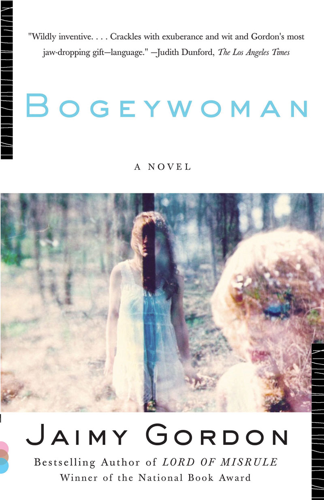
Lord of Misrule was heading to the printer just as the nominations were announced, which put its tiny, cash-strapped publisher in an interesting position. McPherson & Co. had planned a print run of 2,000 copies; after the nomination, McPherson upped the order — to 8,000 copies. Lord of Misrule is now plentifully available in a Vintage paperback edition, along with one of Gordon's previous titles, Bogeywoman, which was first published in 1999 to critical acclaim — it was named a Best Book of the Year by the Los Angeles Times, and Publisher's Weekly compared it to Ulysses and Lolita — but without inspiring much in the way of readership.
Bogeywoman is a lesbian coming-of-age story about Ursie Koderer (a.k.a. the Bogeywoman) who, like so many teenagers, is not entirely in control of her emotions. Kicked out of summer camp, she lands in a psychiatric hospital where she and a few other patients form a loose, antic confederacy. They call themselves the Bug Motels and eventually form a band of that name using instruments constructed from hospital items. (Ursie plays the "pukulele," which employs a plastic vomit basin.) Ursie is sidetracked from their exploits when a visiting psychiatrist, Dr. Zuk, arrives and sends her reeling, desperate to know this much older woman more fully.
The crush sets off a series of wild, hilarious events. But even more than the rollicking ride, it is Gordon's dizzyingly inventive language that marks Bogeywoman as a novel nonpareil, starting with (but hardly limited to) a heaping handful of quirky neologisms: girls are "girlgoyles," guys are "fuddies," and the shrinks are "dreambox mechanics." Breasts are "momps" and nipples are "nuzzies." Lord of Misrule, too, has received much acclaim for its mastery of the racetrack vernacular, and its fans will find Gordon's voice on rich display in this equally brilliant, equally uncategorizable work.
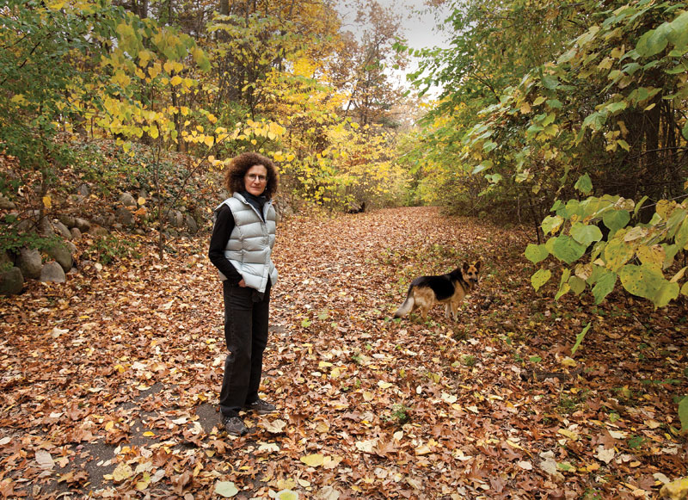
In advance of her reading at Vanderbilt, Gordon answered questions via email.
In an interview with Bret Anthony Johnston, you said that with Lord of Misrule you surprised yourself by writing a book featuring a "reckless young woman," as that was precisely what you did not want to do after writing three who fit that description. Your own aversion to the manuscript led you to bury it for some time. Bogeywoman, of course, was one of those earlier novels about a reckless young woman. Do you feel differently about the novel now that it's being re-released than you did at the time of its original publication?
My aversion to the reckless young woman was based on two factors. I had had high expectations for her in the beginning. I remember sitting in my studio at the Fine Arts Work Center in Provincetown in 1981, thinking that the wreckage of my 20s might be salvaged, or at least harvested for parts, if I could look on the type of person I had been back then as a character in a book, and suddenly it was easy to do. She seemed fascinating to me as a type. But by the year 2000, my choice of her as star of several of my books seemed only to have deepened my obscurity. She hadn't panned out; that was one factor.
And the other was that I was 56 years old and beginning to feel like a has-been without any high expectations left. I had begun to identify more with aging, childless characters like the loan shark Two-Tie and the groom Medicine Ed in Lord of Misrule, who are looking at a lonely and frightening old age. But now that Misrule has done so well, that wild young woman character, Maggie Koderer, is back in my good graces — and even more so her sister Ursie from Bogeywoman, who always had better excuses than Maggie for being a rebel and was better at it besides.
So Maggie Koderer, from Lord of Misrule, really is the older sister of Bogeywoman's Ursie Koderer? Can you tell us a bit more about the connection between the two books, or the development of these sibling characters?
The two books are so different in manner, so different in the textures of their worlds, that I didn't expect many readers to pick up on the connection — thank you for noticing — but it meant something to me. I'm a second child of five, born between two sisters; there was never any time in my life on earth when I didn't have a sister, and for me the fundamental human condition is that of a sister who has a sister. I am close with all four of my real-life siblings — two boys, two girls — but in most of my fictional work one sister is the elemental sibling.
Moreover, I have one real-life sister with whom I have always been unusually tight, so tight that I think of us as sides of a coin — or maybe a better figure would be one land mass torn in half by tectonic forces, both halves adrift in the world but sharing the same roughly jagged edge and geological understrata. She happens to be gay; like Ursie Koderer she happened to become aware of this truth at a beloved summer camp a lot like Camp Chunkagunk, Tough Paradise for Girls; and, again like the Bogeywoman, she ended up in the adolescent ward of a fancy psychiatric hospital for a startlingly long time. You might even say she wouldn't come out. She actually went to public high school from the hospital, and my parents were willing to pay the stupendous bill, until an unorthodox and probably even illegal love affair with a hospital employee somehow gave her the nerve to gather herself up and move on. I had always planned to tell that story, if for no other reason than to understand it better myself, and in the late '90s I got around to it.
Like Bogeywoman, Lord of Misrule is set in a jargon-filled world. In this case, I assume you're not so much creating a vernacular as hewing closely to an existing one. But the process must be somewhat similar. How do you go about establishing authentic, consistent voices in your work?
The two things I love most, in literature, are voice and narrative. By narrative I mean the power of seeming to move through time, and this movement creates the sacred elixir of suspense, the need to find out what happens, or what happened in the past. (Suspense can move in both directions.)
As for voice: I collect slang and interesting formulations of every kind in my journals — proverbs, idioms, regionalisms, malapropisms. Glorious examples of the full resources of English grammar, from Francis Bacon to Jelly Roll Morton. When I landed, as reckless young women just land in certain places, on a cheap racetrack in West Virginia in 1967, what got my whole attention from the first was the language people were speaking, a different language from anything I had heard before in my life. I try to reproduce first that strangeness, then that sense of a ticket to a new world, in Lord of Misrule.
You've been writing and publishing for many years, and though your books have received ample praise, they've found relatively small audiences. Has life after winning the National Book Award been at all strange for you? Has the win changed your writing life in meaningful ways?
Strange is good: I love being read by total strangers who take the trouble to write me a letter about my book, sometimes a very good and perceptive letter into the bargain. Another good part is knowing that someone will want my files and papers when I die — I had started to worry about that. I can even assume that, barring a nuclear apocalypse, my books probably won't entirely disappear, as long as people are still reading. The scary part is that I'm still distractible, disorganized, and habitually unprolific, and now it's easier than ever to not get to my writing table, because I'm constantly traveling. I still feel I might blow my opportunity, a feeling that has dogged me all my life, with good reason up till now.
To read an uncut version of this interview — and more local book coverage, including an interview with National Book Award-winning poet Terrance Hayes — please visit Chapter16.org, an online publication of Humanities Tennessee.



