
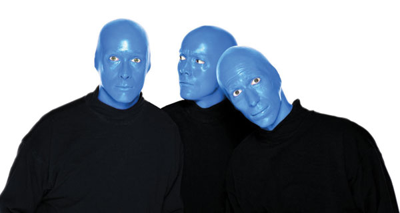

Few organizations are more closely associated with New York City's East Village than Blue Man Group. Founded in 1987 by Phil Stanton, Chris Wink and Matt Goldman, the performance art troupe/percussion ensemble evolved out of of the Lower Manhattan art world, and is still going strong after a two-decade run at the East Village's Astor Place Theatre — not to mention long-term residencies that have brought a taste of New York's downtown scene to Chicago, Las Vegas, Amsterdam, Stockholm, Tokyo and other cities across the globe.
But the touring company of Blue Man Group (literally) hitting the boards at TPAC this week features the product of another village — Hillsboro Village, to be exact. Josh Elrod, who's been performing with Blue Man since 2004, experienced nearly all of his formative years in Nashville. (He spent the first six months of his earthly existence in New Orleans, where he was born.) After graduating from Hillsboro High School in 1991, Elrod went to the Art Institute of Chicago and eventually planted roots in New York City, but he's returned to Nashville for various stretches in the intervening years, leaving his outré mark on the local music scene with The Tony Guides, Phase Selector Sound and the awesomely named Tan as Fuck. He also worked as a production assistant on Harmony Korine's Gummo, and recently returned to town to play a role in James Clauer's upcoming film When the World's on Fire. And if you had your TV on for more than an hour a week in the early aughts, you no doubt saw a Levi's commercial in which a few women purposely damaged their apartments so that a studly be-denimed handyman (Elrod) would have to come play Mr. Fix-It.
Elrod spoke with the Scene by phone during a tour stop in Paducah, Ky., sharing his thoughts on auditions, nepotism and what it's like to work blue.
How did you wind up getting the Blue Man gig?
It was winter of 2004, end of January maybe, my manager called and said, "There's an open call. I want you to go in. Here's your appointment time."
I knew a little bit about Blue Man. I knew they were on Astor Place, and that they were painted blue, and that you shouldn't be late. And it had something to do with percussion. That's all I knew.
I went in and auditioned. They saw me for about 45 seconds, maybe a minute. It was one of the shortest auditions I've ever had. And they're like, "Great. We'll be in touch." And they called me back a few weeks later and I went in for another one. After that they invited me into this two-day workshop-slash-casting process where you learn a couple pieces from the show along with a bunch of other guys, and then you perform those pieces in makeup in front of the casting people and performer/directors.
I got the job in New York after training for like six weeks. I did the show at Astor Place Theatre — the original production is still there — for like two weeks and then they sent me to Boston for 18 months, and then I did the Toronto show for a year, and then they asked me to open the Amsterdam show, and I was there for that entire run, which was a year, and then I moved back to New York.
You're 37 years old. Is Blue Man getting more challenging physically as you get older?
I'm definitely in the best shape that I've ever been in, in a certain way. But in the last city we were in, I was fond of jumping off the stage into the house, and after doing that for six shows, I was like, "My knees hurt!"
How many people are in the touring cast?
There's four of us, and four musicians. There are only three Blue Men in the show each night. So someone has the night off every night. A cast member never appears alone. You always see three Blue Men together. And we're onstage the entire time, with the exception of about three minutes. There are eight shows a week, and we each do six of them.
Is the show pretty static, or is it constantly evolving?
Blue Man kind of cannibalizes itself. Pieces get reworked and re-imagined, and some little kernel of an idea in one piece will be expanded upon. This tour is basically half new material. That material will find its way back into the standing productions in the cities.
Do you have any creative input?
Yeah. It's not a lot. We're not necessarily writing it, but what we bring to bear on it is our experience. For instance, there's a new piece in this show that I spent a good part of the summer working on that involves some video content. We had a loose idea what we wanted to do. In the rehearsal and brainstorming process, we end up informing what becomes the final product. Ideally, what you do as a Blue Man is bring your own take on the material. You're not doing somebody else's show ever. Certain parts of the show are heavily scripted and you have to be in a certain place at a certain time. And other parts are a bit looser and you have more room to play within the framework. That's ultimately what keeps it interesting.
Is it ever hard to keep your head in the game after you've been doing it this long?
Absolutely. I think that's the danger with doing anything for that long, even something that you love and that's been amazing. There's certain physical things that I have to do the same way all the time. Plus I don't have to speak. There's always the danger of checking out. But part of the character is being really engaged with what's happening around you. It's almost like a meditation. It's about totally, absolutely staying in the moment. It's such a great gift. We're performers who are onstage, and we don't have to pretend that there's a fourth wall, that we don't see people. We literally take people in the entire time. At the very base of the experience, I'm taking in human beings, watching them enjoy themselves and watch us every night. You get to watch people trip out, or do their thing, and it's really interesting.
Is it liberating to perform in the rather anonymous Blue Man costume?
Absolutely. Basically it's mask work. We're working underneath a mask. It's greasepaint, but it's the same thing as clowning. You're revealing something that's deeper. I feel really naked sometimes, transparent or something. I forget that I look the way I Iook.
I recently noticed your name in the credits of Rachel Getting Married. Have you done much film work?
I didn't have any lines, but that was a great experience. I probably would have had lines had I been back in New York sooner. I had been working with Blue Man in Amsterdam at the time. That came about because I had worked on The Manchurian Candidate and had a scene in that, which didn't make it into the final cut. I had a very short scene with Denzel and Liev Schreiber which was pretty exciting. I got to hang out with Roger Corman, Cyro Baptista, Robyn Hitchcock. And Jonathan Demme wanted to use me again.
You were recently in town working on James Clauer's upcoming film When the World's on Fire. What was your role?
I play Honey, a drug-addicted street hustler who is not a transsexual, but it's a little unclear what the gender is. I'm not really trying to pass as a woman. I'm a man in woman's clothing. The character is really broken, but is also expressing something beautiful. I tried to portray Honey as someone who is hiding behind something, the wig, as protection.
He's doing what he has to do to get high. You're not quite sure what Honey is up to. It's pretty enigmatic.
My preparations were pretty minimal. I wanted it to be an understated performance. I almost don't want to watch myself act, but I did watch some of my footage and felt good about it.
That Levi's commercial you did was all over network TV for a couple of years. What was that like?
That was about 10 years ago. It was huge for me. At the time I was totally broke, and I was playing in a band. And I just lived off of residuals and went to band practice everyday ... for like a year. It was an amazing year.
I played a handyman. These women were wrecking their apartments on purpose, because they wanted to see me fix stuff. It was shot in London. I went there for two weeks. I went for a fitting, then had six days off. It was incredible.
That stuff can be fun when it happens. But I don't seek it out. My new thing now is nepotism. [laughs] That's how I work. I don't audition anymore. I can't deal with it. It's too stressful. Nepotism is my career plan.



Post a comment as anonymous
Report
Watch this discussion.
(0) comments
Welcome to the discussion.
Log In
Welcome to the discussion.
Keep it clean. Please avoid obscene, vulgar, lewd, racist or otherwise abusive language. Comments featuring hate speech or threatening or violent content will not be tolerated.
PLEASE TURN OFF YOUR CAPS LOCK.
Be truthful. Don't knowingly lie or mislead.
Be proactive. Use the “report” link on any comment that violates our comment policy.
Share with us. We'd love to hear your feedback.