
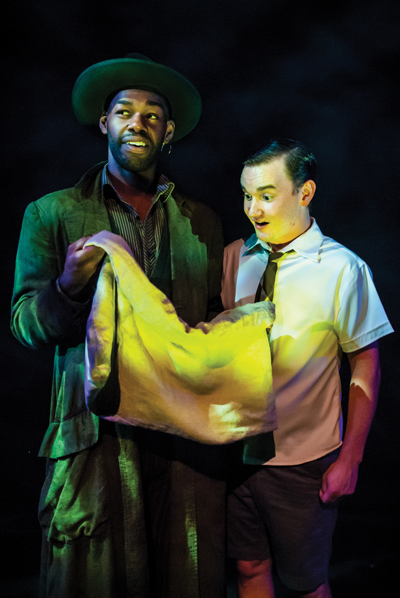
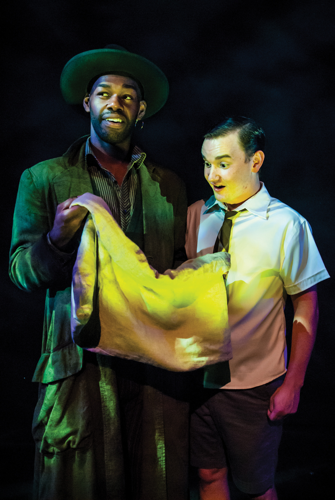
Things are peachy, and very geeky, at Nashville Children's Theatre these days. Their mounting of a brand-new, highly anticipated musical version of James and the Giant Peach — only the second company in the country to do so, after Seattle Children's Theatre — is conventionally entertaining, but it also reaches some modern, technically creative heights.
Director Scot Copeland's magical multimedia production satisfyingly brings to life the popular Roald Dahl children's tale, second in the author's canon only to Charlie and the Chocolate Factory. Dahl published his novel in 1961 and apparently resisted film offers until he died in 1990. His widow later approved the making of a Disney-produced version in 1996.
A young orphan, James, is shuttled off to live with his selfish aunts, Spiker and Sponge, and he's most unhappy. Then, through the intercession of magic and James' innocent clumsiness, a moribund peach tree begins to bear fruit, including one peach that grows as big as a house. James then befriends five oversized talking insects, and the six are whisked away inside the giant peach on an eventful trans-Atlantic journey.
This new script adaptation by Timothy Allen McDonald compresses the wild adventure story without losing its essence — while preserving its blend of darkness and whimsy — and the songs by hot theatrical composing team Benj Pasek and Justin Paul are lively and varied.
The show's stars shine, none more so than young Luke Collins, making his NCT debut as James and striking the perfect tone as a sensitive British youngster deserving of a better deal than life has dealt him. His comically shrewish aunties are veteran performers Rona Carter and Martha Wilkinson, who trot out their best over-the-top, cartoonish brand of mean-spiritedness. The lovable insects — ladybug, grasshopper, spider, centipede, earthworm — are all familiar NCT faces: Cori Laemmel, Shawn Knight, Aleta Myles, Patrick Waller and Bobby Wyckoff. James Rudolph fills out the cast capably as an occasional narrator and somewhat mysterious incidental player.
Yet it's often hard not to focus primarily here on the impressive technical achievement on display. Mixing traditional stagecraft — sets, props, lights, actors, puppets, mime — with computer animation and sound design that reflect the contemporary trend toward QLab-integrated, centrally controlled media, NCT's effort represents a culminating point of sorts in the company's increasing experimentation with digital wizardry under the design supervision of Colin Peterson.
The most striking computer-generated results naturally concern the animation of the giant peach and the subsequent sea journey that finds James & Friends avoiding a perilous school of leaping sharks. There are other notable digitally enhanced moments as our heroes make their way out of the English Channel, then across the pond to New York City.
The musical direction is by Russell Davis, who taught the cast the score and their singing regimens but was exempt from putting together an accompanying band, since — yet another concession to our all-consuming digital age — pre-recorded tracks do the "playing." Choreographer Pam Atha's dances are, thankfully, plenty human, and enliven the more rhythmic numbers, which are sometimes jazz-inflected, sometimes more music-hall-ish, and in one instance, features a touch of rumba. (There are a couple of plaintive ballads in the mix as well.)
Patricia Taber's costumes — for insects and humans alike — are cute and clever and mirthful, especially Auntie Sponge's jokey, rear-end-heavy outfits, which might remind older viewers of the Dan Aykroyd-led Widettes sketches on the Saturday Night Live of the late '70s.
The show's puppets — which require a bit of hand-and-rod skills from cast members — are designed by local puppet master Brian Hull, and they are charming creations indeed, though ultimately they play a lesser role in the unfolding of the story. In fact, they almost look a little clumsy in the midst of a production where the only real tactile consideration that matters is when a techie's fingertip touches the space bar on a Mac. Such is theatrical progress in the 21st century, where there appears to be less work for humans but where the digital possibilities open up seemingly limitless — and more budget-friendly — creative options.
What more can be said? The kids — and the grownups — seemed to love it.
Email arts@nashvillescene.com.



