
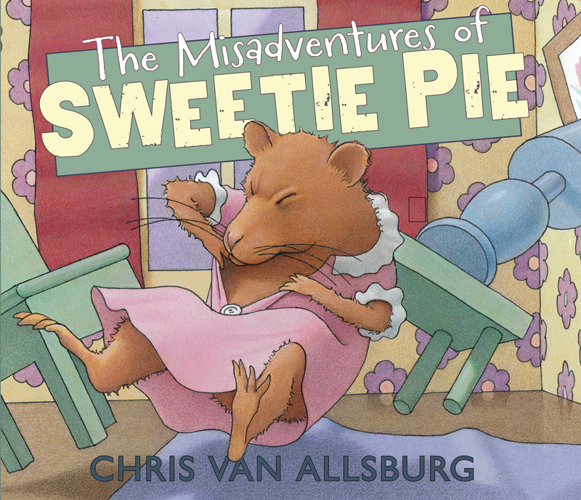
Author-illustrator Chris Van Allsburg's newest picture book, The Misadventures of Sweetie Pie, opens with a young girl gleefully squealing over a caged hamster in a pet shop: "He's sooo cute!" The hamster, Sweetie Pie, sits there, arms folded and glaring. He'll have none of this happy nonsense, thanks very much. But his friends have all dispersed to various homes at the hands of eager pet-owners, and today he won't put up a fight. No more of the squirming and scratching for which he's known — he'll simply see what's in store.
Readers join Sweetie Pie for the adventure, which is sometimes dark and often dangerous, for he's subjected to a series of children who deal carelessly with him. After a young boy absent-mindedly leaves the cage outside as the snow piles on, all ends well when the hamster finds freedom. Even as readers see Sweetie Pie frolic in a tree at the book's close, the boy is ridden with guilt: "During recess, he could not keep his eyes from searching beneath bushes and dried leaves. Where could Sweetie Pie be?"
To say that Van Allsburg is familiar with the Caldecott Medal, the award given to the most distinguished American picture book of the year, is an understatement. He's received it twice — once in 1982 for Jumanji and four years later for the perennial bestseller The Polar Express. And he kicked off his long and distinguished literary career with a Caldecott Honor in 1980 for The Garden of Abdul Gasazi, his debut. Sweetie Pie is a departure from the starkly shadowed, sepia-toned illustrations for which he's famous. Using bright watercolors, Van Allsburg keeps the surface of this book light, though its narrative comes with shadows.
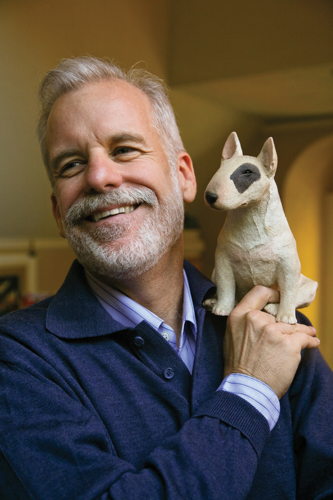
In anticipation of his visit to Nashville for the library's Salon@615 series, Van Allsburg answered questions via email about The Misadventures of Sweetie Pie, children's book publishing today and what's next for him.
What made you want to tell a story from a hamster's view of the world?
I suppose I wanted the readers to empathize with the plight of the hamster — to see the world, in some of the images, from his point of view. I did not tell the story in the hamster's voice, however, because I did not want to anthropomorphize him. He is not a little person. He is an animal, and that is part of the story's theme.
The book is dedicated to the memories of "Marmalade and Little Gray." Can we assume those were hamsters in your own life?
Those were two hamsters that were pets of my daughters. Despite considerate care-giving, they did not enjoy, in my opinion, happy hamster lives.
What prompts you to depict a story, like this one, in color, as opposed to the sepia-toned work for which you are so well-known?
I chose watercolor for this book, because I'd never used it before and am always eager to learn about new materials. I did know that this medium would result in more colorful and conventional-looking illustrations, and I believed that suited the story. The slightly dark subject matter is more likely to take the reader by surprise when the illustrations suggest a happy, conventional tale.
You have been creating books for 30 years. In looking back, what changes in the picture-book industry have been the most rewarding?
I believe there is more variety in children's books today. The comforting stories that can put a 5-year-old to sleep are still being published, but there are also stories that puzzle children, that intrigue children, that mystify them, that excite them, scare them or make them laugh.
You taught at the Rhode Island School of Design for over a decade, yes? Do you ever miss it?
I do miss teaching, because it is satisfying and rewarding to talk about art among a group of younger people who are excited about it and eager to learn.
What do you, as an artist, find most challenging and satisfying in the creative processes you employ?
The most challenging is producing something that closely resembles the ideal thing you had in your imagination before you began working. The most satisfying is actually getting close enough to that ideal that you feel you have succeeded in transforming the imaginary into reality.
Will this be your first visit to Nashville, by chance, or have you experienced Music City before?
This will be my maiden voyage to the Music City.
What's next for you?
I am currently struggling to complete some set designs for a ballet. Following that, I am contemplating spending some time practicing the discipline I studied in art school: making sculpture.
For more local book coverage, please visit Chapter16.org, an online publication of Humanities Tennessee.
Email Music@nashvillescene.com.
Tags: Books | Chris Van Allsburg | Salon@615 | The Misadventures of Sweetie Pie | Jumanji | The Polar Express



