
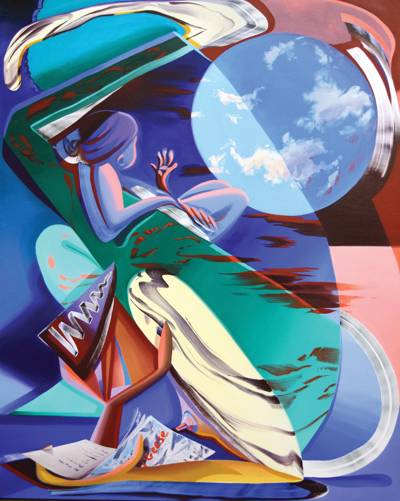

"Nights in the Swale," Karen Seapker
In the aftermath of Nashville’s March 3 tornado, the serendipity of Karen Seapker’s Circuities cannot be overstated. Her third solo show at Zeitgeist opened only a few days after the overnight storm sliced through Middle Tennessee, rupturing families and homes, and leaving communities vulnerable and fragile, their futures unclear. Seapker’s own studio in East Nashville’s Five Points neighborhood was destroyed, and the works of Circuities are all unbelievably lucky survivors, pulled out of the wreckage by friends and the employees of a nearby Mexican restaurant.
Over the days that followed, Nashville became a community of action, showing up all at once, hauling in donations with zero hesitation — as if compassion could undo it all. While many came to the March 7 opening of Circuities to pour even more love into the community (Seapker organized the Artists for Tornado Relief fundraiser for the same evening, with the sales of donated artworks benefiting Gideon’s Army), the exhibit offered those attendees something even closer to home. Viewers found themselves mirrored in Seapker’s paintings: The disco-bright figures, rendered in bizarro, prismatic hypercolor and gleaming brushstrokes, contort themselves in geometric shapes as they attempt to understand their world. Grief happens alone, but Seapker’s subjects have the power to do some heavy lifting.
The beings of Circuities come directly from Seapker’s previous solo show, Sentinels, which depicted mothers as monumental guardian-goddesses grasping their children with vast, arcing arms and hands. Seapker describes that earlier work as responsive and didactic — she’s never been shy about clarifying her art’s intention, but Sentinels drove its point home. Following the 2016 presidential election and other personal burdens, Seapker wanted desperately to protect, to calm, and so her surrogate beings and their interior spaces did that for her.
With Circuities, those interior spaces are now open to the viewer. Where Seapker’s figures once sought to soothe, here they have begun to abandon their posts, offering themselves up to the inconsistent world, allowing their children to experience new opportunities for wonder and surprise.
After a natural disaster, the sky can feel uncaring, but Circuities accepts the paradox of nature as a source of both capriciousness and healing. Last spring found Seapker walking a circular path in her garden, seeking inspiration after Sentinels closed, and reaffirming a connection with her environment. Around this same time, Seapker had an imagined conversation with a mother and daughter from Sentinels, a dialogue in which the mother said to the daughter: “We have to go.” The more Seapker walked the circular path, the less the shape seemed to resonate. The circle seemed far from an emblem of the acceptance of the passing of time, of perfection, completion, calmness, and the great cradle of the turning seasons. For Seapker, it was time for action.
Within Circuities, we see circles again and again, and they are never still. Often the circle appears as a moon, bouncing from corner to corner in different paintings, sometimes reflecting back at the viewer an unexpected time of day. A woman may carry this moon-circle on her back (“Outpost”), while other times it seems to have a mind of its own, rolling across splashes of colors (“Churning”). Maybe it’s a crystal ball, offering some clarity from divination (“The Conjurer”), or perhaps it is entirely elusive, as when a woman in dramatic plaid pants draws a circle in the dirt like a long-lost love (“Still”).
In the series’ most cathartic piece, “Running Mama,” the moon-circle rests at a woman’s feet as she pummels her body with clenched fists in shades of succulent cherry-red and thick magenta. She is the anti-Vitruvian Man: She isn’t at the center, and she will never sit still. Is she pounding herself into a circle shape, or does she resist it?
Motherhood is a perennial theme in Seapker’s work (the oldest of her two children is about to turn 6), and these lessons of letting go and opening up extend to the mother-child relationship as well. “Nights in the Swale” sees a child gazing up at the moon, leaning against her mother — they are together, but apart. In “Outpost,” a child sleeps in the crook of her mother’s hip, but the mother is looking elsewhere, her giant feet and hands splayed across the bottom of the painting, rooting her so sturdily that she will never falter. And then there is “Opening,” which depicts two intersecting circles that seem like whole worlds overlapping with a rounded body shape. Swooping hands stretch out like palm fronds. We see them again in “Pink,” where they entwine like DNA over a newborn child.
This openness feels revelatory. We are called to join. (This call to action goes beyond the show itself: Alongside the paintings grow seedling native plants, to be distributed to locals after the show’s end.) The show’s title emphasizes our abilities to make our own way — we aren’t circular, but our actions can be circuitous.
Seapker’s sumptuous colors are just as unexpected. They illuminate a time of day we haven’t seen yet, but is infinitely more intense than we could ever imagine. Similarly, planes of reality seem porous, and forms are ever-shifting. Consistency is but a dream. “The Gardener,” with its silly-sweet “Mom” tattoo (and the only non-gendered figure in the series), digs its hands into blood-red earth, its fingers turning green as they pass the threshold from aboveground to below.
Often when a work seems to coincidentally align with a devastating event, at best the artist seems prescient. At worst, the event is romanticized or minimized. But the themes of Circuities seem amplified: a painful and beautiful relationship with the larger world, an attempt to exist within the cyclical nature of season, and the linear way that humans exist within time, ever creating friction with that cyclical ritual.
The tornado came from this world, Seapker’s beings remind us — and so did we.



Post a comment as anonymous
Report
Watch this discussion.
(0) comments
Welcome to the discussion.
Log In
Welcome to the discussion.
Keep it clean. Please avoid obscene, vulgar, lewd, racist or otherwise abusive language. Comments featuring hate speech or threatening or violent content will not be tolerated.
PLEASE TURN OFF YOUR CAPS LOCK.
Be truthful. Don't knowingly lie or mislead.
Be proactive. Use the “report” link on any comment that violates our comment policy.
Share with us. We'd love to hear your feedback.