
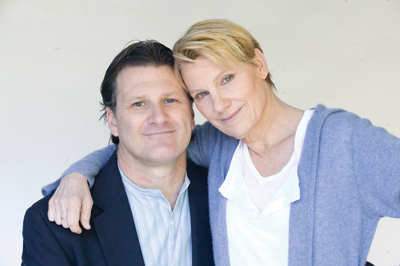

She's played a frustrated hockey wife in Slapshot, a whistle-blowing nurse in The Verdict, a wronged spouse in Places in the Heart, and a compulsive psychiatrist bent on self-destruction in the classic David Mamet thriller House of Games. She's made countless TV appearances, including recurring roles on Buffy the Vampire Slayer and Law & Order SVU. And she's a veteran of numerous stage productions in New York and at regional theaters across the country.
So how, exactly, did Lindsay Crouse go from filling Joe Mantegna with lead to teaching Buddhism at retreats across the country? The Scene recently posed this question to Crouse — who along with her husband, film and TV editor/director Rick Blue, will lead a retreat at Scarritt-Bennett Center this weekend titled Engine of Happiness: Ancient Prescriptions for Modern Bliss through the Wisdom of Tibetan Buddhism. Since we just spoiled the ending of House of Games, we don't want to spoil anything else. Let's just say the answer has something to do with William Sloane Coffin, reality TV and a tirelessly inquisitive mind:
How does a successful stage and film actress wind up devoting so much of her time to teaching Buddhism?
When I was younger — a teenager, especially — I was very interested in religion. I actually worked with William Sloane Coffin in the summers. He was part of a program for teenagers, on the East Coast. It took place in a boarding school that was shut down for the summer. He taught us to give sermons, and really talked about what it meant to have some kind of spiritual path.
Coffin was a chaplin at Yale in the '60s. He was the first person to give sanctuary to draft-card burners at the Yale chapel, and he eventually headed up one of the largest churches in New York, called the Riverside Church. He was one of the great, great figures. If you ever met him, you'd think twice about being an agnostic. He was very smart, very immediately available, a real New Yorker, down-to-earth. And he'd talk turkey with you, even as a 14-year-old.
I continued to have an interest, and I only applied to colleges that had divinity schools. And then the '60s hit, and of course, coming from a theatrical family, I was involved in theater at Harvard, and I found that I wasn't sure about the positions that the churches were taking in the '60s. I felt a certain conservatism in the churches. And yet the theater was a kind of open pulpit. I was a dancer for a while, and then I became an actor. I felt that being an actor, I could carry on what I was doing in a fabulous way by embodying it rather than preaching about it.
And now my business — the film business, the television business — it's a mess. And when reality TV came in, it really deprived half of the people working in prime-time television. I became unemployed for the first time in my life. I wasn't ever steadily unemployed, but I was, to my mind, shockingly unemployed. I never thought I would ever be unemployed. I thought I was a good enough actor that I'd always work at something.
And it really took me down. It was so painful, so shocking and so upsetting that I kind of collapsed under it. I had no idea what I was going to do to make a living, what I was going to do with my life. This was my calling, my passion.
At that time, I had remarried a man name Rick Blue, who was an editor and director of Scrubs for nine years. We were married in the middle of our lives, so we weren't marrying to have children and build empires. We were marrying in the middle of our lives, which meant that our lives were going to move toward our deaths. It's a different kind of marriage, and we were aware of this. And we lamented that we didn't have a real spiritual figure in our lives that could be guiding us in this second part of our lives.
We kept looking. And eventually, through an interesting route, we found a teacher, Brian Smith. Brian had been a professor of comparative religion at Columbia and then UC Riverside for 25 years, and he was teaching something called the Asian Classics Institute Program, which was created by his teacher, his lama, named Geshe Michael Roach, an extraordinary figure in American Buddhism. This program was basically graduate courses in Buddhism — not as an academic, but in order to teach people how to really live their lives, to understand the history of Buddhism, the philosophy of Buddhism, the logic of Buddhism ... a really elegant graduate education in real, on-the-ground Buddhism.
Geshe Michael, Brian's teacher, was the first American to get what they call a geshe degree in a Tibetan Buddhist monastery. He'd gone to Princeton, gotten a scholarship to the Woodrow Wilson School of International Affairs, and went to study with the Dalai Lama, and then became a monk. A geshe degree takes about 20 to 22 years in a monastery. And they do hours and hours and hours of debating every day, sometimes long into the night, which is this fabulous system in Tibetan Buddhism that keeps the philosophy alive and challenged and having to be backed up and thought through by new minds. So it's a very living thing. It's not dogma. Buddha never said, "You have to believe this or that." As a matter of fact, he said, "Don't believe what I say. Got out and figure it out on your own. Tell me if what I said works."
These two teachers, Brian and Geshe Michael, were so dynamic, so funny, so sharp, so warm, so full of conviction. The only comparable teacher I can think of in style is Robert Thurman. He's an amazing teacher. He speaks in the American idiom. We just heard him last night give a lecture here in LA. Fantastic. He just held the audience spellbound. He was very funny. And the medicine went down really fast, really easily. And that's what Geshe Michael can do and Brian Smith can do. You're not getting something through a translator with a kind of ... I always describe it like this: All my life I grew up with Chekhov and thought he was a very uninteresting writer, until I read a playwright translating his work rather than a British academic. And I began to absolutely adore Chekhov. It was all the difference in the world. And I think a lot of our translations that come through Tibetans who have learned English and who are traveling with a lama, etc., are just simply in a different idiom. So you don't get the kind of teaching that's great, which is through innuendo and idiom and humor and cultural references.
So here I had these incredible two teachers, who were just such a challenge, and so much fun to be with, and so exciting, because the learning wasn't just academic. It had to do with your life, and it was immediately helpful. And my husband and I became so intrigued that we kept going, and pretty soon our house became a center in Los Angeles for our teacher. We had a good-sized house in LA, and pretty soon people were coming to stay with us, and then our teacher became a Tibetan Buddhist monk.
Were you brought up in a religious background?
My dad [renowned playwright Russel Crouse] was religious, but in a very private way. But he loved a good sermon. He went to a church in New York City, where we lived. It had a wonderful minister, Dr. Fosdick, who was well-known and very dynamic. My dad was someone who practiced invisible acts of goodness all of his life. He died when I was about 17, but I got to know him really well through other people coming up to me and saying, "I want to tell you something that your father did for me." It was just a stream of it after he died.
I think it had a huge impact on me. And I think that if your father dies when you're young, you're able to take on aspects of your father. If they don't die when you're young, you're rebelling against who they are! [Laughs.] It take years to get back to it. I had an advantage, in a way. I was able to think, "My father was so loved, and clearly he helped people so much, and he was a happy person." And I thought, there's a connection here. There's a reason why he was happy, and it had to do with him helping so many other people.
So all of it began to come together in Brian Smith's little Venice apartment, where he had his surfboard behind him and was teaching in his blue jeans. And then he became a Tibetan Buddhist monk, and now he's internationally known. And so Rick and I began to teach alone and together, and with two other people we created a center here in Los Angeles, which is a thriving center.
When did you start that?
Somewhere around 2005. It had become so big that we had to get them out of our house! [Laughs.]
And you've studied with the Dalai Lama?
We have, in Dharamsala, India. It was probably about five or six years ago.
What was that like?
Well, it's extraordinary. I don't care who you are — you walk into the presence of the Dalai Lama and you're changed by it. Whenever he comes here — he'll come to the Pasadena Civic Center, or whatever — you can feel it on the street. You can feel it in the grocery store across the street. You feel like you could set your purse down on the sidewalk, and it would be there when you came out. It's just palpable what an extraordinary, radiant human being he is.
Now, his translator is one of the top scholars in the world of Buddhism. And he's not only a great scholar — he speaks literally the King's English. He's Oxford-educated, and it's the most magnificent English you've ever heard. [Laughs.] And he's very cute and all the women are in love with him! [Laughs.]
So when you go to hear the Dalai Lama, the two of them are like one person. So it's not a halting translation, or dry. It's tremendously fun. It's extraordinary just to feel the room, to see what it's like when someone of that depth of spirituality is in a room. He just makes all of the baloney fall away.
Is traveling and teaching the main thing you do today?
Yes, it really is. I work, but what I'm doing mainly is teaching, and I'm just having a ball doing it.
Are you thankful to reality television for changing your path?
I'm very thankful to reality television! [Laughs.] It's the absolute proof that nothing is good or bad, right? I'm very thankful.
What is the thrust of the workshop, and who is it for?
Here's the deal: We're not really teaching Buddhism to Buddhists. That's not the point of what we're doing. We take the principles of Buddhist philosophy, that are literally unique in the world — I have never heard these ideas anywhere else. They're unbelievable. They're so fresh that the minute you hear them, everything changes, and you can't go home again. Once you hear these ideas, you change.
I run a retreat in the summer, where my lama teaches and I teach and Rick teaches. We've never lost a single person in seven years. They come back and back and back. At some point when I have the time, I'm going to write up what happened in some of their lives, because it's just extraordinary.
We're teaching people how to live in order to be happy. Simply to be happy. Period. If they become Buddhist, that's fine. If they don't, that's fine. If they're not Buddhist now, that's fine. We don't care.
We have many people at our center in Rockport, which grew out of this retreat that I run in Massachusetts, who are hardcore Catholics, are Jewish, are Muslim, are Sufi, are Zen Buddhists, etc., and people who are nothing, who are just finding their way. But everybody is thrilled to get these teachings. They're totally nonthreatening. They're not dogmatic.
So there's no prosyletizing?
Nothing. We're just there to help people be happy.
Any thoughts about teaching Buddhism here in the Bible Belt?
For me, I always say it took my Christianity out and shined it up again. I identify myself happily as a Christian Buddhist. There are certain philosophical aspects if you were going to become a monk or something, because Buddhism is not a theistic religion.
This retreat is going to be fun. The main thing that I think is so exciting is to introduce people to really new ideas. There's not much that we hear that's new in the world. We hear a lot of self-help ideas, and there's new self-help books each year, which proves that the self-help system doesn't work. People think, "Oh no, we just need a different self-help system this year." [Laughs.]
So you're offering selfless help.
Yes! We're offering selfless help. It's a whole different thing. Buddhism really teaches you the causes for happiness in all kinds of ways. And the way they teach it is unique. So people will not be hearing some hackneyed version of the seven of this, or the 10 of that, or how to put your money in the stock market. They're going to hear something very new that they're going to be able to take home. I feel part of my place in Buddhism is to teach the philosophy in such a way that you can walk out of the room and start using it immediately. We're going to teach about some basic principles of Buddhism. We're going to teach about partnership, about family, and I'm going to teach on Sunday about the arts and creativity.
Are there parallels you draw between acting and meditation?
Yes. I'm writing a book on it. They are so similar. I think I was so prepared to slide right into Buddhism on account of how I teach and understand acting. Acting is actually a great metaphor to teach out of.
Like when you shot Joe Mantegna at the end of House of Games.
[Laughs.] That's a very good example of a parable. The story of a [psychiatrist] who announces at the beginning of the movie she just wants to do good. That's all she wants to do. And her mentor says, "Take a vaction. You need joy. You need rest." And this woman is seriously trying to find an answer. "I just want to do good, and I'm not having any effect on anybody. These people I'm treating are just as crazy and unhappy as ever." But no one has an answer for her, and she's extremely vulnerable. And she's talking about herself. She's not able to heal anyone, because she can't heal herself. But when the first person who comes along and says, "You want to be taken into a new thing," she says, "Yes." And I think that's how people go to Jonestown. Everyone is looking for something, and sometimes the wrong thing comes along.
That's another reason why we teach. We think these ideas are healthy, and we're not proselytizing. People can pick them up, or put them down, or whatever they want to do. It's a wonderful, open manner of teaching. It comes from people who say, "We have something that's true. We're not going to try to convince you, but it's true. If you think about it, and you just try it for a little bit, you'll see that it's true."
How did you feel about the reaction to the death of Osama bin Laden?
Rejoicing over the death of anyone is not a good thing to do. They say in Buddhism that if you have an Osama bin Laden, you must stop him. Buddhists are not pacifists in that sense. They don't sit back and do nothing. You can see in terms of the Buddhist monks in Myanmar, how incredibly brave and active they were. They would say you have to stop a bin Laden — out of compassion for him, so that he will stop creating the karma for himself, to be living in hell realms, for eons and eons. But you don't become him, by killing him. We're a little naive that way, that we think that to kill someone is a cause of peace. Killing anyone is not a cause of peace. But I don't judge anybody for it, though. If I didn't have a spiritual path, I would be doing all kinds of things that would probably be resulting in my own unhappiness, thinking that they were correct. But that's one of the reasons I teach, so people can begin to understand that.



