
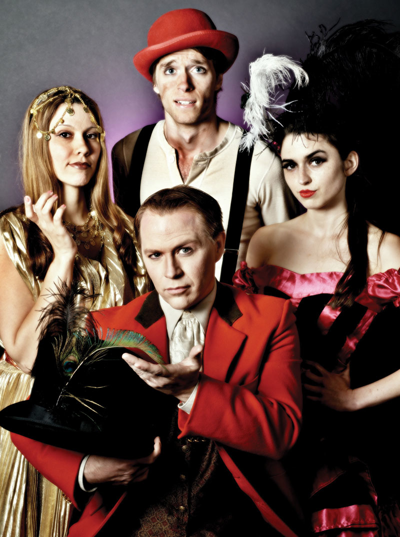
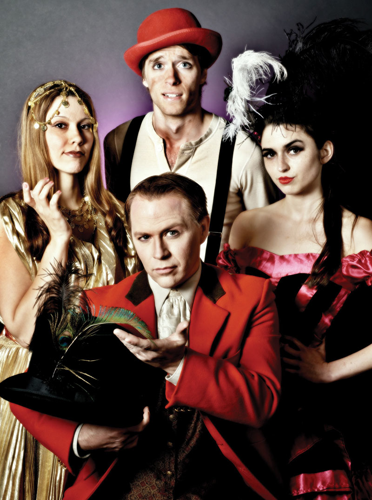
Pippin is a theatrical curiosity: an unconventionally structured musical that blends the historical with the fanciful and surrounds it with a Stephen Schwartz score that now sounds pleasantly nostalgic. A fond familiarity sets in with the show's opener, "Magic to Do," which hinges on a riff that wouldn't have sounded out of place on Carole King's Tapestry. The '70s pop sensibility of the songs that follow has aged better than more ambitious artifacts from the dawning of the Age of Sondheim.
Certainly Schwartz's tuneful score has weathered the years better than Roger O. Hirson's thin book, which barely merits expansion into an Act Two. Yet under the direction and choreography of the late Bob Fosse, Pippin ran on Broadway for nearly five years and 2,000 performances. For a show with that kind of history, Pippin revivals are surprisingly rare — which makes Boiler Room Theatre's new version worthy of scrutiny.
Doubly so in this case, since director Paul Cook has somewhat altered the show's framing device, changing the original production's strolling players into a slightly more contemporary circus troupe. Ultimately, the reframing plays as mostly superficial: The plot and characters still derive from Middle Ages lore, forming the tale of a young prince and his journey to manhood, self-knowledge and the Meaning of Life.
Having experienced war and the pleasures of the flesh, callow Pippin takes issue with the tyranny of his father, the ruler Charlemagne. Promising "freedom and dignity for all men," Pippin kills the king, then naively attempts to rule his empire, only to realize the overwhelming difficulties and human complications of the task. In Act Two, Kid Charlemagne finds purpose not on the battlefield, the throne or in self-immolation, but in the "simple joys" of domestic life with a widow and her young son.
With its peacenik hero and nods to free love (and its disenchantment), Pippin is very much a vestige of the late hippie era. Yet timeless messages emerge from the play — about the extraordinary gifts of ordinary life and love, about making the most of our time on earth — and director Cook puts them across with feeling and verve. The circus setting works, even when imprecision undercuts the high spirits and bawdy good humor. At the performance we saw, the occasional (and probably unavoidable) Fosse-isms in Holly Shepherd's choreography were less problematic than a mild sloppiness that couldn't be entirely shrugged off as excess energy.
Chalk it up to opening-weekend jitters, though, as for the most part Cook's casting mix of reliable troupers, new faces and summer replacements delivers the goods. Newcomer Josh Lowery makes for a handsome, fresh-faced Pippin: His vocals are suitable, if unspectacular, and he handles his signature tune "Corner of the Sky" with competence. But veteran character actor Dan McGeachy as the regal dowager Berthe has a ball with the playful sing-along "No Time at All" — performed originally on Broadway by Irene Ryan (aka Granny Clampett from The Beverly Hillbillies) — and Rosemary Fossee dominates Act Two with her strong singing and acting as love interest Catherine.
Other major contributors include Reischa Feuerbacher, W. Scott Stewart and Greg Richards. Multitalented Billy Ditty ties all the performances together as The Leading Player, in essence the circus' ringmaster (not unlike Cabaret's Emcee, whom Ditty once played at BRT). Jamey Green leads the band with his usual elán, making keen use of electric guitarist Dale Herr's '70s-evoking wah-wah pedal. BRT may not redefine Pippin, but it's a pleasure to get reacquainted with this time traveler from the Nixon era.
Men overboard
In its current production at Darkhorse Theater, anyway, John Holleman's play Pokerface is an introspective exercise rich in thought but often devoid of dramatic connection. It was first mounted locally approximately 15 years ago under the title Fish or Cut Bait, and Holleman has revised it sufficiently to merit another go, this time under his own direction.
The premise promises slowly mounting tension: Two marooned cruise-ship passengers (Cris Cunningham and Andrew Gumm) make their way to a remote island, where they await rescue. A power struggle of sorts ensues — essentially alpha male vs. thoughtful artistic male — as they strive to maintain their sanity, live off a dwindling supply of coconuts, and not kill each other.
Save for Henry Gottfried's strange cameo as a puppet-like Swedish lady sailor — a curious contrivance, to be sure — the show is all Cunningham and Gumm, charged with transforming Holleman's meandering banter into meaningful drama. Despite the efforts of the castaway cast, alas, the murky dialogue and quasi-absurdist action (including some business involving a phantom card game) leave the audience as lost as the protagonists.
Let it be said, however, that rich piano interludes — Tin Pan Alley ballads, familiar melodies of Satie, Debussy, etc. — bring the different scenes in and out with style. What appear to be covered foam-rubber couch cushions anchored by an impressionistic single palm tree comprise the quirky set.
Pokerface continues through July 14, then makes its way to Chicago for a July 19-21 gig at Theater Wit, a company whose motto, "Smart Art," challenges audiences to think while being entertained. Bon voyage.
Email arts@nashvillescene.com.



